
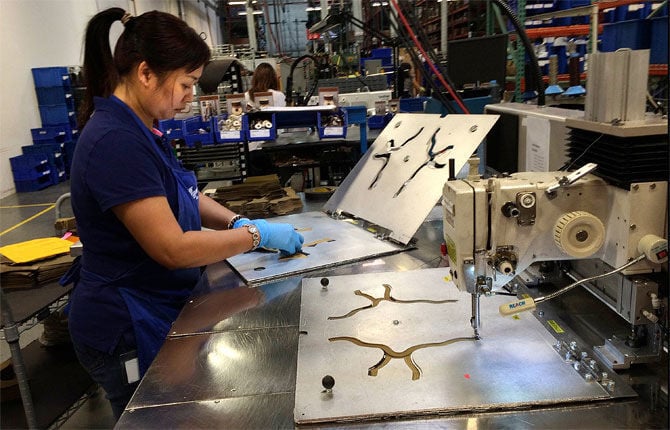
Throughout the Danner Boots factory floor in Portland, computer monitors provide workers with updates every 15 seconds on where productivity levels are — and where they should be.
While that struck a reporter as intense time pressure, it was seen by Chris Perrotti, the commercialization manager for Danner, in a wholly different light: “I love it. It’s really organized, just like the military.”
Perrotti, who was awarded the Bronze Star in 2011, deployed twice to Iraq in the Marine Corps in 2003 and 2004, and again in 2010-11 with the Oregon National Guard unit based in The Dalles. Earlier this year, he was named commander of the guard unit.
In his civilian role, his team oversees the rollout of new styles of footwear at Danner Boots.
Those new styles come out at a surprisingly high clip, as many as four or five a month, though it can mean something as minimal as a new color for an existing boot.
The high-end brand — founded in Wisconsin in 1932 and moved to Portland in 1936 — is used by hunters, hikers, workers, law enforcement and the military.
“Every single Marine that goes through basic training gets issued to them a Danner RAT,” which stands for Rugged All-Terrain Boots, Perrotti said.
The brand is especially big in Japan, where it has 11 Danner retail outlets. Just four are in the U.S., three in Portland and one in Washington.
British actor Daniel Craig, famed for his roles as “007” James Bond, is reportedly “a big Danner fan,” Perrotti said. He wore Danners in the latest Bond film, “Spectre.”
The 70,000-square-foot factory floor currently runs one shift assembling the boots.
Mechanization and efficiency are the two tools Danner has to use in its competition against foreign companies that can pay employees just $1 or $2 an hour, Perrotti said.
Perrotti, who has a bachelor’s degree in biology and an MBA, also holds a Lean Six Sigma Green Belt certification, which deals with process improvements and lean manufacturing. The philosophy focuses on eliminating numerous types of waste while perfecting production.
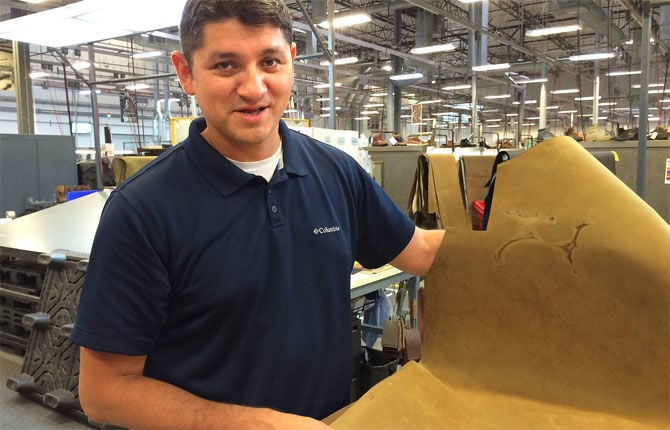
The boot-making process starts at the north end of the floor, where journeymen workers daily grade 6,000 square feet of Midwest-sourced leather hides on multiple factors. Most hides meet the grade and are fed into the system. At the first stop, other journeymen quickly cut the leather into needed pieces, leaving almost no scrap.
But it’s not just a cookie-cutter function of getting the most out of a hide. Placement matters, and certain parts of the boot need to be cut from thicker parts of the hide.
It takes a year to gain real proficiency in cutting just one pattern, Perrotti said.
At each successive work station, a boot slowly takes shape as pieces are cut, flattened, glued, hole-punched and sewn. Some workers use templates to follow complex sewing patterns, while others simply eyeball their work, yet sew a perfect seam, every time, at a rapid clip.
One line of workers gradually assembles the leather pieces as another line simultaneously assembles the fabric inner portion, made of breathable, waterproof Goretex. Both meet at a central point for assembly in the sewing department.
Meanwhile, others are working on the soles, in preparation for their final formation into an assembled boot, which originally started as over 60 different pieces. The last step is boxing them.
It takes just two hours to fully assemble a boot, but to course through the factory takes a boot two days.
The factory works on 12 to 15 styles on any given day, and each style has different sizes and widths.
During a factory floor tour, a loud bang is heard. An air bladder, used to press parts of the sole together, finally gives out and pops. It happens about once a month, Perrotti said, and it makes for some brief fun on the floor. “Everybody goes, ‘ooohhhh!!’ and they go back to work.”
Danner standards are strict, and it’s the job of Matt Torgerson to ensure they’re met. His workspace has a series of machines that put boots through all kinds of stressors, testing wear, waterproofness, crush-proofness (your toe will break, but won’t be shattered), the smoothness of eyelets so laces don’t fail, and even whether a boot sole is cushiony enough to absorb the impact when a Marine jumps out of a helicopter.
They’re tested to ensure they’re firm but pliable, and inspected for blemishes.
As he stands by one machine that tests a boot’s ability to withstand squeezing and pulling, Torgerson said, “It’s my baby. I love this machine. I can do a lot of bad things to a boot with this machine.”
Above the machine are some dents in the ceiling. Those were made by the boots that failed the test. “Sometimes it’s a little scary,” Torgerson said. “But that’s what the safety goggles are for.”
Asked to provide a damaged boot for a photo op, he grabs one and deftly slashes the leather with a blade. “I love my job, I cut up boots all day long. I basically just rip stuff apart.”
As he poses with the shredded boot, Perrotti lamented, “That’s $300 right there, gone.”
Perrotti started at Danner as the swing shift production supervisor in charge of 72 production workers.
“It was great because a manufacturing factory is much like a military organization,” he said. “I would have production leads report to me which were much like squad leaders. I had a production coordinator that was much like a platoon sergeant and as the production supervisor it was similar to being a platoon leader in the military.”
After leaving the Marines following four and a half years of service, he enrolled at Oregon State University in January 2005.
In 2007, he enlisted with the National Guard, and was commissioned as a second lieutenant in 2009 after completing officer candidate school. He is now a captain.
In the civilian world, his team at Danner, which includes pattern engineers and technicians, must ensure profitable, on-time delivery of new products into manufacturing.
This entails making patterns for each size — from about a size 3 to 16 — ensuring manufacturability, creating standard operating procedures, testing, sourcing materials, and programming the machines to make the boots.
A small corner on the factory floor — called the production readiness unit — is devoted to Perrotti’s team’s work. Called the proving area, it has a duplicate of every machine in the factory, and prototype boots are run through the assembly process to make sure it’s both workable and profitable.
His team’s tasks include ensuring new templates for sewing work in the machinery, creating new tooling, constructing sales samples, making pattern revisions, creating new material qualifications, process development/documentation, and bill of material constructions. They also develop tooling to make outsole molds.
“Having very defined processes are important to have repeatable good results and to ensure that when it enters production that it’s production-ready and that the consumer gets a pair of boots that meets up to Danner’s high quality standards,” he said.
He encouraged a reporter to be free with any questions. “I love this manufacturing stuff…”
He added, “The best part of my job is the people I work with. Danner has a family culture which you don’t have in a lot of companies today. While a lot of footwear manufacturing went overseas we continue to build here in Portland. This is a testament to American manufacturing, quality, and design.”


Commented
Sorry, there are no recent results for popular commented articles.