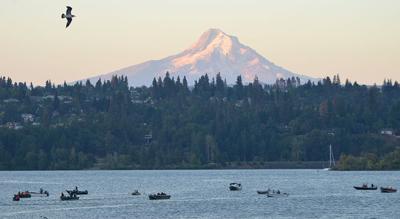
Fishing boats stack up at the mouth of the White Salmon River at dawn. River mouths are good places to catch fall Chinook because they stop to rest in the cool water before continuing upstream.
Fishing boats stack up at the mouth of the White Salmon River at dawn. River mouths are good places to catch fall Chinook because they stop to rest in the cool water before continuing upstream.
September is harvest time for salmon and steelhead along the Mid-Columbia, and with huge numbers of Chinook, Coho and Steelhead migrating up the Columbia River past Hood River and The Dalles, now is your chance to capture one of these monster fish.
Given that the Columbia is warm this time of year, your best chance for fishing success can be found in or at the mouth of cool water tributaries like the Eagle Creek, Wind, Drano (Little White Salmon River), White Salmon, Klickitat, Deschutes and John Day Rivers. You see, although much of the salmon and steelhead run is bound for the upper Columbia and Snake River systems, many will linger at the mouth of these tributaries for a temporary breather from the warm water of the main-stem Columbia.
Although most of the Chinook are bound for the last free-flowing section of river upstream from Tri-Cities (called the Handford Reach), this year’s big run is also seeing an increased number of fish bound for the Snake, Deschutes and Klickitat River systems. The fish headed for these rivers are known as Up River Brights (URB’s), while many of the stocks spawning in the mid and lower Columbia (west of the Hood River bridge) are of a different strain called Tule salmon, which mature quickly and can be more of a brown color than the bright silvery color anglers are accustom to.
It’s the URBs that represent the best eating quality and therefore are the most sought after by sport anglers. These fish come in all sizes with most averaging 18-to-25 pounds. Due to a large portion of this year’s Chinook run being made up of 5-year old fish, this could be the year you capture a much larger trophy that could bounce your fish scale at 40, 50 or even 60-pounds.
In addition to Chinook, of course, there are Steelhead and Coho (also called silver salmon) congregating off the same river mouths, with most averaging 7-to-9 pounds and a few that might dip your scale to 15-pounds or more.
Every conceivable angling method works for these fish, including a few you may not have tried. If you’re interested in targeting chinook, try forward trolling a salmon size (4 inches or more in length) FlatFish, Kwikfish or Mag Lip style plug near bottom. Rigging consists of a twelve inch weight-dropper line and five-foot leader. Adding a fillet of sardine to the belly of your salmon size plug can trigger arm wrenching strikes. Most anglers hold their fillet in place by wrapping it on with sewing thread or 2-to-4 pound test monofilament line. For best results you should change your sardine fillet every hour, since by doing so your lure will emit a scent trail that might be irresistible to salmon.
The strike of a salmon taking a salmon-size plug may be the hardest you’ll ever feel; however, don’t set the hook until Mr. Salmon is holding your rod tip down steadily, peeling line from your reel, or until your rod tip pulsates up and down three to four times. Waiting on the bite will increase your chance of a solid hook up, while yanking too soon can result in a miss or later losing your fish. If you’re using a bait-cast reel, realize that it’s important to have your thumb firmly planted on the reel spool when you finally do set the hook.
Since it lends itself to the slack water found behind the Mid-Columbia dams, egg mooching (also referred to as suspending bait) is a productive fishing method you should try when tackling Mid-Columbia salmon. Realize, too, that this technique works anywhere salmon are found holding in slack water. Egg mooching is like bobber fishing, but without the use of a bobber – you just suspend your bait off your rod tip – your boat is the bobber.
Rigging is easy, just attach a swivel to the end of your main line, an 18-inch leader and 5/0 single hook, like a super sharp one made by Owner. You’ll need to add weight, usually two to three ounces, which can be attached to a snap connected to your swivel.
Finding success with this method can be as simple as locating a concentration of salmon with your fish finder and lower your bait to the level they’re holding. In most cases just drop your sinker to the bottom and reel up one and a half to two turns of the reel handle. Given an 18-inch leader this will put your bait 18-to-36 inches off the bottom. You should realize that one handle turn on an Abu Garcia 5500 or 6500 bait-cast reel will spool 24-inches of line. To ensure your bait is at the correct depth it’s critical to not reel up too far.
While there are times Mr. Salmon will choke your bait down in a noticeable way when egg mooching, the bite can be subtle, so pay close attention and if your rod tip dips ever so slightly, try setting the hook hard. I like to stand with the tip of my rod 12-inches off the water. In this position, I can concentrate on my rod tip and better distinguish the rat-tat-tat “peck” of small unwanted resident fish from the usually more deliberate, hang-on bite of a Chinook salmon.
When it comes to egg mooching it’s a fresh, scent dispersing bait that is the most likely to trigger strikes. Don’t be shy about changing your baits often, every ten minutes or so is sometimes required to produce consistent hook ups. In addition, you may turn a slow day into fast limits by adding a fillet of sardine or other bait to your egg offering.
If it’s Steelhead and Coho you’re after, try trolling a deep diving plug, like a Mag Lip in the 3.5 size, 40 to 70 feet behind your boat.
With over two million salmon and steelhead returning to the Columbia this fall now is the time to try your luck.



Commented