
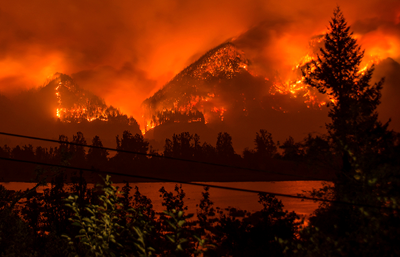
Hood River County District Attorney John Sewell brought charges this week against a 15-year-old boy who allegedly started a major wildfire Sept. 2 by tossing fireworks along a hiking trail at the west end of the Gorge.
The unnamed teen from Vancouver, Wash., is being prosecuted for reckless burning, depositing burning materials on forest lands, criminal mischief and recklessly endangering other people.
The Eagle Creek fire he allegedly sparked by throwing a smoke bomb into a ravine has charred more than 48,000 acres. The blaze was only 50 percent contained as of press time Saturday.
It may be that the teen knew that his actions would result in a fire of that magnitude. Overstocked and diseased stands of trees allowed the flames to spread rapidly, destroying structures, threatening hikers trapped behind the fire line and removing vegetation, underbrush and tree roots that kept the soil stable on steep slopes.
Authorities now expect landslides as well as rockslides during the wet and rainy weather of winter, so there may well be more threats to lives and property.
The economies of Gorge communities were also harmed when Interstate 84 shut down for almost two weeks to accommodate fire suppression activities, which brought tourism to a grinding halt.
The teen was caught after a hiker spotted him tossing the smoke bomb as girls with him reportedly giggled and another boy took video with his cellphone.
The hiker ran back to the parking lot to warn others that a fire had started.
Commentators have spent the last several weeks calling for the identity of the teen to be revealed, for charges to be filed, and for the boy’s family to pay some of the damage costs. There were also outrageous public calls for the teen to be “sterilized, whipped or even lynched.”
It is doubtful the boy intended to cause the level of harm that he did. His state of mind, whether to commit arson or just capture attention from his peers, will be revealed during court proceedings.
Meanwhile, people need to be cognizant of the fact that he is just 15 and has to live an entire lifetime with the knowledge that he is responsible for one of the worst wildfires in the U.S. during an intense season.
It is probable that the teen is experiencing some type of emotional or psychological trauma from the result of his irresponsible actions.
Iris Schenk, 67, who lost her home and all of her belongings in the fire, has suggested that the teen perform community service instead of going to jail. Certainly, there needs to be accountability for the damages he caused, but Schenk’s idea is a good one, given that the consequences for this boy need to be restorative because he is, after all, still a child.
Two other topics of societal discussion arose from the Eagle Creek fire and 63 others that blazed across 10 western states.
The U.S. Forest Service spent a record $2 billion on fire suppression this season. We agree with U.S. Sen. Ron Wyden, D-Ore., and U.S. Rep. Greg Walden, R-Ore., about the need to deal with this massive budget issue by reforming forest budgeting and management practices.
For the fifth year, Walden is pushing for legislation that makes the process less burdensome to remove diseased and overstocked stands of trees in national forests. He said these trees feed catastrophic wildfires that destroy natural resources and cause large-scale pollution.
Wyden is calling for establishment of a permanent fund to pay for fire prevention. He said wildfires should be treated like natural disasters and suppression costs not removed from the regular budgets of federal agencies, reducing the money they have for prevention and management activities.
Another point of conversation needs to be the rules regarding firework use and whether it remains safe to allow incendiary devices outside of sanctioned events.
Currently, Americans are shooting off almost one pound of fireworks every year for every man, woman and child, according to the U.S. Consumer Product Safety Commission.
That figure has grown rapidly in recent years, from half a pound in 2000. In 1976, the bicentennial celebration for the U.S., the figure was just one-tenth of a pound annually.
While fireworks use has gone up, the number of professional displays have fallen since 2000, when roughly one-third of all fireworks were launched in the air by experts.
By 2016, professional displays comprised less than 10 percent of fireworks use.
Aerial fireworks are essentially a low-yield missile and they are dangerous.
In 2016, 3.4 people per 100,000 were maimed, injured or killed by wrongful fireworks use. About 15 people die every year from these injuries.
Faulty fuses have caused many of these injuries, some burning rapidly and igniting a rocket too quickly, others taking too long to ignite, leading people to investigate whether it needs to be relit just as the firework explodes in their face.
Sparklers may seem harmless as children wave them around, but they burn like mini blow-torches at a temperature of around 2,000 degrees.
The estimated cost of fireworks-related injuries exceeds $100 million annually.
While Americans follow the exhortations of John Adams to celebrate the nation’s birthday with “illuminations,” fireworks use starts in June and stretches weeks after July 4.
If people can’t apply common sense to fireworks use, then more restrictions will become necessary to protect resources and public safety.
Every state has unique rules and regulations concerning the use, possession and distribution of all types of fireworks.
Learn the laws in Oregon, not only to keep your own family safe, but to ensure that you don’t harm the property or risk the lives of others.


Commented