
Public debate can get messy, and sometimes it cleans itself up.
An example of this was good to see Aug. 12 outside City Hall.
City council had heard testimony that night from both sides of the Lot 700-Morrison park rezone debate, and some of those folks continued their argument outside City Hall.
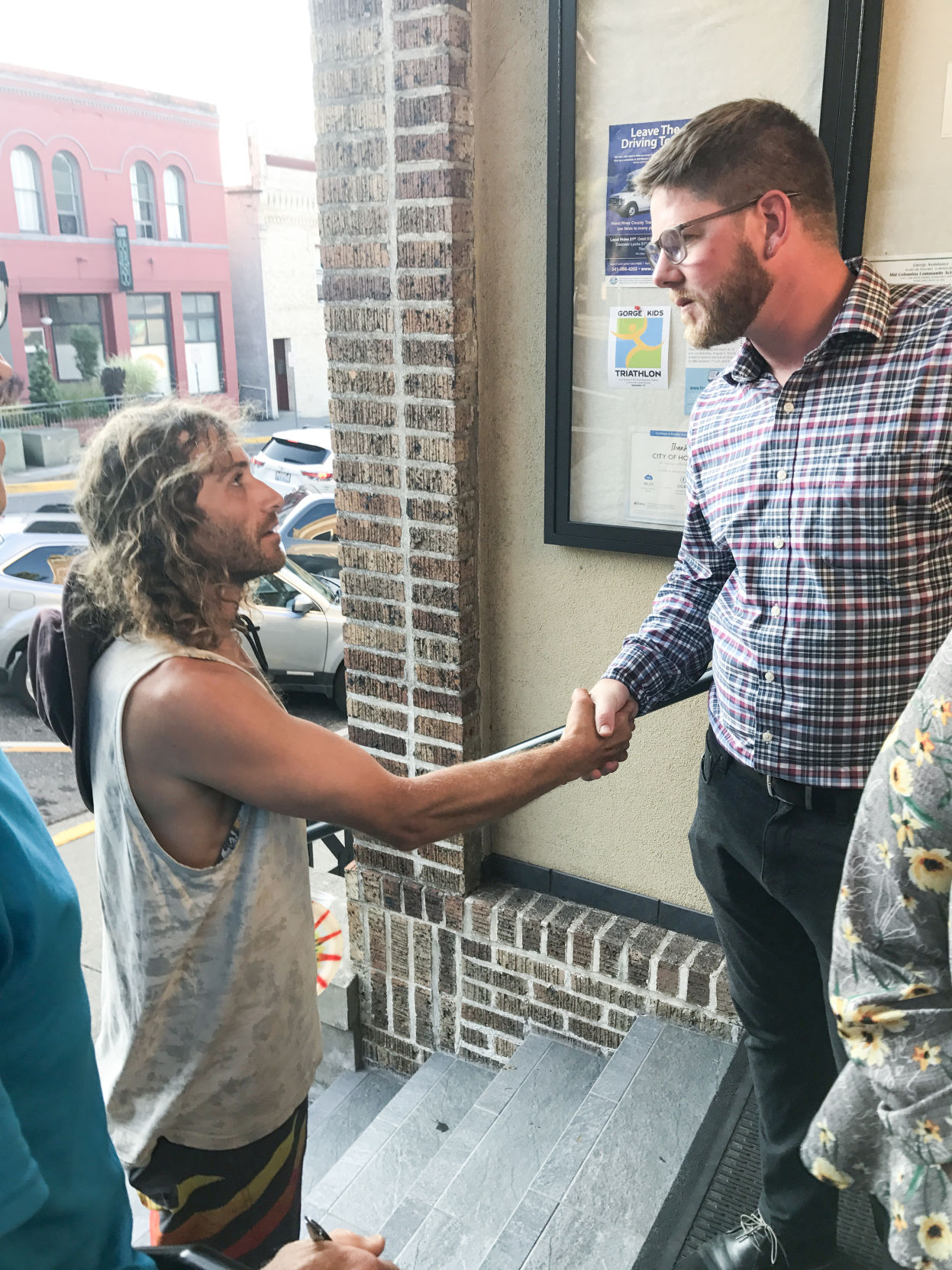
Things remained a little heated, but then a nice moment happened.
It started when Joel Madsen, executive director of Mid-Columbia Housing Authority, gave council extensive testimony explaining his agency’s decision, announced a few days earlier, to discontinue its current partnership with the city for the affordable housing proposal at what is now Morrison Park. Madsen’s statements, and others, took the first 45 minutes of business, and then the council moved on to approving garbage rates and discussing a proposed space analysis for the police departments.
The conversation outside, meanwhile, was civil yet loud enough to carry into the council chambers, a proximity that happens from time to time, but for optics and air flow, the chamber’s double doors are never closed, so staff will ask people to move outside. It was Public Works Director Mark Lago who had the honors.
An example of this was good to see Aug. 12 outside City Hall.
City council had heard testimony that night from both sides of the Lot 700-Morrison park rezone debate, and some of those folks continued their argument outside City Hall.
Things remained a little heated, but then a nice moment happened.
It started when Joel Madsen, executive director of Mid-Columbia Housing Authority, gave council extensive testimony explaining his agency’s decision, announced a few days earlier, to discontinue its current partnership with the city for the affordable housing proposal at what is now Morrison Park. Madsen’s statements, and others, took the first 45 minutes of business, and then the council moved on to approving garbage rates and discussing a proposed space analysis for the police departments.
The conversation outside, meanwhile, was civil yet loud enough to carry into the council chambers, a proximity that happens from time to time, but for optics and air flow, the chamber’s double doors are never closed, so staff will ask people to move outside. It was Public Works Director Mark Lago who had the honors.
That is a partial backdrop to the meeting, and to the potently worded “Another Voice” by Ben Mitchell, which appeared in the Aug. 21 edition.
For the record, Mitchell, a former reporter, approached us asking if he could write the Another Voice. We did not request it — which is how it almost always works with the Viewpoints page. People ask to write about a topic, and we generally green-light it. Topics must be local, and not repetitive of recent Another Voice submissions.
After Mitchell’s column appeared, a number of readers took issue with it, questioned its accuracy (it’s accurate) and suggested that it was mean-spirited. That’s a subjective take, and we respect that some may see it that way. I viewed it as a reasoned, but vigorous and pointed commentary. I don’t agree with all of it myself; I think Mitchell overstates the elitism behind some of the rezone opponents, but that’s his opinion.
(Hood River News gave measured editorial support to the Lot 700 rezone when it first happened in 2017, but our most recent comment on the topic was to say the state and city need to work in earnest to explore the possibility of developing on the nearby Cascade Yard property, owned by the state, before committing Lot 700 to development.)
For the record, Mitchell, a former reporter, approached us asking if he could write the Another Voice. We did not request it — which is how it almost always works with the Viewpoints page. People ask to write about a topic, and we generally green-light it. Topics must be local, and not repetitive of recent Another Voice submissions.
After Mitchell’s column appeared, a number of readers took issue with it, questioned its accuracy (it’s accurate) and suggested that it was mean-spirited. That’s a subjective take, and we respect that some may see it that way. I viewed it as a reasoned, but vigorous and pointed commentary. I don’t agree with all of it myself; I think Mitchell overstates the elitism behind some of the rezone opponents, but that’s his opinion.
(Hood River News gave measured editorial support to the Lot 700 rezone when it first happened in 2017, but our most recent comment on the topic was to say the state and city need to work in earnest to explore the possibility of developing on the nearby Cascade Yard property, owned by the state, before committing Lot 700 to development.)


Commented