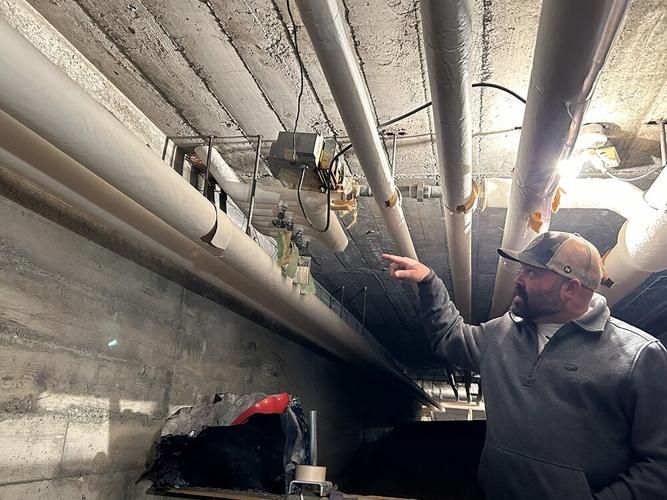
Jesse Bryan, facilities and maintenance director for the district, points out an issue with a failed valve at Whitson. With no replacement option, it must be manually adjusted. “When these valves get to this point and they stop functioning, [you] just manually crank them and play to adjust heat in classrooms,” he said.
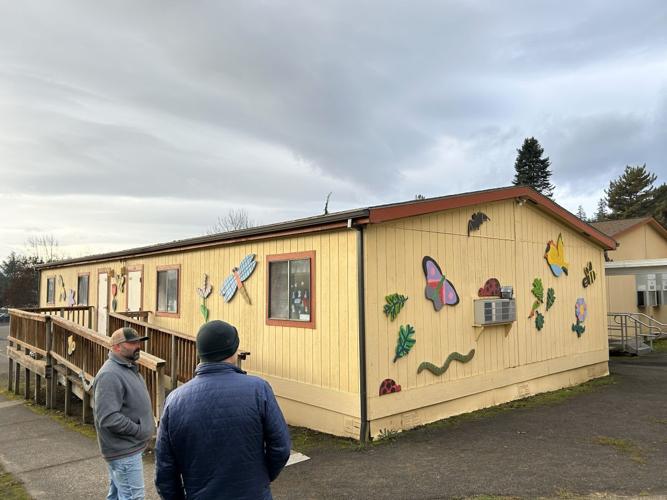
Jesse Bryan and Rich Polkinghorn in front of a portable classroom at Whitson Elementary. Portables are used for office space and storage, and due to their age, are difficult to maintain.
A crack in a wall outside of Whitson Elementary outside of the gym. An addition of storage to accommodate cafeteria tables further complicates the building's structure.
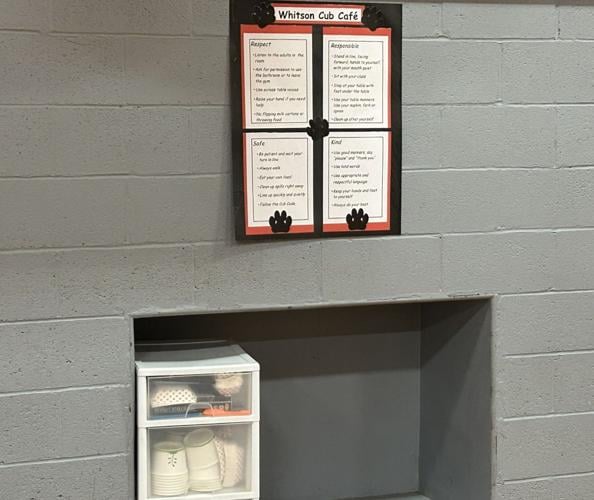
Eating utensils stored in the Whitson Elementary gymnasium. Closing the area for meals limits instruction time and PE opportunities for students, said Principal Todd McCauley.
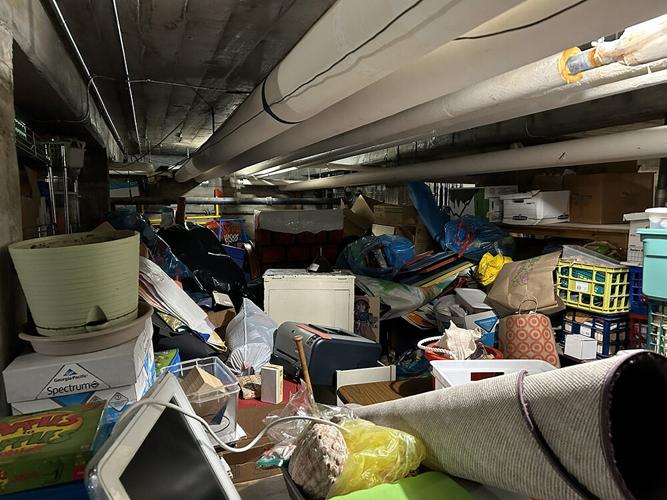
Loose items sit nestled together closely in storage at Whitson Elementary. Adequate storage space is an issue at the school, where items are stored wherever there is room.
In rooms that have failing heat, like this kindergarten classroom, auxiliary heaters have been added. But the building was wired for one 120-amp circuit per every two classrooms, and using the heaters killed the power in both rooms, adding another problem to be fixed. Also visible is one of the many cracks in the building’s interior and exterior.
Jesse Bryan, facilities and maintenance director for the district, points out an issue with a failed valve at Whitson. With no replacement option, it must be manually adjusted. “When these valves get to this point and they stop functioning, [you] just manually crank them and play to adjust heat in classrooms,” he said.
Zach Thummel photo
Damage visible on the roof of a side entrance at Whitson.
Trisha Walker photo
Two basketball hoops had to be removed from the gym due to structural issues and cannot be replaced. A crack is partially obscured by the flag.
Trisha Walker photo
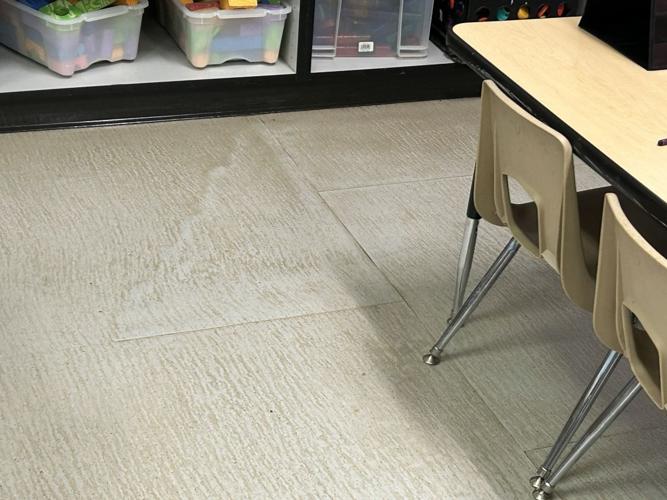
Flood damage in a kindergarten classroom at Whitson Elementary.
Zach Thummel photo
Jesse Bryan and Rich Polkinghorn in front of a portable classroom at Whitson Elementary. Portables are used for office space and storage, and due to their age, are difficult to maintain.
Zach Thummel photo
A crack in a wall outside of Whitson Elementary outside of the gym. An addition of storage to accommodate cafeteria tables further complicates the building's structure.
Zach Thummel photo
Eating utensils stored in the Whitson Elementary gymnasium. Closing the area for meals limits instruction time and PE opportunities for students, said Principal Todd McCauley.
White Salmon Valley School District recommends upgrades, consolidation after year-long facilities study
WHITE SALMON — After 35 years with no significant facilities upgrades, the White Salmon Valley School District (WSVSD) is ready to make sizable improvements.
The Feb. 10 Washington State Special Election ballot will include the district’s $77.8 million bond ask to create a unified K-12 campus and improve safety, a priority identified by staff, students, and community members, said Superintendent Rich Polkinghorn.
“We took that feedback and said, okay, let’s walk down this road,” he said.
The ensuing study included site visits and community input, informing the district’s Facilities Advisory Committee unanimously recommending a one-campus, two-school model at the current middle school / high school site. The recommendation includes the decommissioning of Whitson Elementary School, a 75-year-old building that has reached the end of its serviceable life.
The unified campus model also means WSVSD will receive almost $34 million in School Construction Assistance Program (SCAP) funding if the bond passes, meaning that for approximately every $2 the community invests, the state gives $1.
“What was really the tipping point for this committee was looking at enrollment coupled with the opportunity to maximize the SCAP funds,” Polkinghorn said. Those funds can only be used for construction projects. Columbia Gorge News will look at SCAP funding in part three of this series.
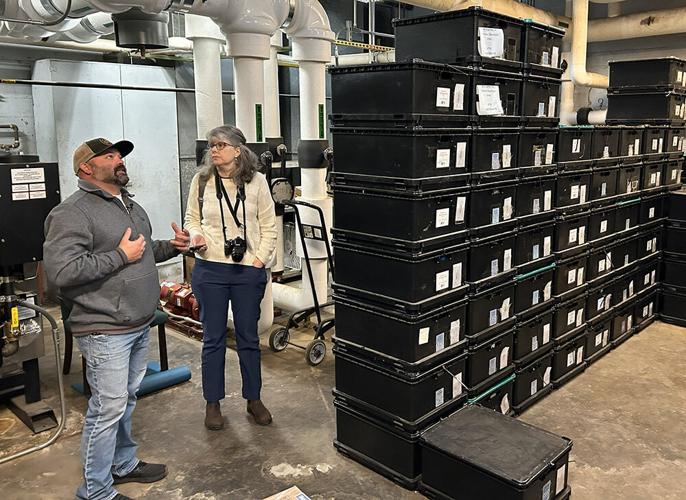
Jesse Bryan (left) and Trisha Walker (right) talk next to science kits stored in the boiler room, which is also being utilized for storage space.
Zach Thummel photo
A closer look at Whitson
The unified campus model primarily came about due to Whitson’s current state. SCAP funding can be used to remodel the current intermediate-middle school, but not on Whitson itself due to state policies. Additionally, closing Whitson could potentially save more than $500,000 annually, Polkinghorn said.
“We’re throwing a lot of money into that school to keep it up and running, to keep it functional for our staff and our kids, when it’s really not as functional as a school should be in 2025,” he said.
“There’s no question, we love our school,” said Principal Todd McCauley. “It’s a special spot. But we would have to invest significantly in a building that’s 75 years old — it’d just be a constant investment that, given our [declining] enrollment and the condition of the building [is cost-prohibitive].”
Built in 1949, Whitson has significant problems that include cracks in load-bearing walls, inadequate power, and failing heat systems. Jesse Bryan, WSVSD facilities and maintenance director, said every two rooms share a 120-amp circuit.
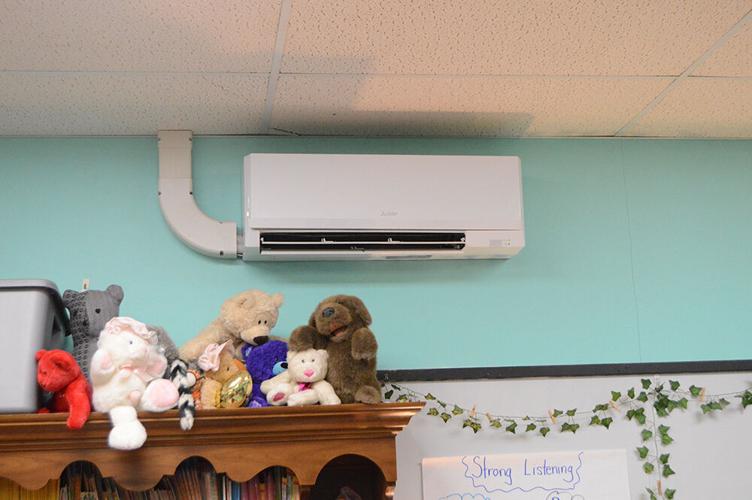
“In the rooms that have failing heat, they were trying to plug in auxiliary heaters, and they would just kill the power in both rooms,” he said. “We’ve done some transitioning to some mini splits as needed, but we had to bring in extra power. It’s tricky.”
Whitson was built with radiant heating — water pipes buried in the floor. When pipes break, the floor must be torn out to fix them. “Then you’re just chasing problems,” Polkinghorn said. “Your major reoccurring theme with this building is you’re just chasing issues and constantly fixing things that just keep breaking over and over again. At some point, you’ve got to cut your losses.”
In rooms that have failing heat, like this kindergarten classroom, auxiliary heaters have been added. But the building was wired for one 120-amp circuit per every two classrooms, and using the heaters killed the power in both rooms, adding another problem to be fixed. Also visible is one of the many cracks in the building’s interior and exterior.
Trisha Walker photo
McCauley said the entryway is also a concern. “Seventy-five years ago, it would make sense to have people just come on into the office and visit an open school,” he said. “But today, this is a safety hazard, even though we have a buzzer on the outside … as soon as you’re in, you have total access.” It’s also not ADA compliant, he said.
The building additionally lacks a designated cafeteria, with breakfast and lunch served in the gym. “It limits the amount of PE you’re able to offer the kids,” McCauley said. “We have a second part- time PE teacher that takes a group of kids for 30 minutes once a week outside, and if it’s raining, they go to the covered play area. But that’s less than ideal, especially in the next three months.”
The gym has its own issues. When the district tried to install new basketball hoops, inspection uncovered structural issues — posts were added for reinforcement, but not only were the new hoops not installed, the old ones also had to be taken down.
“We’re going backwards, right?” McCauley said. “That’s become the place we’re at.”
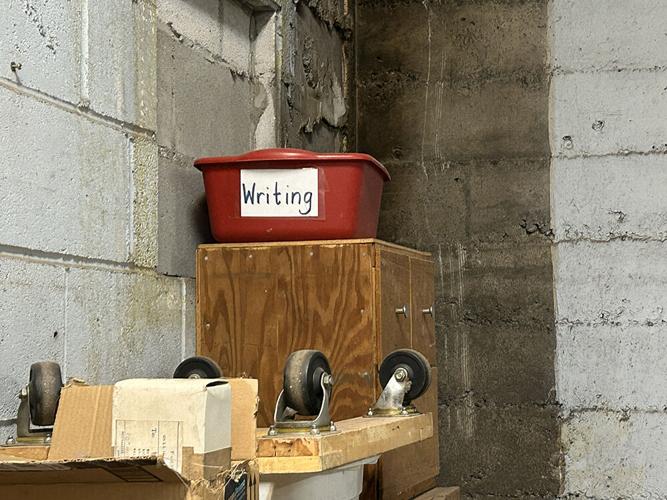
Writing materials sit on a cabinet in one of the storage areas at Whitson Elementary. More photos at columbiagorgenews.com.
Zach Thummel photo
There are more issues outside. The school’s playground equipment is about 50 years old and does not meet modern standards or ADA compliance. The district has done a good job in maintaining the equipment, he said, but it lacks safety and engagement commonly seen at other Gorge elementary schools. For students with mobility issues, it means added limitations for play and entry indoors.
“We’re looking forward to [a new playground] as a real upgrade for kids — how you create spaces for them to socialize is different than we did it 50 years ago, so that will be tremendous us,” McCauley said.
He also worries about traffic during pick-up and drop-off periods, as the school sits on a main thoroughfare. There isn’t a designated parking lot or bus lanes. It’s organized chaos when school lets out, with buses on one side of the street and parents and walkers on another, he said, crediting police with keeping everyone safe.
In a follow-up email, Polkinghorn said passing the bond means that K-6 students would move to a remodeled school updated to meet current standards and designed with elementary students in mind. Other benefits include a full kitchen and cafeteria, a dedicated gym for PE classes, and a dedicated music room.
Loose items sit nestled together closely in storage at Whitson Elementary. Adequate storage space is an issue at the school, where items are stored wherever there is room.
Zach Thummel photo
“These are all big upgrades. Bringing all of our elementary students together on one campus also feels important, both for consistency and for building a stronger sense of community, rather than being split across two sites,” he said.
Both McCauley and Polkinghorn acknowledge the special place Whitson holds in the community — and agreed the true heart of the school is its dedicated staff.
“The kids are happy here; it’s very warm and welcoming and inviting,” said Polkinghorn. “A lot about that feeling in the school is not the building, it’s the tone of the principal and staff, and the warm environment that’s created.”
•••
Next week, Columbia Gorge News will look at challenges at Columbia High School and planned improvements at the site.






Commented
Sorry, there are no recent results for popular commented articles.