The year 2023 begins. Another rotation of the Earth around the Sun will yield the usual starry treasures in the night sky, including dazzling stars, bright planets, meteor showers, and this year another partial solar eclipse in October (more on that in later months). Make sure that viewing the night skies are on your recreation list for 2023!
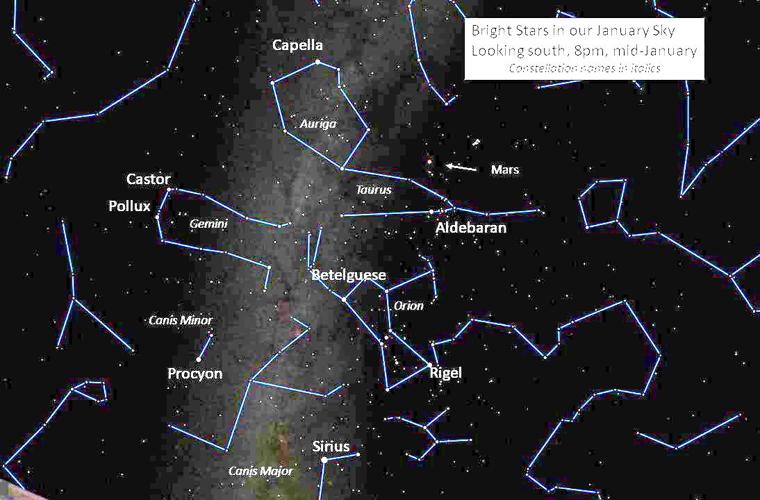
January may be cold, but it presents some great opportunities for stargazing when the skies clear. Have you ever thought that winter skies seem the darkest, with the stars shining brighter than in summer nights? There is some truth to that. First of all, January’s night skies are dominated by some very bright stars. Our evening sky includes Sirius, the brightest star in the sky (other than the Sun of course); Capella, No. 6, Rigel, No. 7, Procyon, No. 8, Betelgeuse, No. 10, Aldebaran, No. 14 and the twins Pollux, No. 17 and Castor, No. 24.
But that is not the only factor. Also, in winter evenings we are looking toward the outer extent of our galaxy, whereas in summer evenings we are looking toward the more star-dense parts of the galaxy. The collective light from millions of stars in summer nights lends a bit less contrast, with the background not quite as black.
Those bright stars will have a planetary companion again in January, the planet Mars. While the red planet is now pulling away from us, and growing less bright, it will still outshine all of the stars except for Sirius.
Mars will not be the only visible planet in the evening sky. Jupiter still shines bright, now low in the west. Look for a close encounter with the crescent Moon on the evening of Jan. 25.
Saturn will still be in the evening sky, but very low in the west before sunset. Bright Venus re-enters the evening sky this month, and will have a close encounter with Saturn on the 22nd of the month. Look for the two planets, very low on the western horizon, just after sunset. If you have a good view of the horizon, and a pair of binoculars, you may be able to detect the very thin crescent Moon just below the planets. Jan. 23-24 will also have nice views of the two planets, quite close to each other, plus the now more easily visible crescent Moon, higher in the western sky.
January’s full Moon comes on the 6th, with new Moon following on the 21st. On the 30th, the Moon and Mars will be very close together, separated by less than the diameter of the Moon as we see it in the sky. Look for it at about 8-9 p.m. if skies are clear.
The Quadrantid meteor shower peaks just after New Year, on Jan. 3-4. The bright Moon will wash out all but the brighter meteors around that peak. The name Quadrantid comes from the old name for the Constellation Bootes, once called Quadrans muralis.




Commented