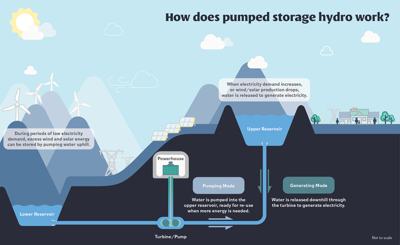
The Goldendale Energy Storage Project uses a turbine and pump system, within a penstock connecting a lower and upper reservoir, to capture and store the energy created when water is dropped from the upper reservoir.
The Goldendale Energy Storage Project uses a turbine and pump system, within a penstock connecting a lower and upper reservoir, to capture and store the energy created when water is dropped from the upper reservoir.
Construction would cause ‘significant and unavoidable adverse impacts’ to cultural resources
The Washington State Department of Ecology has finalized an Environmental Impact Statement (EIS) for the proposed Goldendale Energy Storage Project. The 310-page document, available online at www.ecology.wa.gov, examines potential significant and adverse impacts of the construction and operation of the estimated $2 billion project.
The comprehensive and science-based EIS will be used by permitting agencies as they continue to consider permits for the project. The Department of Ecology will be making decisions on granting permits, including a water quality certification, a reservoir permit, and a construction permit, which are expected to occur over the next two years as project details are finalized, according to a press release.
The project is going through a separate environmental review through the Federal Energy Regulatory Commission.
The final EIS includes an examination of potential impacts to air quality, plant and animal habitat, transportation, water resources and water quality, as well as an evaluation of potential impacts to Tribal and cultural resources.
A draft version of the EIS concluded that construction of the project would cause significant and unavoidable adverse impacts to cultural resources, a sentiment that was repeated in the final version of the document. The developing firm, Free-Flow Project 101 LLC through Boston-based Rye Development, estimated that nearly all of four archaeological sites, and up to 20% of a fifth archaeological site, would be disturbed. The Washington State Department of Archaeology and Historic Preservation estimated that 15 sites would be completely disturbed through the development of the project.
Construction of the project would occur in Pushpum and Nch’ima, “which are areas used for resource gathering and other ritual and cultural activities,” according to the Final EIS. “Construction of the proposed project would limit, if not eliminate, use of these areas, which is a significant adverse impact. There is also a potential for significant adverse impacts on unrecorded archaeological sites that are associated with the (traditional cultural properties).”
In August, seventeen tribal leaders from across Washington signed a letter to Gov. Jay Inslee calling for the state and federal governments to deny the permits for the development of the project.
According to the FEIS, no information has been provided or supported by the Tribes about mitigation practices that would reduce the level of impact caused by the project’s development.
The Ecology department also found that the potential impact to terrestrial species and habitats would require mitigation, with recommendations of measures such as restoration, protection, weed management, revegation and monitoring of habitats.
Only two alternatives were considered during the environmental review process, the project and a no-action alternative. Under the no-action alternative, no construction would commence, and the planned clean-up of the smelter site would continue under a separate process.
The project, which is planned to be sited adjacent to the former aluminum smelter grounds near the John Day dam, utilizes a connecting upper and lower reservoir fitted with a system of pumps and turbines to generate a maximum of 1,200 megawatts per day by releasing water pumped from the lower to upper reservoir through a vertical shaft and underground powerhouse.
The 7,640 acre-feet of water required for the project would be drawn from an intake pool off-stream from the Columbia River.
Construction is estimated to commence in 2025 to be completed in 2030.



Commented
Sorry, there are no recent results for popular commented articles.