
THE DALLES — A large, longstanding homeless camp on property leased by Walmart was taken down in late December, and as crews removed the last of a massive debris pile from the site early this month, new camps were visible.
A Texas-based company, Horizon Cleaning and Restoration, posted yellow “Notice to Vacate” signs on the property in mid-December, saying all personal property and structures had to be removed by Dec. 19.
The camp, at the end of West Second Street, near I-84’s Exit 82 fish overpass, has existed since at least 2018, according to previous Columbia Gorge News coverage of area homelessness.
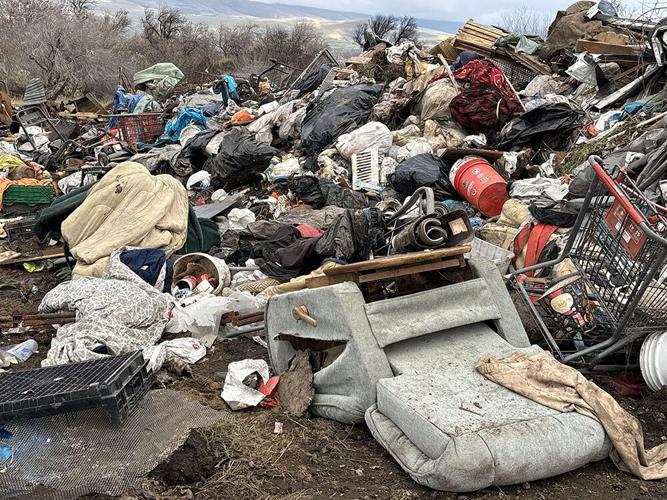
The cleanup crew removed the encampments and the trees that were hiding them. A massive berm of debris more than 150 feet long stayed onsite for weeks. The debris removal, delayed by muddy ground, finally occurred just recently.
While Columbia Gorge News could not learn from anyone, including Walmart, what prompted the camp’s removal after so many years, a number of people interviewed, including the local fire marshal, believed it had to do with repeated fires on the property.
Mid-Columbia Fire & Rescue (MCFR) Division Chief and Fire Marshal Chris Grant said the encampment had 13 fires in 2025. He was incident commander on three of the recent fires there.
He said MCFR never contacted Walmart, and “Walmart never contacted us at the fire department. Most 911 calls came from motorists on the freeway.”
The Dalles City Manager Matthew Klebes said no city funds whatsoever were spent on the encampment removal, which is on private property. Walmart did not answer Columbia Gorge News’s question about how much money it spent on the cleanup.
Camp dynamics
Lupita Castillo, an outreach worker for a local non-profit organization, has visited the camp weekly for three years, distributing supplies and naloxone, an opioid overdose reversal drug. She estimated 20 people lived there.
She was there as people were moving out in December. “I saw one person carrying out their hamster. They actually lived there. They were packing their suitcases, their stuff, their kitchens, yeah, all of it.
“These are humans too. They were established, they have real lives with real feelings and they’re important just like everybody else is,” Castillo said.
As removal work continued, some tent sites were re-established.
“They’re still down there, they didn’t prevent anything, they didn’t stop people from staying down there, they just took away their homes and prevented them from being warm,” Castillo said.
The encampment area was divided into two sections, in small, tree-covered areas a few hundred feet apart. One area housed fentanyl users and the other housed methamphetamine users, Castillo said. This is a common phenomenon in homeless camps.
She said they were separated because “fentanyl was killing people. They were tired of the overdoses.”
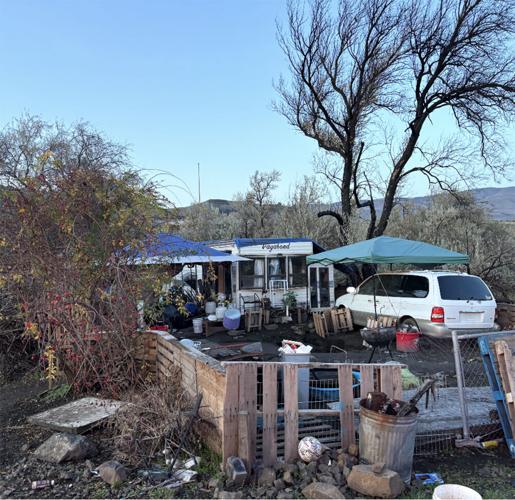
She estimated one camp area had two tents, three huts, or wooden pallet structures, and two trailers. The other camp area had five huts and up to five tents at a time.
Huts typically had a bed, windows, and a door that could be locked. Some had bathrooms, cooking space and a lounging area. One man could lift his roof for ventilation.
“They were built very, very well,” Castillo said.
One trailer had a fenced yard, a tarp carport, and a covered-tarp patio.
Another had a garden arbor and a walkway, Castillo said. Another hut was actually a treehouse, she said.
Grant noted that, while the camp sites were themselves trespassing on private property, many had ‘No Trespassing’ signs posted on their tents or near their makeshift structures.
Site hazards
Walmart was emailed questions including cost of removal and what prompted it. A spokesman said only, “Following coordination with local authorities, work occurred on private property associated with Walmart to remove debris and other materials.”
Later, the spokesman called and emailed Columbia Gorge News to clarify the land where the encampment was located was on land leased, not owned, by Walmart.
The owner of the 67-acre parcel is WM3, Inc., an entity that shares the same mailing address as Walmart’s headquarters in Bentonville, Arkansas. Walmart leases 18 acres of the parcel.
Grant said the debris from the encampment is “a public health hazard and a big concern to emergency responders. The trash attracts rodents, and the biowaste and drug paraphernalia create the potential for a worker or emergency responder to be injured and possibly infected if the waste contains a communicable disease.”
He said “these conditions presented a tremendous risk” to cleanup crews and to emergency responders.
He said there have been three fires on the site just since cleanup began.
Grant recounted that, on Dec. 7, a cleanup official notified a man in a trailer that he would have to leave, and the man got belligerent. About 10 minutes later, as the cleanup official was driving away from the property, he saw smoke in his rearview mirror. The man’s trailer and a car next to it were engulfed in flames.
Of the 13 fires at the encampment in 2025, Grant said nobody would ever say how they started, but he suspected they may have been retaliatory fires. “Fire is an easy way to get someone out.”
Each fire required stopping train traffic, Grant said, since the Union Pacific Railroad’s tracks run right by the encampment. That, in turn, would delay deliveries of the freight moved by train.
‘Scared and devastated’
Castillo said when people at the encampment learned of the impending removal, “they were scared, they were sad, they were devastated.” She said, “They immediately tried to find a loophole and find what they could do legally to stay because they’ve been down there so long.”
She didn’t encourage that approach, and then people started talking about going to drug treatment. She said the people who lived there are still in town.
“Some people didn’t want to live like that forever and they did want treatment and some were, ‘I’m good where I’m at.’”
She said they didn’t want to leave their things, but once their things were gone, they said, “I may as well go now.”
Agency response
The Dalles Police Capt. Jamie Carrico said the cleanup crew reached out to police in early December “in an effort to be good community partners and figure out the best way to do it. We encouraged the crew to post treatment and housing resources if/when they were going to post the property ‘No Trespassing.’ They were thoughtful about the impact on both the people that live there and the entire community of The Dalles.”
The Dalles Police Chief Tom Worthy said the encampments have seen multiple fires over time. “It’s an area of concern for us, you know how it gets around here in the summer. Having a campfire, cooking fire, warming fire, it’s a concern when it’s not attended, or even when it’s attended.”
Worthy said of the cleanup, “We’re just glad to see any area of the town get cleaned up into a better state than what it was.”
Nick Smallmon works with local law enforcement agencies as a Law Enforcement Assisted Diversion (LEAD) navigator. Police call him to connect people in need with available services.
He went out with law enforcement officers in December before the encampments were removed and gave out business cards, supplies, and information on available resources. He asked what people’s plans were and said, “There was a lot of ‘I don’t knows.’
“We did what we could, and will continue to help where we can,” Smallmon said of the outreach he and law enforcement did.
Smallmon also believes fires were the ultimate cause of the removal. He said not one, but three trailers had burned down at the encampment. “I think that ‘out of sight, out of mind’ was no longer a reality.”
Smallmon has worked with people who were at the encampment. Some he sees around town now, and most he hasn’t. “They are engaging in services, but the thing they’re looking for is housing, and we don’t have it.”
“We’re getting calls from law enforcement because they’re starting to pitch tents in areas that aren’t acceptable,” Smallmon said.


Commented