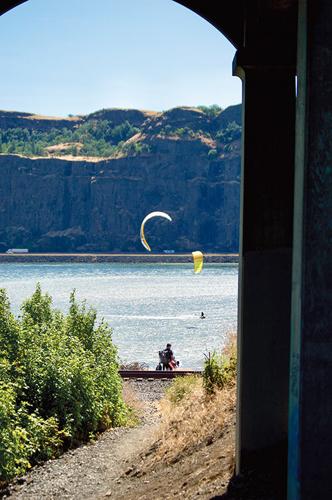
After walking under State Route 14, a kiteboarder illegally crosses railroad tracks owned by Burlington Northern Santa Fe (BNSF) while approaching the Klickitat River Delta on July 19. He joined at least 15 other kiters already on the delta.
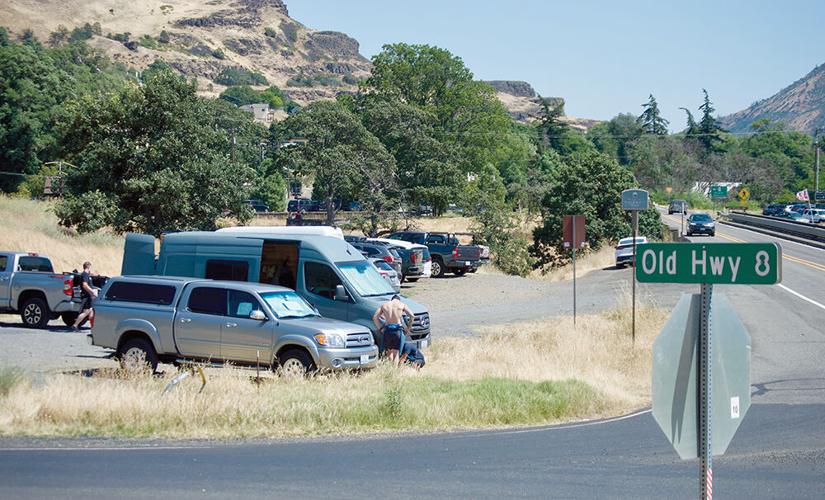
The gravel turnout where most kiters park to access the Klickitat River Delta. The unmanaged lot, which can hold more than 20 cars, sits alongside State Route 14 where cars drive by at 40 miles per hour.
After walking under State Route 14, a kiteboarder illegally crosses railroad tracks owned by Burlington Northern Santa Fe (BNSF) while approaching the Klickitat River Delta on July 19. He joined at least 15 other kiters already on the delta.
With kiteboarders, the Yakama Nation, salmon and other stakeholders using the delta, can they coexist?
LYLE — In the late 1800s and early 1900s, Lyle, Washington, directly across from Rowena Crest, was a bustling hub for sheep and lumber. At the confluence of the Columbia and Klickitat rivers, like other early settlements in the basin, Lyle depended on these arteries and coal-powered rail to transport goods.
“Lyle is a ghost town of what it used to be,” said Vern Harpole, one of its few hundred residents and a retired physician.
In the past decade, however, more and more people have come to Lyle — not necessarily to live or start a business, but to kiteboard. As some have learned, the Klickitat River Delta offers ideal conditions for harnessing winds funneled down the Gorge and racing across the Columbia’s waters — an escape from Hood River’s often overcrowded banks.
Dale McCann has taught people how to kite all around the world, from Cape Town, South Africa, to St. Petersburg, Florida. Ever since first visiting Lyle in 2015, he said the number of kiters crossing historic State Route 14, over Burlington Northern Santa Fe (BNSF) tracks and down to the delta has dramatically increased.
“The Lyle sandbar gets really good, consistent winds all the way to sunset, and it’s pretty shallow for a long way,” said McCann. “It’s just an excellent place for people learning to kite as the sandbar acts as a safety net.”
But there are two problems. For one, no safe, legal way to access the Klickitat Delta exists. Kiters haphazardly park along or in a gravel turnout just off Route 14, walk over the highway or follow a dirt trail leading below it and then risk a ticket by unlawfully hopping over the railroad tracks. Without an established path, it’s uncertain whether emergency medical services could reach the delta in the event of an injury.
“The overriding reason for this pursuit is safety,” said Harpole, the chairman of Lyle’s Community Council Committee for Safe and Legal Access to the Delta. For the past three years, the committee has held regular public meetings with the United States Forest Service (USFS) to resolve the issue, but there’s been little movement despite support from the Klickitat County Board of Commissioners. Apart from safety concerns, the stalemate negatively impacts local restaurants, hotels and other businesses that would certainly benefit from more visitors.
In 1994, the USFS purchased the Klickitat Delta and the land above it, formerly Starr Ranch, turned city garbage dump, and now, Balfour Park. According to Harpole, the property deed guarantees an easement, or the right to cross land owned by a different party, over the railroad tracks as agreed upon in documents dating back to April 28, 1911.
Claire Fernades, the USFS partnerships and special projects manager for the Columbia Gorge, said the agency does not actively manage recreational activities on the Klickitat Delta and has not recognized the easement.
The gravel turnout where most kiters park to access the Klickitat River Delta. The unmanaged lot, which can hold more than 20 cars, sits alongside State Route 14 where cars drive by at 40 miles per hour.
Nathan Wilson photo
Therein lies the second problem: The Klickitat Delta serves as a vital cold water refuge for migrating salmon and steelhead, and the USFS has a responsibility to co-steward this area with the Confederated Tribes and Bands of the Yakama Nation to protect their fishing rights enshrined by the Treaty of 1855.
“Co-stewardship means working cooperatively and collaboratively with Tribal governments directly and engaging them early and often in conversations regarding land management,” said Fernandes. The Yakama Nation was not able to comment on this story.
Once again, recreational desires and economic gains are at odds with conservation and ecological health. Like many environmental issues in the Columbia Basin, it all ties back to dams.
Sixteen distinct salmon and steelhead stocks spawn entirely upstream of the Bonneville Dam, but seven of those stocks are listed as threatened or endangered under the Endangered Species Act, and four no longer naturally live in the region. Historically, more than 7.7 million of these fish returned to the Columbia and Snake Rivers every year, but an average of 237,304 returned between 2010-2019, according to data from the National Oceanic and Atmospheric Association (NOAA).
In the same report, NOAA determined that hydropower generation has the greatest overall impact on the survival of salmon and steelhead populations. This includes direct mortality along with indirect mortality since dams degrade water quality, create conditions where predators can thrive and decrease sediment movement.
“The reservoirs caused by dams along the Columbia affect the way that tributaries like the Klickitat River function,” said Fernandes. By slowing water down, dams increase the Columbia’s temperature and have led to a buildup of sediment around the Klickitat Delta. While this makes the area more appealing to kiters, salmon and steelhead have a harder time avoiding heat stress and are more vulnerable to predators, like birds or smallmouth bass, in shallow waters.
According to Fernandes, the Klickitat Delta has the lowest survival rate for outgoing juvenile fish between the Columbia and the Klickitat Hatchery release site miles upriver.
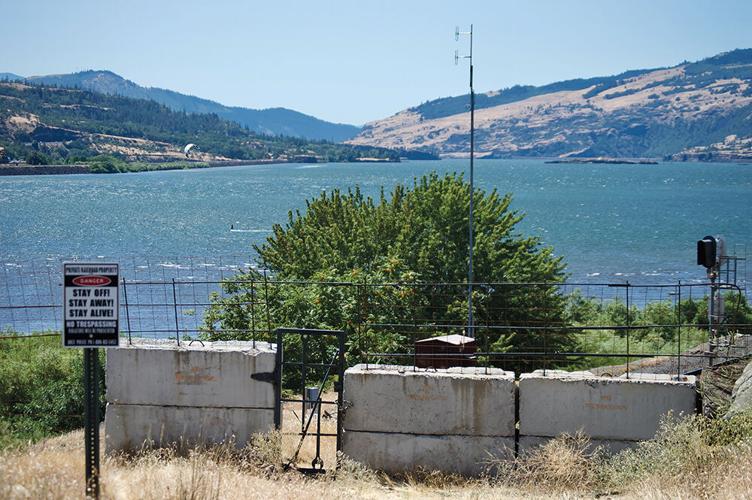
The easement, now barricaded, formerly provided access to the Klickitat River Delta by going over railroad tracks owned by BNSF.
Nathan Wilson photo
The Yakama Nation, USFS and several regional agencies have been studying how to improve fish survivability at the Klickitat Delta and similar areas between the Bonneville and McNary Dams. This may involve deepening the Klickitat River at some locations and planting native vegetation to provide more shade, but the results and recommendations won’t be finalized until this fall or winter.
There has also been a renewed federal focus on Pacific Northwest fisheries. On Sept. 27, 2023, President Biden called for “a sustained national effort to restore healthy and abundant native fish populations in the [Columbia River] Basin” by virtue of the Columbia Basin Restoration Initiative, a coalition of Tribal Nations working with Oregon and Washington. More recently, the Biden administration devoted $240 million to help Tribal Nations in the Pacific Northwest and Alaska repair and modernize hatchery facilities.
“When Yakama Nation determines the extent of restoration activities they believe should be implemented in this location, the Forest Service will support these actions and determine if there may be opportunities to support both recreation and restoration at this location in the future,” said Fernandes.
McCann affirmed that he supports restoration efforts and hopes to see a positive outcome for the Yakama Nation. Beyond protecting ecological health, however, there are several other barriers impeding safe, legal access to the Klickitat Delta, and many other stakeholders.
In order to recognize crossing rights, the USFS must conduct a feasibility study and assess the cost of different easement options, which began earlier this year. Then, it’s a matter of getting BNSF on board, but the railroad company has not joined public discussions to date. Separately, the USFS and the Washington State Department of Transportation must develop a formal parking plan, but that won’t be a priority until BNSF comes to the table.
“Sometime in the next 15-20 years, there might be a solution,” said Harpole. “I’m just discouraged that the solution is so obvious, and it’s being ignored.”
“We don’t own this. It belongs to our children. It belongs to our grandchildren,” said Davis Washines, the Yakama Nation’s government relations liaison, during a 2021 interview. “We’re trying to save it for them.”
Lyle’s conundrum, which has garnered local attention for at least two decades, will likely last much longer.



Commented