
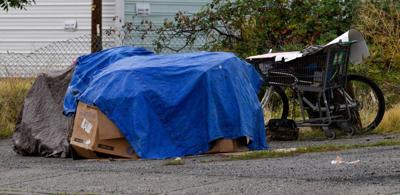
On Oct. 23, The Dalles City Council voted 3-2 to pass an ordinance implementing a system where individuals will be able to report abandoned shopping carts to businesses, with the understanding that businesses will retrieve them within three days or face a fine of up to $50.
Development of the ordinance
City Attorney Jonathan Kara explained that when creating the ordinance, the city had to take into account ORS 98.525 and ORS 98.520. Though these statutes do not require cities to adopt this ordinance, they do outline provisions that must be included in such an ordinance.
These provisions make it so certain requirements are placed on business owners who have shopping carts, including putting up signage about not taking carts, identifying the owner of the cart on the cart itself and providing a telephone number that the public can use to report abandoned shopping carts. Once an abandoned cart has been reported, the store is required to go retrieve their property within 72 hours, with the penalty for not doing so being up to $50 per cart.
According to Klebes, the fine is not intended to generate any revenue or negatively impact the business owner. It is meant to ensure that businesses go retrieve their carts once they have been identified. Kara clarified that the $50 is also one of the requirements under state law.
Klebes also clarified that in order for a cart to be considered abandoned, it must be somewhere other than the owner’s property, empty and not in active use. If a business goes to retrieve their cart and finds it doesn’t fit this definition, they will be able to submit photographic evidence to avoid a fine.
“We were trying to craft an ordinance that addressed the nuisance concern [of abandoned shopping carts] that was expressed, as well as reduce or avoid adverse impacts on vulnerable community members,” Klebes said.
In the city’s research of the matter, Klebes said the city reached out to cities with similar ordinances throughout the state, though he particularly mentioned Newport, Milwaukie and Coos Bay.
According to Klebes, Coos Bay had just adopted their ordinance just a month prior, but even before its effective date they had noticed its impact. They were previously retrieving and mitigating about 45-60 shopping carts a month, but it had dropped to 27.
Klebes also said that when they spoke with the city manager of Newport, they learned that Newport’s ordinance had been in effect since August 2022, but the city has never had to issue a fine.
“They’ve actually received some comments from business owners that it is a helpful tool, and it is helpful to have an actual process in place that supports their efforts in retrieving their property and getting it back,” he said.
The city of Milwaukie implemented their ordinance in 2008 and highly recommended it, Klebes said. According to Milwaukie, they were previously dealing with 50 carts a week, but it has dropped to almost zero.
Discussion
Following Klebes’ explanation of the ordinance, City Councilor Tim McGlothlin spoke, bringing up many concerns, one being the use of an 800-number to have people call in the abandoned carts. He pointed out that having an app or a website would be more “current,” and that it was something he saw from other cities in California, Oregon and Washington.
McGlothlin also expressed frustration at the ordinance’s lack of focus on preventing the cart thefts in the first place, rather than just retrieving them, as well as not holding the people who took them responsible.
“It is a crime to steal a shopping cart,” McGlothlin said. “Yet individuals roll down the streets with carts filled without consequence.”
Councilor Rod Runyon later expressed support for McGlothlin’s points and said he believed the fines against business owners, the victims in the situation, were unfair, and that it looked bad on the city’s part.
McGlothlin also noted that when people see someone getting away with theft, more people are likely to do the same. According to McGlothlin, he has heard many people ask why there aren’t consequences and he believes it’s a question worthy of response.
“In a perfect world, I would like to see anyone pushing a cart, anyone, it could be the mayor, myself, anyone, pushing a cart in the right-of-way, they would be stopped and confronted,” he said. “The officer or code enforcement officer could read the following statement: ‘You’re in possession of stolen property. It is against the law to remove a shopping cart from the owners’ property … If you return the cart immediately, no further action will be required. If you fail to return the property, you may face legal action, including legal charges against you.’”
He added that, as people are using the carts to keep their possessions safe, the city could provide storage to meet that need. Between providing storage and putting consequences in place for those who stole carts, McGlothlin said he believed it may eliminate, or at least greatly reduce, the issue.
“You have to have consequences to behavior to change behavior,” he said. “I did this for 43 years in the school system and I know how human nature is. I know that things run when everything is very tightly and consistently applied and everyone understands.”
Kara acknowledged McGlothlin’s points and agreed that this ordinance was only one piece of a larger puzzle, rather than a full solution to the problems in the community. He also noted that, in regards to prosecuting individuals for the theft of shopping carts, District Attorney Matthew Ellis has stated that he will not prosecute anybody experiencing unsheltered houselessness for using a shopping cart to carry their belongings.
“I would encourage anybody who would like to know more about that particular issue to contact the Wasco County District Attorney’s Office,” he said.
McGlothlin also mentioned that he had noticed that Fred Meyer had added electronic locks to the wheels of their carts, which he believed had reduced the amount of carts being stolen. Kara pointed out that this was very likely in response to the possibility of this ordinance being passed and there being potential fines, which McGlothlin agreed with.
Councilor Darcy Long expressed support for the ordinance, noting that she thought fines were unlikely, as businesses would likely be eager to get their carts back. She believed that providing people with a way to report abandoned carts would save the businesses time and be helpful, rather than harmful.
Councilor Dan Richardson noted that he too was inclined to support the ordinance, as it seemed proportional and feasible, wouldn’t impose too high of a cost or workload on staff or too high of a burden on merchants and was likely to be effective.
Councilor Scott Randall expressed a similar sentiment, saying that he believed this ordinance was about the abandoned carts and retrieval of them, rather than enforcing the crime of shopping cart theft. He said he believed that, in that light, the ordinance made sense.
“If your vehicle is stolen and the police find it on the street, they call you until you come get it and pick it up, or it’s going to be towed and impounded,” he said. “I think it’s similar to that. They don’t want abandoned property. Once the owners know that’s there, they need to come get it and take care of it.”
Community feedback
Abandoned shopping carts were previously brought up as one of the community’s problems at the March 13 regular city council meeting. Four months later, on July 24, a general ordinance was proposed as a discussion item. According to City Manager Matthew Klebes, before the July 24 meeting, city staff sent letters to each of the businesses that would be affected by the ordinance, letting them know it was on the agenda.
Klebes said that, at that time, they received feedback in the form of an email from Coastal Farm and Ranch, as well as a statement at the July 24 meeting by a representative from Grocery Outlet. However, while the city also sent notification before the Oct. 23 meeting, they hadn’t received any additional feedback or correspondence from any of the business owners, he said.
After the councilor discussion at the meeting, the public was given a chance to testify. No one spoke in opposition, with one member of the public voicing support.
Vote
Following the discussion, Richardson moved to approve the ordinance, which was seconded by Long. The vote passed three to two, with Richardson, Long and Randall voting aye and McGlothlin and Runyon voting nay.
There is a 90-day implementation period, in order to give business owners ample notice to prepare and become in compliance with the ordinance by posting signage and making sure their carts are properly labeled. This means the ordinance will go into effect on Sunday, Jan. 21, 2024.
Other business
In other business, Klebes announced that the replacement of the Dog River Pipeline, which was 100 years old and made of wood, is nearly complete. The new pipeline is in place and operating, with water currently flowing through it, Klebes said.
The replacement was more than two decades in the making, with current Public Works Director Dave Anderson previously stating he had been helping with the project since the mid-1990s, as previously reported in the Columbia Gorge News.
City Councilor Dan Richardson applauded the work that has been done on the project.
“One definition of a functional city is you’ve turned the taps and there’s good water coming out,” he said. “I know there’s a few other little fish passage things to finish up, but the main bit appears to have been completed … It feels really good to have that done.”
The city also approved a rate increase for The Dalles Disposal Service, resulting from increased operational and disposal fee costs. The increase averages approximately 2.65% and is based on 85% of the consumer price index. It will take effect Jan. 1, 2024.
In response to concerns about affordability, particularly for those who are elderly or low-income, Waste Connections District Manager Jim Winterbottom explained that pickup is free for anyone 85 and older. Discounts for those struggling to make ends meet are available through Mid-Columbia Community Action Council, he said.
The last item of discussion for the night was on short-term rentals led by Community Development Director Joshua Chandler. He noted that at the regular meeting on May 8, staff was directed to reevaluate existing ordinances in regards to short term rentals and the growing nuisance concerns that have arisen from them. He provided many potential options, including putting a moratorium on short-term rentals, limiting how close they could be to one another or even reclassifying the zones they’re allowed in.
The council gave consensus for Chandler and staff to draft a potential moratorium on non-owner occupied short-term rentals in residential areas. It will be brought for the council to vote on at a future meeting.


Commented