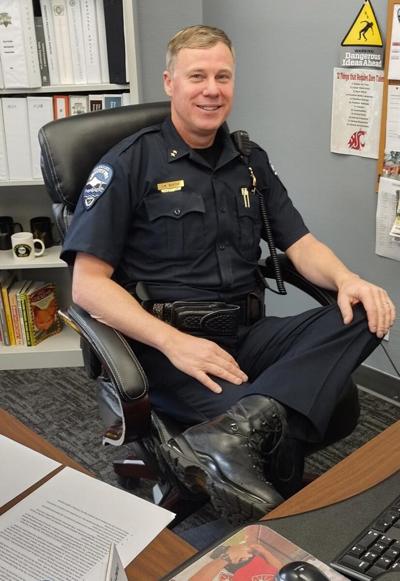
The Dalles Police Chief Tom Worthy sits at his desk in The Dalles Police Station.
Kelsie Cowart photo
At the regular city council meeting on July 10, The Dalles Police Chief Tom Worthy presented Officer Karrie Call with a lifesaving award for her actions on April 13, when officers were sent to the scene of a dog attack on E. 13th Street.
According to Worthy, the 911 call reported that an out-of-control dog was mauling multiple people at that location. Officer Tyler Caldwell, who has since been promoted to sergeant, was first to arrive on scene and identified that the dog was no longer a threat, as it had been dispatched by one of the victims.
Caldwell called for the paramedics, as two people at the location had been injured. As he was getting the details of the incident, Sergeant Doug Kramer and Officers Juan Castro, Madison Rivers and Call arrived.
Upon arriving at the scene, Worthy said that, according to Kramer, Call immediately noticed another victim was in need of emergency tourniquet application to stop the bleeding from his left arm, which had been badly mauled by the dog.
“Officer Call correctly applied the tourniquet and then did an excellent job in providing calm and reassuring support to the victim,” Worthy said. “Officer Call recognized that the victim was in shock and managed his care until the paramedics could arrive sometime later and transport the victim for emergency care at the hospital.”
A month after the incident, on May 12, Police Captain Jamie Carrico spoke with Mid-Columbia Fire and Rescue Chief David Jensen, who reportedly said that Call’s actions “undoubtedly saved this person’s life.”
Four days later, on May 16, Jensen forwarded an email from Mid-Columbia Medical Center’s (now Adventist Health Columbia Gorge) Dr. Aaron Burnham. In the email, Burnham said he had reviewed the trauma case of the victim, a 65-year-old male attacked by his pit bull terrier, and explained the man had both open bone forearm fracture with near amputation and multiple bite wounds to his head, shoulder and other arm with significant blood loss on scene.
“Bleeding was controlled by a tourniquet placed by law enforcement (Officer Call) roughly 10 minutes prior to EMS’s arrival,” the email read. “He was ultimately transferred to OHSU where the limb was saved after multiple surgeries and he’s been discharged. Although his recovery will be long and challenging, the quick action by law enforcement likely saved his life.”
In other business, Public Works Director Dave Anderson presented a contract for the upgrade of the city’s SCADA (supervisory control and data acquisition) system, which monitors and controls the city’s sewer and water systems. Anderson explained that the current system was developed by CH2M Hill Engineers, now Jacobs Engineers, in a two-part process which began in 1996.
The second phase of the project started in 2004, and the contract was awarded to CH2M Hill on a sole-source basis, as a continuation of their work, as they were the ones who had originally designed and constructed it.
According to Anderson, in the years since the completion of the project, the city has made annual maintenance and upgrade agreements with CH2M Hill / Jacobs.
“No one else has ever worked on our SCADA system,” Anderson said.
Anderson said the SCADA system is now in need of a complete overhaul, with 27-year-old equipment and software that are now obsolete and unsupported. In cases where the city has needed replacement or repair parts, they have often had to search on eBay, as the parts are no longer on the market.
The current fiscal year 23-24 budget allocates $1.5 million to fund phase one of the SCADA upgrade project, which will focus on enhancements and upgrades at the Wicks Water Treatment Plant, as that’s where the oldest and most critical systems are located.
“Normally when we would be talking about awarding a project of this type, an engineering services contract, we would develop and advertise a competitive request for proposals,” Anderson said. “And Oregon law requires that engineering contracts that have a value over $100,000 be awarded solely on the basis of qualifications … It seems extremely unlikely that another firm could come in and demonstrate to the city that they were more qualified than Jacobs to do this upgrade of a Jacobs-designed-and-built system.”
Rather than doing a typical competitive bid process for the project, Anderson proposed that the council approve an exemption and enter directly into negotiations with Jacobs. The council voted unanimously to approve the exemptions and allow Anderson and Public Works to begin the process of formalizing a contract.
According to Anderson, the city plans to enter negotiations with Jacobs throughout the summer, with the intention of presenting the proposed contract to the council around October of this year.
Finally, City Manager Matthew Klebes presented a resolution to disband the Ad Hoc Beautification Committee and form a Standing Tree and Beautification Committee, in alignment with the vision action plan the city adopted last fall, as well as with the climate resiliency recommendations the council received earlier this year.
As Klebes explained, the difference between an ad hoc and standing committee is that ad hoc committees are meant to be on a temporary basis or to achieve one particular purpose, rather than an ongoing committee, which will serve as a staple in the council. Additionally, the additional focus on trees will open up different opportunities.
Klebes said he’d been working with the committee and other city staff to create a plan to guide and identify different recommendations and initiatives to explore and work on, which having a standing committee in place will allow them to do.



Commented
Sorry, there are no recent results for popular commented articles.