
By Charlie Vanden Heuvel
Columbia Gorge Beekeepers Association
The Sky Is Falling!
The Sky Is Falling!
Over the past few years, the cry has been heard, “The Bees Are Dying! The Bees Are Dying!”
Honey Bee colonies have seen an increase in losses over the past few years. Newspapers, magazines and other periodicals have taken the cry to a crescendo level. To place some perspective to this news, the USDA conducts an annual survey of commercial operation, finding that the number of colonies has not declined.
How is this possible? Honey Bee colonies swarm at least once per bee season. Essentially the colony splits in half. Once a robust colony finds the existing queen along with the female workers prepare the hive for their departure. The brood (babies) are built in population; queen cells are created for the existing queen to lay fertilized eggs which develop into queens.
As the time nears, activity in the colony increases until the existing queen along with half the workers depart in search of a new house. A cloud of bees seemingly devoid of organization are linked in a united effort. Often finding a bivouac area, a branch, to rest while scouts come and go in search of a new home.
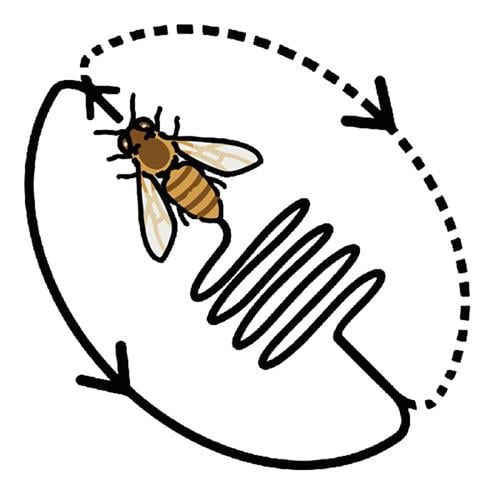
It’s similar to humans searching for an apartment or house. The scouts bring back the volume of the entrance, volume of the interior, location, direction, distance and quality. This information is shared via a Waggle Dance.
The colony operates in a democratic fashion. Each scout’s reception is met with either excitement or mild interest. The colony votes. The number of potential houses quickly is reduced to a relative few. Those whose sites were highly received in turn have new scouts sent to verify the information.
A primary is held with the masses voting, reducing the sites down to a few for the Primary Election, selecting the ultimate site. The swarmed colony then exits their temporary site for the new home.
Back at the original hive, which is now queenless, work continues foraging for nectar, pollen, propolis and water. Tending to the brood continues. The queen cells have been capped. From the moment the queen egg, a fertilized egg, is laid, she emerges 16 days later. For perspective, the worker bee (female) takes 21 days and the drone (male) 24.
The first queen to emerge rules the lot. Either she or the workers will kill the remaining queens before they have a chance to hatch. The virgin queen must now be mated. Once her wings are dry, she ventures out for her maiden flight in search of drones, who amass in Drone Congregation areas.
The virgin queen mates with nine to 19 drones while in flight. The greater the number of drones ensures a strong queen as she performs her duties laying healthy eggs. The sperm is homogenized in the queens spermatheca gland. Once fertilized, she returns to the colony to only leave should her turn to swarm arise.
With the emergence of the new queen the old colony resumes its life of foraging for groceries, cleaning their house, and as in all nature surviving.
The 62% loss over the 2024-2025 winter was shocking. But the surviving colonies, amassed in northern California for the annual almond pollination, were divided to bring about increased numbers.
Yet, there remains a greater threat, the loss of habitat. Agricultural lands are diminishing. This parallels the noise being heard concerning Native Bees. Similar challenges are felt throughout the insect world. The cry — Feed Me!
This voice is reaching a high pitch. How to reverse the trend in loss of foliage. Some have offered to cultivate the embankments along our freeways, planting flowering crops alongside almonds and other crops.
Urban environments with their multitude of home gardens support the insect world.
Consider the response: humans who are weakened by under nourishment suffer greater in diseased moments. Those enjoying complete diets find strength to rise above the infection.
Ultimately the solution to enhance nature, which operates hand-in-hand with its inhabitants, and must have food to survive.
A great saying: “Dead Bees Don’t Make Honey.”
Native Bees are able to flourish only if their queen, the sole member to come through the winter to begin again to build her colony. A cycle repeating itself annually.
Honey Bees who survive the winter, swarm in the spring to increases their colony numbers.
But both Honey Bee and Native Bee, must acquire nourishment to survive in the future.
How may we help? Visit your local garden shop to purchase native foliage suited for both Native and Honey Bees.
Nature brings about the circle of life, a system in which all living things are connected, reliant on each other. Each respective species survives through birth, death and growth.
Consider dispensing a few dollars toward Project Apis m in support of their funding (www.projectapism.org/partners/#give).
The Columbia Gorge Beekeepers Association meets on the third Wednesday of each month — www.gorgebeekeepers.org — at the Hood River Extension Office, 2990 Experiment Station Drive at 6 p.m. A different subject is presented by an Entomologists or experienced beekeeper. All are welcome.
Visitors may attend in person or via Zoom. You may reach out to the club for login information — admin@gorgebeekeepers.org. You may also enjoy a visit to the Hood River Extension to view the three bee hives maintained by the Columbia Gorge Beekeeping Club and financially by the Hood River Master Gardeners, Klahre House and the Columbia Gorge Beekeepers Association.


Commented