International tourism is more than just crowded landmarks and fully booked hotels—it is a critical economic engine for the United States. When overseas travelers visit, they inject billions of dollars of foreign spending into local economies, supporting everything from high-end retail and fine dining to regional airlines and hospitality. Economically, this inbound travel functions as a massive U.S. export, creating millions of jobs and fueling local tax revenues in both major metros and gateway communities.
In 2024, the World Economic Forum suggested that international travel and tourism was on track to eclipse pre-pandemic levels, and popular destinations in the Middle East had already fully regained their tourism export levels. However, the recovery in the U.S. has been uneven. While travel and tourism-related exports have returned to roughly their pre-pandemic value, much of that growth reflects inflation rather than a full recovery in underlying economic activity. Both overseas arrivals and inflation-adjusted tourism exports remain below 2019 levels, suggesting the anticipated post-COVID tourism boom has subsided and settled into a milder tourism landscape.
Despite this broader national lag, tens of millions of foreign tourists continue to visit the U.S. each year—and they are highly selective about where they spend their time and money. To understand which destinations are successfully capturing today's international travelers, Luxury Link—an online booking platform specializing in luxury hotels, resorts, and travel—analyzed the latest data from the U.S. Department of Commerce to identify the U.S. cities and states attracting the most international tourism.
The Economic Impact of International Travel to the U.S.
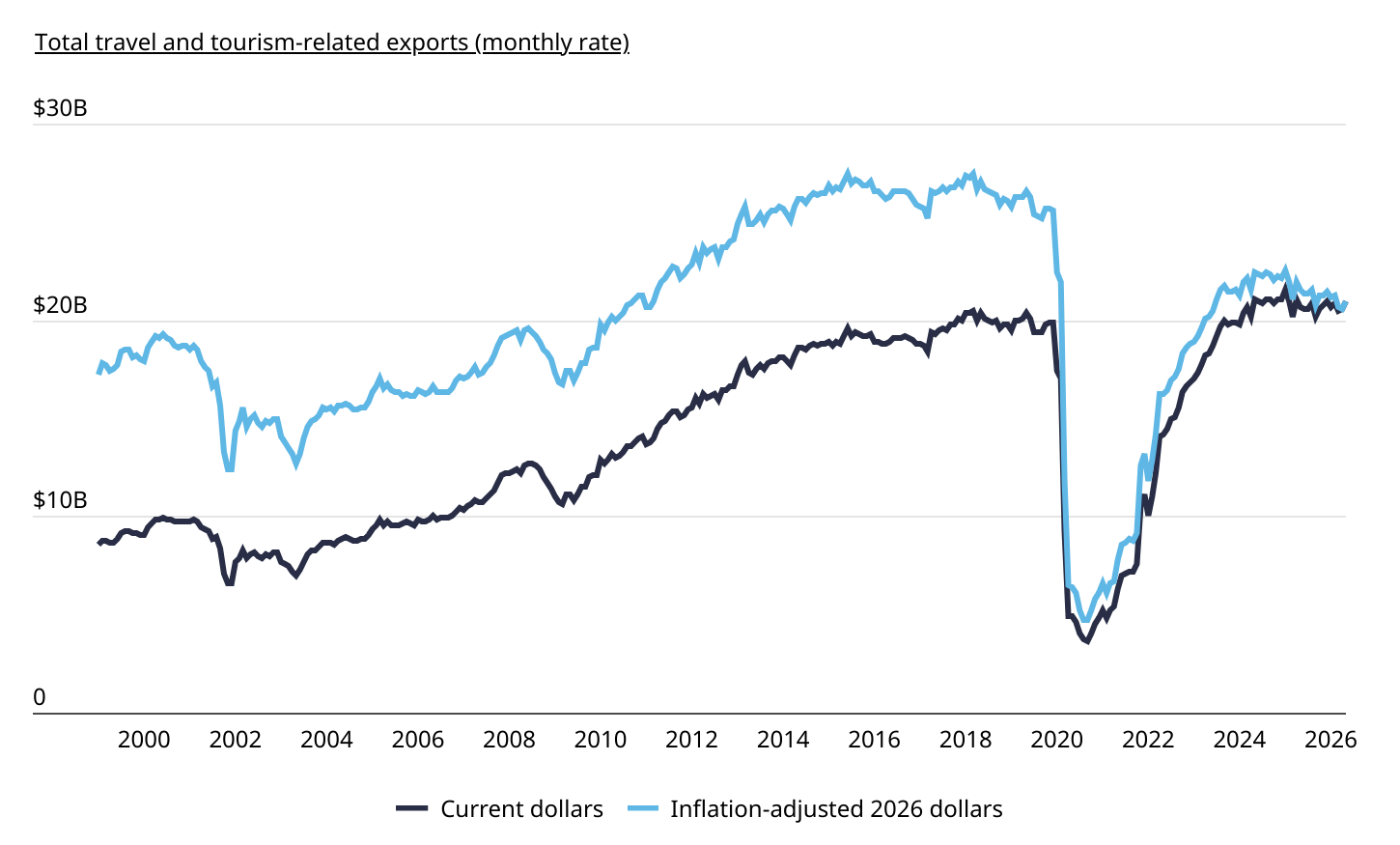
While international tourists have returned to the U.S. since COVID, their economic impact is well below pre-pandemic levels
Source: Luxury Link analysis of Bureau of Economic Analysis and National Travel and Tourism Office data
At first glance, the U.S. tourism economy appears to have largely recovered from the pandemic. Total travel and tourism-related exports reached $20.9 billion in May 2026, surpassing the $20.3 billion recorded in May 2019 before COVID-19 disrupted global travel. Measured in current dollars, foreign visitor spending has returned to roughly its pre-pandemic level.
After adjusting for inflation, however, the recovery looks far less complete. Measured in 2026 dollars, the $20.3 billion in travel and tourism-related exports generated in May 2019 would be worth $26.6 billion today. By comparison, travel exports generated in May 2026 remain 21% below that inflation-adjusted pre-pandemic level. In other words, while today's tourism economy has returned to roughly the same nominal dollar value as it had before the pandemic, the purchasing power of those exports—and their overall economic impact—remains substantially lower than it was in 2019. The comparison illustrates how inflation can make the industry's recovery appear stronger in current dollars than it has been in real economic terms.
What Attracts International Visitors to the U.S.?
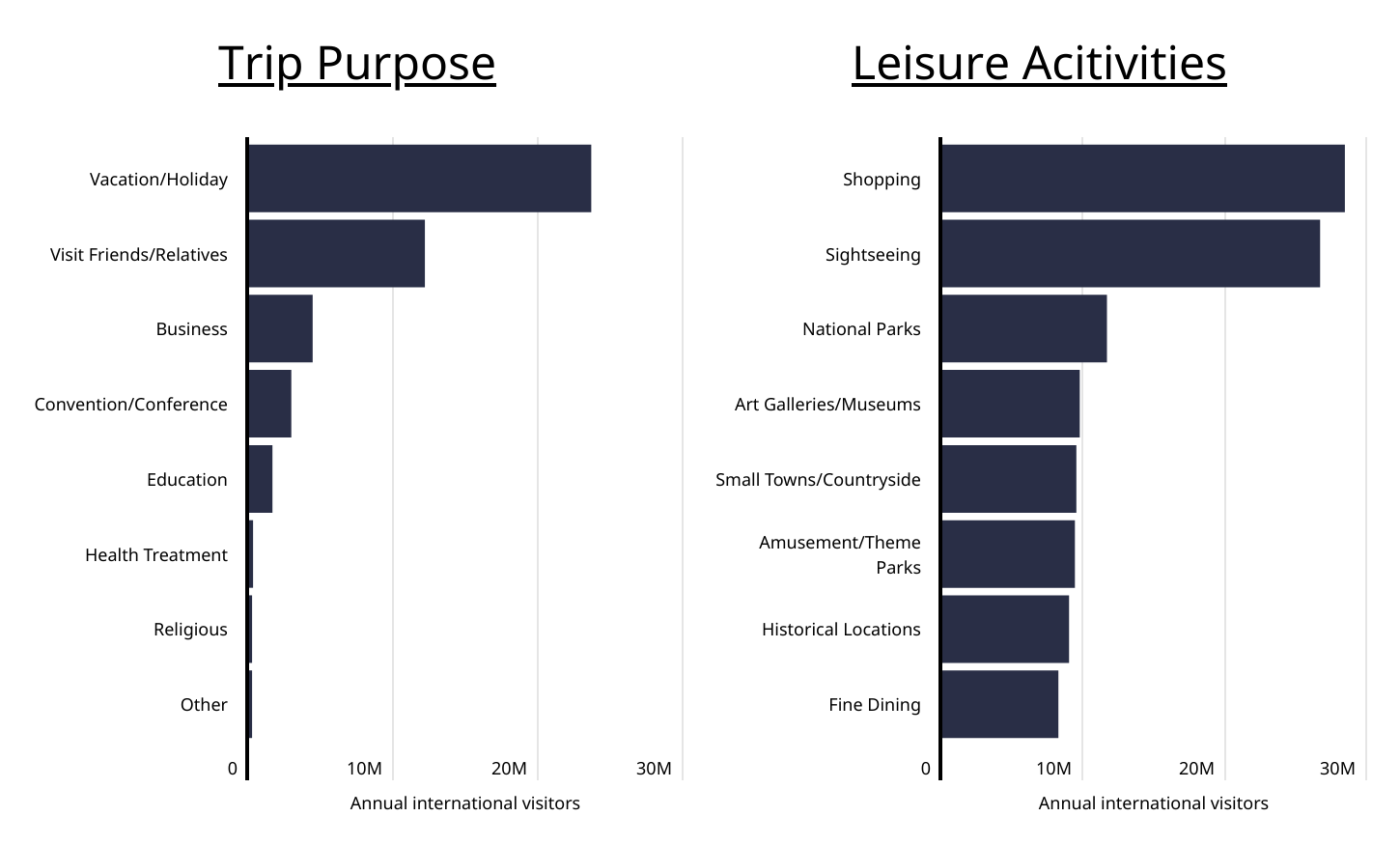
Overseas tourists arrive for vacation or to visit family, most often filling their itineraries with shopping, sightseeing, and national park visits
Source: Luxury Link analysis of Bureau of Economic Analysis and National Travel and Tourism Office data
The reasons international visitors come to the United States shape how they contribute to the tourism economy. Leisure travel overwhelmingly drives international arrivals to the United States. More than 23.6 million international visitors travel to the U.S. for a vacation or holiday each year, making it by far the most common primary purpose of a trip. Visiting friends or relatives ranks second at 12.1 million visitors, while business travel accounts for 4.4 million. Travel for conventions and conferences (2.9 million), education (1.6 million), health treatment (274,000), and religious purposes (206,000) represents a much smaller share of international arrivals.
That spending extends across a wide range of attractions and experiences once visitors arrive. Shopping is the most popular activity, with 28.4 million international travelers shopping during their visit, followed closely by sightseeing at 26.7 million. Nature-based tourism also plays a significant role, with 11.6 million exploring national parks. Meanwhile, 9.7 million visit art galleries and museums, and 9.5 million venture into small towns and rural areas. Amusement parks (9.4 million), historical sites (8.9 million), and fine dining (8.2 million) also attract millions of international visitors each year, highlighting the broad appeal of the country's retail, cultural, recreational, and natural attractions.
Where Do International Tourists Visit in the U.S.?
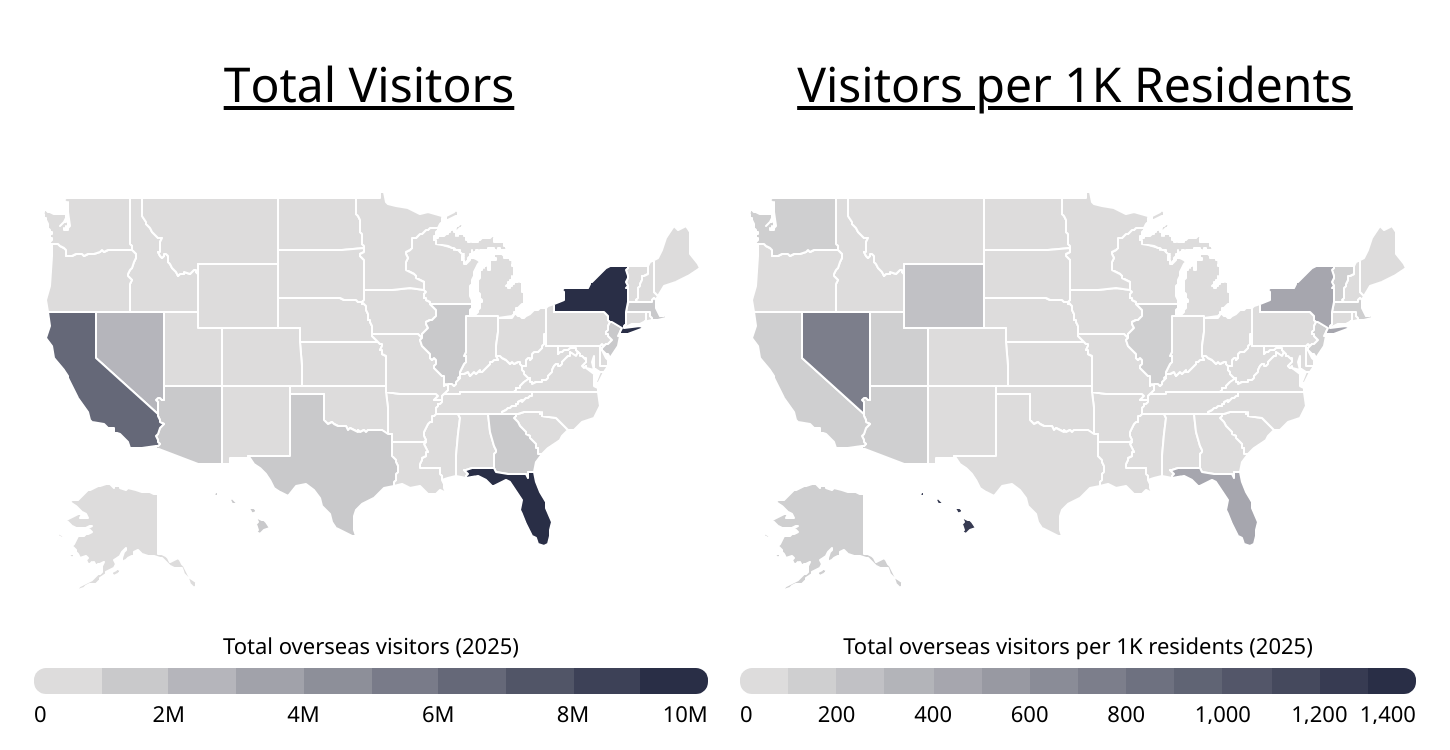
While coastal giants like Florida, New York, and California draw the highest total volume, Hawaii and Nevada by far host the most international tourists per capita
Source: Luxury Link analysis of U.S. Department of Commerce data
International tourism remains heavily concentrated in a handful of gateway states, particularly along the East and West coasts. Florida welcomes the most overseas visitors with 9.3 million, narrowly ahead of New York at 9.1 million, while California ranks third with 6.6 million. Together, those three states attract more than 25 million overseas visitors, outpacing the rest of the country combined. They are followed by Nevada (2.3 million), Texas (1.9 million), Hawaii (1.8 million), Massachusetts (1.4 million), and Illinois (1.3 million), reflecting the continued appeal of major international gateways, iconic attractions, and business hubs.
Adjusting for population, however, reveals a different picture. Hawaii welcomes the equivalent of 1,243 overseas visitors per 1,000 residents, the highest concentration in the nation and nearly twice that of second-place Nevada (718). New York (458) and Florida (417) also rank among the leaders, while smaller tourism-focused states such as Wyoming (276) and Massachusetts (199) place surprisingly high. The per-capita rankings highlight how international tourism can play an outsized role in smaller destinations, even when their total visitor counts trail those of the country's largest states.
Here is a summary of the data for Oregon:
Total overseas visitors (2025): 226,000
Total overseas visitors per 1K residents (2025): 53
Percentage of total U.S. overseas visitors (2025): 0.7%
Percentage change in visitors (2024–2025): +3.7%
For reference, here are the statistics for the entire United States:
Total overseas visitors (2025): 34,289,000
Total overseas visitors per 1K residents (2025): 102
Percentage of total U.S. overseas visitors (2025): N/A



Commented