
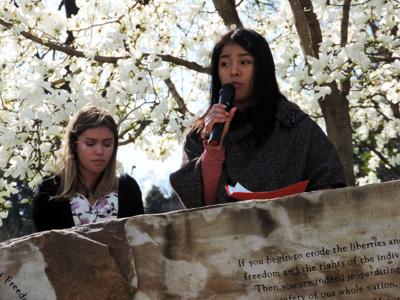
The stone served as a podium for a ceremony to honor a native son who has inspired generations.
Wednesday, March 28, is Minoru Yasui Day in Oregon, and in Hood River the event took on special meaning. Family and friends of Yasui gathered at dedication of the new Minoru Yasui Garden next to Hood River Library.
Yasui, a Hood River native who lived from 1916-86, worked his entire life for justice for Japanese-Americans and people of all backgrounds. He received the Presidential Medal of Freedom award in 2016 from President Barack Obama, the first Oregonian so honored. Yasui and his family were among the thousands of American citizens whose homes and livelihoods were taken from them in 1941-45 and who suffered discrimination and privation for years to follow.
“This is relevant today because the current U.S. administration is reminding us of this horrible period in our history,” eighth-grader Melanie Glatter said, reading from her winning entry in the local Yasui Day essay contest. Glatter was joined by Hood River Valley High School junior Monserrat Garrido and college student Christina Garcia of Hood River, a Western Oregon University pre-med student. Garcia and Garrido spoke of their nascent activism and urged the community to work for justice.
Speakers also included Maija Yasui, who organized the creation of the monument over the past two years, her cousin, Holly Yasui, daughter of Minoru Yasui, and State Sen. Chuck Thomsen (R-Hood River). Maija’s son, Niko, served as emcee.
Following the ceremony, many who had assembled went inside the library for a talk by Portland resident George Nakata, who was himself incarcerated in Minidoka.
“Minoru Yasui was my hero,” Nakata said. He recalled the harsh conditions on Minidoka, where he lived as an adolescent, and the ways the people forced to live there persevered with gardens, cultural life, and sports.
See the April 4 Hood River News for coverage of Garcia’s and Garrido’s remarks, and Nakata’s talk.
See page A10 for additional photos and remarks by Maija Yasui. Glatter’s essay is published on page A4 of this edition.
At the Legacy Garden ceremony, Thomsen said, “It is my pleasure to be here today and to be involved in his dedication. He co-sponsored the 2016 legislation, with Rep. Brian Clem, declaring March 28 to be Minoru Yasui Day each year in Oregon. Clem’s wife Carol Suzuki, grew up in the Hood River Valley. Thomsen noted that the bill passed unanimously in both chambers.
Thomsen read a part of the Yasui Day bill, citing the words of President Obama: “Min’s legacy has never been more important. It is our call to our national conscience, a reminder of our enduring obligation to be the land of the free and the home of the brave, an America worthy of his sacrifices.”
Thomsen also quoted Sen. President Peter Courtney, who said, “Minoru Yasui has made all Oregonians and all Americans proud. As Minoru Yasui is the only Oregonian to receive the presidential Medal of Freedom.
Holly Yasui said the quotes chiseled on the stone “were given to us by Min.”
One reads, “If you begin to erode the rights and freedoms of individuals then you are indeed jeopardizing the safety of our entire nation.” (The stone also bears the names of Min’s grandchildren and the Medal of Freedom emblem.)
The inscriptions spoke of Minoru’s belief that the rights of the individual is “our most fundamental principle,” Holly said.
“He said, ‘It is up to us the people to safeguard our rights and freedoms, not only for ourselves but for others,’” she said.
“Min also said, ‘when you suppress or press any group of people you are derogating the rights of all people because if you can do it to the least of us, you can do it to all of us. I knew I had to protest’ the forced removal of Japanese American citizens from their homes. Yasui, the first Asian American to graduate from the University of Oregon law school, caused his own arrest on March 28, 1942 in Portland for violating the newly-invoked curfew. As a result, he was held in solitary confinement for nine months and sent to Minidoka, and upon his release in 1945 he started a lifelong career as a justice advocate.
“He could definitely applaud the young people today,” said Holly, “who are standing up and speaking out, defending the rights of all people in America, the right to live free of gun violence, free of sudden arrest for no crime other than coming to America and pursue a better life, and for the American dream and the ideals of our nations.”
Pointing to another statement engraved on the stone, Holly said it was “A phrase often heard in my childhood: “We are born into this world for a purpose. And that purpose is to make it a better place.” Masuo Yasui (his father) was fond of saying this to his children, nieces and nephews, and to his own children, she said.
Holly said, “How do we make the world a better place? I believe each of us will do it in our way, true to our own life experiences and natures. Not everyone is a great orator like Min was or an organizer. Activism takes many forms, not only in our work but in our personal relationships, schools, churches, community groups, and everyday lives. Everyone has their gifts and it is our job to discover and develop our gifts and then give them away. Love is unlike any material possession — the more love you give the more you have. The act of giving creates more love and I believe that is how we make the world a better place.”


Commented