
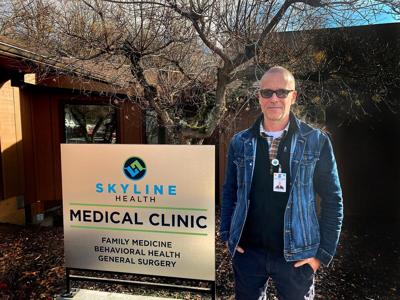
A recently implemented co-responder program — a partnership between Skyline Medical Clinic and the Bingen-White Salmon Police Department — is funding on-the-scene behavioral health services to certain people who come into contact with law enforcement.
The one-year pilot program, which was funded by a $65,000 grant from Klickitat Community Link Project (K-Link) — a program further funded by Southwest Washington Accountable Community of Health, pairs law enforcement officials with a certified behavioral health consultant, who is trained to provide an array of services, including short-term counseling, assessments, de-escalation, and referrals to people who officials may detect as individuals experiencing trauma or displaying signs of an impending mental health crisis.
During a crisis call, in which a subject is behaving in a way that could cause harm to themselves or others, a Designated Crisis Responder (DCR) is called, because those professionals have the certification that enables them to detain the subject and bring them to a health facility. In the Bingen-White Salmon area, Police Chief Mike Hepner said it could take up to an hour for a DCR to arrive.
Even when a DCR arrives, there may not be enough beds to hold the patient, in which case they are taken back home. It’s not common, but it does happen, and it has led to acts of violence by a patient, Hepner said.
As a result, this program instead targets individuals who may be headed towards a mental health crisis, which officials have labeled “pre-crisis.” This could be anyone identified by police officers as being vulnerable to a mental health crisis, including those undergoing trauma, or those with substance use issues.
“Ideally, whenever something arises that potentially could lead to a crisis situation, this program is to head that off before it reaches the crisis,” Hepner said. “I call it pre-crisis, but it can be any event. It could be anything that could add to what you already have going on in your life.”
Kristoffer Lindstrom, the behavioral health consultant assigned to the program, rides along with officers one day each week and is on call during his normal work hours at Skyline Clinic. He has been in partnership with the police department since May. When a police officer recognizes a need for behavioral health services, Lindstrom is able to respond and intervene. The consultant does not use force to detain an individual.
You might have seen Lindstrom around; aside from his work with the police department and the clinic, he also provides consulting services to Klickitat, Glenwood, and Trout Lake schools, doing much of the same work he does at the clinic, including short-term counseling and assessment services.
Lindstrom, who has more than 20 years of experience working as a clinical social worker, has seen this kind of program before. In the Portland-metro area, where Lindstrom worked prior to joining Skyline, he interacted with law enforcement officers and saw how a co-responder program, much like this one, works.
“It’s part of the national movement for more of that integrated behavioral health law enforcement model throughout different police departments across the nation,” Lindstrom said.
Unlike in Portland, where there is a larger variety of services available, first responders are called upon to address a larger range of needs in the Bingen-White Salmon area, Lindstrom said.
“What I’ve seen is that (local police officers) will really do whatever they can to help out the people they interact with,” he said.
Lindstrom said the overarching goal of the program is to provide those services to people who have behavioral health needs immediately before a situation escalates, offering a path that avoids arrests and detainment or acts of violence towards oneself or others.
“I think for the most part … providing that support and encouragement at the minimum helps a lot, and I think the problem is access,” he said.
Lindstrom said it’s important to recognize the barriers that individuals are faced with when considering accessing counseling services; cost and transportation were recognized as some of the greatest barriers to access in this area by officials overseeing the program. Stigmatization of mental illnesses also creates an obstacle to individuals who may require those services. Offering this program helps with destigmatizing mental health by making more people aware of those services. Lindstrom called the program another “access point” to the behavioral health system.
Crime does not happen in a vacuum, Lindstrom said. “I truly believe that it just comes down to what’s going on at that particular moment,” he said. “We bring our history with us … and that definitely can lead to behavior issues that could lead to breaking the law.”
Even if the intervention does not prevent an arrest, being able to show up and let the individual know about the services available is beneficial to the individual and to the community, he said. Through his work, he tries to empower individuals to use the resources available.
“It’s really about self-determination, and really sort of advocating for people’s rights to make those decisions for themselves,” Lindstrom said. “We are there to provide them with the resources and to help them see that these services exist in the community. Another central part of this work is to destigmatize mental health, and to normalize counseling as a part of ‘whole person health care.’ And that, I think, is really a big part of the focus.”
Hepner agreed that mental health is stigmatized. This program, he said, will at least bring attention to the services around, and if one person is saved by providing intervening services before a crisis occurs, he believes the program will have achieved its goals.
“Anything I can do to help out people to better their mental being is a win,” Hepner said.
Hepner said the program benefits law enforcement and the community by destigmatizing seeking treatment for a mental illness and law enforcement interactions with the public. It also separates the investigative work law enforcement performs from the work Lindstrom provides, and reduces strain on healthcare resources.
Throughout his career as a law enforcement officer, Hepner said he has responded to multiple traumatizing events, an experience that he says inspired him to approach Skyline about a possible partnership in the first place. While he is experienced at talking to victims and referring them to counseling, Hepner said it’s better that Lindstrom talks to victims and people close to them, because he has the specialized training to perform a wide variety of services. His officers undergo behavioral health training as mandated by the state, but not to the extent that behavioral health consultants do.
“I don’t have a degree in psychology,” Hepner said. “We need to leave that part to the professionals.”
The program also fits into the department’s model of community policing, Hepner said. He said that policing should be about getting to know the members of the community, including the homeless population, and introducing them the Lindstrom.
This model serves the department well by beginning the process of de-escalation sooner, because Hepner said it is easier to de-escalate a situation when an individual is already familiar with the responders.
During Lindstrom’s interactions with individuals through this program, he is able to schedule appointments to Skyline Medical Clinic. Clinic Manager Bobbi Sloan said the facility is an integrated system, which offers behavioral health services as well as primary care. This type of facility is another example of destigmatizing mental health care, because of their ability to hand off patients to a professional such as Lindstrom during a normal visit if the primary doctor identifies symptoms of a possible need for behavioral health services.
Sloan, who oversees Lindstrom, is seeing residual impacts to the police officers as well. When officers are sitting in a patrol car with Lindstrom for hours at a time, they are able to bounce ideas off each other and learn aspects of each other’s training and duties. It’s beneficial, she said, for both parties as they learn more about the work they do and the people they interact with.
Sloan said the program will be looking at the number of patients who access the health care system in a timely manner as a result. They don not yet have that data, but Sloan said it is relatively low due to the fact that Lindstrom is with the officers four hours every week. She hopes in the future to secure a full-time position solely dedicated to this work.
“The sky’s the limit here, with what’s coming,” Sloan said. “We’re only limited by our imaginations, but our true North for this program is to meet our community’s needs by supporting the care needs of its individuals.”


Commented