
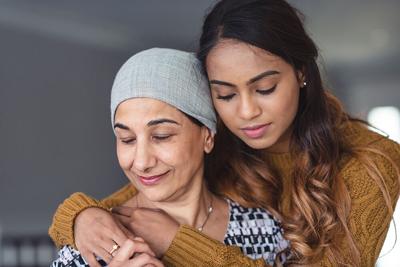
When someone first learns they have breast cancer, it can feel like a gut punch to the soul. Fears, doubts, uncertainties, and apprehensions can surface, making it difficult to stay focused. And during and following treatment, it may be more challenging to summon the strength and determination to accomplish routine tasks.
It’s times like these where friends and loved ones are crucially important, say experts and cancer survivors alike.
“Receiving a breast cancer diagnosis can make you feel alone, isolated, and afraid. Treatment is equally alienating and scary. When we feel alone, we often feel hopeless. But support from friends and family is extremely helpful and can provide much-needed comfort and hope,” says Sarah Kouten, a therapist and breast cancer survivor in Saint Augustine, Florida. “When patients experience a positive outlook and feel like loved ones have their back, they tend to follow through on treatment and other beneficial activities.”
Ellen Albertson, a North Hero, Vermont-based psychologist, author, and a board-certified health and wellness coach who was recently diagnosed with breast cancer, echoes those thoughts.
“Friends can help you stay happy, laugh, and forget your troubles. They can also make sure you practice self-care by encouraging you to exercise, rest, and eat right,” notes Albertson.
Christina Moreno, a Vancouver, British Columbia, Canada-based certified personal development coach and breast cancer survivor, appreciates how her close circle went the extra mile to elevate her spirits as she navigated her breast cancer experience years back.
“Seeing others genuinely hopeful for me, especially during times when fear would take over, was very comforting. It’s sort of like being on a turbulent flight and looking at the flight attendants’ reactions to gauge whether or not you should panic,” she says.
Know someone you care about who is dealing with breast cancer? Even small gestures can make a big difference in her life.
“Ask the person what she needs and get specifics. Does she need a ride to the doctor’s office? Does she need you to cut the grass? Are there any favorite meals you can make for her? Don’t assume you know what she needs — inquire,” suggests Albertson.
Remember that support can come in many forms.
“You can offer to clean, care for the kids, and provide transportation to appointments,” Kouten advises. “For those who are more empathetic and tuned into emotions, you can sit with the patient and lend an ear, providing validation and listening without trying to solve every problem. Or you can provide distractions by taking them to a movie, watching TV together, and spending time being ‘normal’ and not preoccupied with breast cancer.”
Cinde Dolphin, a three-time breast cancer survivor from San Luis Obispo, California, recommends practicing patience with and continually demonstrating kindness to your friend or relative with breast cancer.
“Avoid the tendency to ask them about activities, family health history, or earlier signs that may have triggered the disease. Help them stay in the present and avoid falling down the rabbit hole of over-researching breast cancer,” says Dolphin.
Additionally, remind your loved one that you still see her as the same precious human being she has always been.
“Continue to ask about and value her thoughts and opinions on things other than cancer. For example, if your friend is a bookworm, ask what they’ve read lately,” recommends Moreno. “Breast cancer can come with hair loss, pale skin, scars, and weight gain. Point out to your loved one all the different ways her beauty continues to shine through. Also, be aware of the language you use. Not everyone likes or wants to use fighting language when it comes to cancer. For some patients who are sensitive to words and like to use language to support themselves in healing, it’s helpful to listen and adapt to how they are choosing to experience it.”
Others agree that words matter, so choose them carefully.
“Personally, it bothers me when everyone’s response to your cancer diagnosis is ‘I’m sorry.’ That can feel so disempowering,” Albertson adds. “I’d much rather people say to me, ‘I love you. How can I support you, and what do you need?’”
Also, encourage your loved one to seek extra support and resources from breast cancer organizations like the Susan G. Komen Foundation, Living Beyond Breast Cancer, CancerCare.org, Young Survivor Coalition, Breast360.org, and others.
Lastly, when offering support, avoid being pushy or critical and try not to micromanage or “fix” your friend.
“By telling them all the things they should be doing — like thinking positive, exercising, eating healthier, etcetera — this can be interpreted as blame,” Kouten cautions. “There’s a fine line between encouragement and shaming.”
Why increased breast cancer awareness is vital
Breast cancer remains the most common type of cancer globally and the second leading cause of death in women. Each year in the United States, around 255,000 cases of breast cancer in women are diagnosed versus 2,300 cases in men, and it is estimated that breast cancer takes the lives of 42,000 females and 500 males in America every year, per data from the Centers for Disease Control and Prevention. About one in eight women will develop breast cancer in their lifetimes.
Sobering statistics like these remind us of how crucial it is to be cognizant of the risks as well as proactive in our approaches toward breast cancer prevention and testing.
“Breast cancer awareness is extremely important among the public. For so long, the word ‘cancer’ itself was taboo. A family member would be diagnosed, and it would be kept a secret. The patient would feel ashamed, and those around them feared it could be contagious,” says Zoraida Mendez, MD, clinical lead and oncology consultant for Cleveland-based Care Oncology. “Thankfully, the medical community has made a big effort in breaking these myths, and breast cancer educational programs have grown tremendously throughout the country over the years.”
One major factor that has enhanced recognition and understanding of this disease has been Breast Cancer Awareness Month (every October), first established in 1985.
“I was at first greatly annoyed by all the attention to breast cancer in October, when everything I saw was pink — football player cleats, cans of soup, kitchen strainers, even our newspaper,” says Meg Stafford, a licensed clinical social worker in Littleton, Massachusetts, who was diagnosed with breast cancer in 2007. “At that time, I did not want reminders of all the treatments and chemicals I received. But I came to appreciate this raised awareness in the following years, even as my gratitude was profound, as these treatments have saved my life.”
Jill Binkley, founder of the nonprofit TurningPoint Breast Cancer Rehabilitation, and a two-time breast cancer survivor, says greater public consciousness about breast cancer has significantly contributed to higher screening rates for breast cancer.
“That’s important, as proper screening can catch the disease early enough when it is most treatable,” says Binkley, who particularly credits the Susan G. Komen Foundation with helping to spread the word about breast cancer prevention and treatment and driving down mortality rates.
Janice Johnston, MD, chief medical officer and co-founder of Redirect Health in Glendale, Arizona, appreciates that several significant efforts have been made to grow breast cancer awareness further.
“These include social media campaigns, commercials, and the global focus on educating and encouraging females to conduct at-home self-exams,” says Johnston. “There have also been many scientific advancements in recent years that have made early detection of breast cancer easier for providers, including improved imaging technology and nanotechnology. Increased awareness has also pushed for improvements to certain standards for routine checking of breast cancer, such as new recommendations for women at a certain age — usually 40 to 50 years old, to begin routine mammograms and for high-risk patients to receive more routine screenings earlier.”
One of the most common fears Johnston hears from her patients is that they are afraid to get a mammogram because they believe it may be uncomfortable.
“While it’s true that some women may feel slight discomfort, the majority do not. As organizations worldwide continue to educate individuals about preventive measures, like mammograms, these misconceptions and fears should decrease,” she adds.
Mendez notes that she’s been proud to participate in several programs designed to educate people about breast cancer better.
“The first thing I start telling the public is that it is okay to talk about breast cancer. I explain the importance of doing self-breast exams once a month and not ignoring any changes in your breasts. I also stress having a yearly exam done by your regular physician,” says Mendez. “Another subject I educate them on is knowing the risks, and explaining the different treatment options helps relieve their fear of seeking medical attention.”
To learn more about breast cancer facts, risks, preventive measures, and treatment options, visit NCCN.org, Cancer.org, and Komen.org.


Commented