
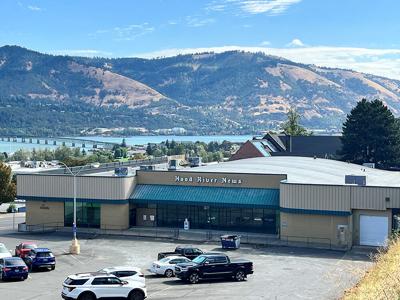
HOOD RIVER — The Hood River Planning Commission public hearing on the proposed Marriott Hotel site plan, scheduled for Monday, Aug. 18, was canceled at the request of the applicant, Line 29 Architecture.
Dustin Nilsen, director of city planning and zoning, notified stakeholders of the cancellation on Friday, Aug. 15. The hearing has been postponed until further notice.
Nilsen said that there would be no planning commission deliberation, presentation on the applicant’s request, or public testimony taken at the regularly scheduled planning commission meeting on Aug. 18.
“Comments submitted in response to the application will remain as part of the application record, and when a future hearing date is scheduled, a subsequent notice will be provided,” he said.
The proposed plan includes a 135-room hotel with a restaurant, meeting center, and parking garage, as per the public hearing agenda.
Eagle Newspapers, Inc., based in Salem, purchased the property at 419 State St. in 1995. It owned Hood River News from 1961-2020.
Barrett Smith, vice president of Eagle Newspapers, submitted a letter to the editor to this newspaper on Thursday, Aug. 14 that offered a history of the site and the company’s plans for development.
“We have considered various uses for the underutilized, unsightly space since [2020],” he wrote in part. “Finding a financially viable option with community value proved challenging, given code and site constraints. A market study indicated a hotel as the best fit. A hotel offers Hood River a long-term source of economic activity, while keeping traffic flows at manageable levels. It also adds much-needed overnight accommodations and introduces new dining, spa and event venue options for visitors and locals to enjoy. Locally owned and operated, the hotel will have a marketing partner as a Marriott AC Hotel.”
Smith did not respond to requests for comment on the continuance before press deadline.
City council advised
At Hood River City Council’s Aug. 11 meeting, City Attorney Daniel Kearns and City Administrator Abigail Elder addressed the application and appropriate ways for the public to provide comments.
Kearns first referenced an email councilors received prior to the board meeting opposing the hotel. Should the project be approved and appealed, it could come in front of city councilors, who will review it “as judges; this is called quasi-judicial,” he said.
As such, “these sorts of contacts and communications outside the context of a hearing shouldn’t happen,” Kearns said. “And it’s not even helpful for the people who do this, because their comments aren’t going to be part of the record if they don’t communicate through a hearing process.”
He emphasized the hotel’s application will be decided solely based on planning codes and “not how you feel about it … It’s whether the application meets or doesn’t meet the applicable approval criteria, and you’re supposed to decide it based on testimony and evidence that’s in the record. Applicants are entitled to that.”
Elder encouraged questions, concerns, or comments to be directed to either herself or Nilsen. “We want to make sure their comments are officially entered [into the record],” she said.
She also reminded councilors that comments directed to them could be considered ex parte communication — factual information received about a quasi-judicial matter outside of a hearing — and they need to document all conversations “just so you can disclose that and be transparent, should this topic come to you later.”
Kearns said that, in instances such as this one, most communications are more opinion than fact. “No one’s going to grab you on the street and talk about trip generation or traffic circulation associated with an application,” he said. “But if they do, that could be very factual, and the applicant — or anyone — is entitled to rebut those comments and the information you get through them.”
This is a developing story and will be updated as information becomes available.


Commented
Sorry, there are no recent results for popular commented articles.