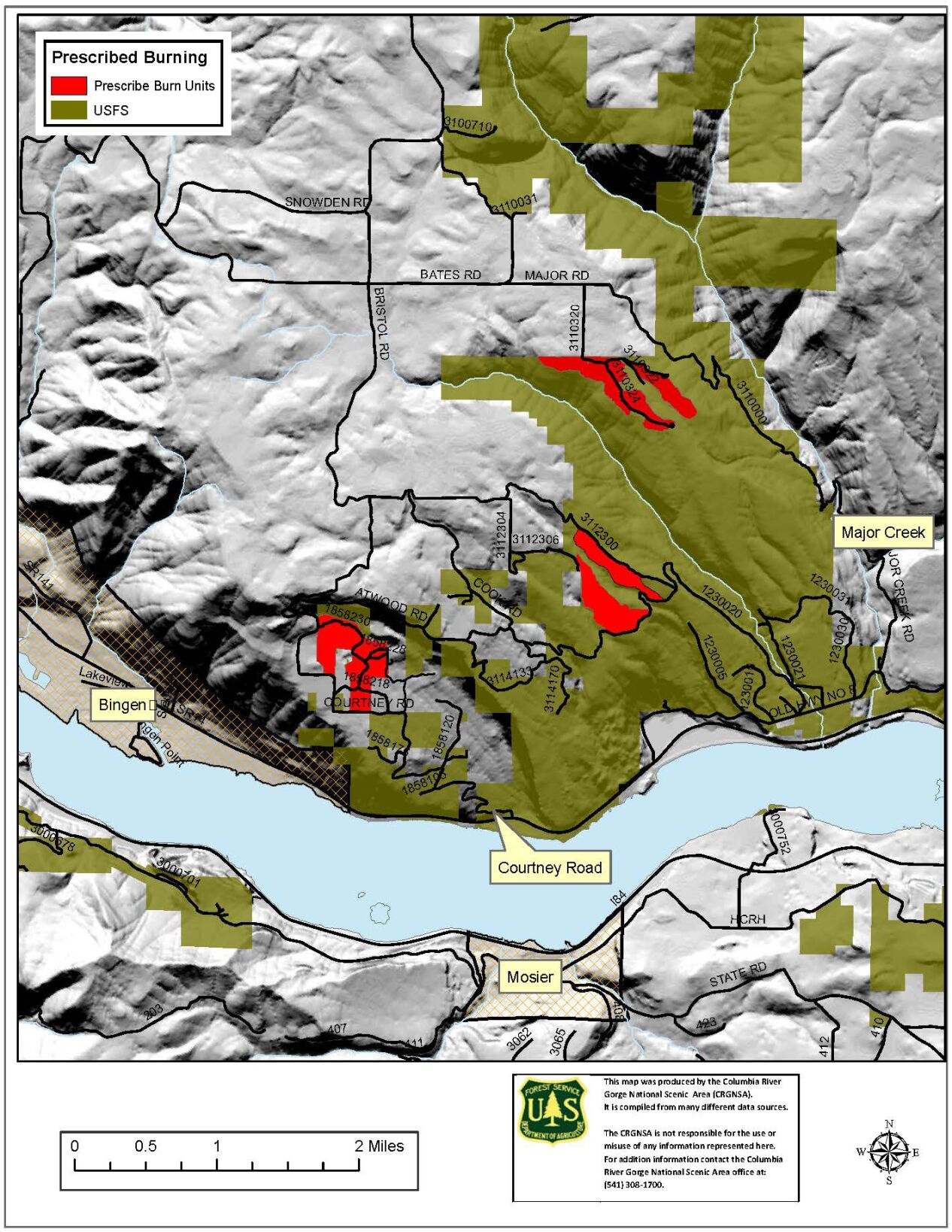
THE GORGE — Low-intensity prescribed burns, to create “landscape-scale firebreaks” while increasing forest health and wildlife habitat, are planned this fall and perhaps early winter in Klickitat County, between Courtney Road and Tracey Hill, east of Bingen. Columbia River Gorge National Scenic Area (CRGNSA) heads the group of agencies returning fire to this landscape.
The first burns were planned for last week.
“[Wildfire] seasons like we’ve had should demonstrate the need for this,” said Roland Rose, fuels planner at CRGNSA. “It’s the most critical thing that we continue to do burning, because of these giant fires that we are getting — bigger and bigger, more fires every year. ... If we don’t proactively burn and release a little bit of smoke, that same piece of ground can burn and have a lot more negative effects.”
A map of the planned fall burns near Bingen.
Contributed graphic
Each day of burning costs the National Forest Service between about $60,000 and $80,000. Most funding is federal, some local.
But the benefits are proven, and were locally visible in the “huge” 2014 Rowena fire, Rose said. The Rowena area had burned in 1998, then again in 2014, after prescribed burning treatments were done just east of McCall Point.
In the 2014 fire, treated areas had less soil erosion, and retained their green canopy of forest. That wildfire “just did a nice prescribed burn,” Rose said — before “ripping through” mature forests and eroding soil, in areas where no prescribed burning had been done.
Where lots of fuel has accumulated over decades of fire suppression, a wildfire can get severe enough to kill the whole forest and destabilize the soil, harming every creature from herbs to fish.
Prescribed burns remove that extra flammable material.
Historically, regular low-severity wildfire ignited by lighting or by Indigenous peoples kept the amount of fuel on the forest floor low. Today, burning that accumulated fuel off again reduces the severity of big wildfires, making them easier to stop, and reducing their negative effects.
These burns benefit also wildlife, by reducing wildfire's negative effects, recycling nutrients and improving habitat.
Not all of fire's effect are bad. According to a recent national report, about 50% of the area burned in larger fires had positive effects. Prescribed burns aim to maximize the positive, and minimize the bad.
How the burning is done
Burning is dependent on weather conditions, which must fall within a narrow window before the fire can be lit. Wind speed and direction, temperature, relative humidity and moisture levels in understory vegetation are considered. (The understory is the lowest layer of forest — the floor of grass and plants under an oak grove, for example.)
Before burning, scientists take samples of soil and duff from each forest they’ll burn, and test moisture and fuel content. They use computer models to come up with a prescription for the burn, intended to scorch the forest floor at just the right temperature to release stored nutrients into an ideal seed-bed for native plants, and kill just enough baby trees to keep the forest open.
“We’re working really closely with our botanist to ... expose more areas for proactive seeding of native species,” said Rose. That means creating bare earth for native wildflowers and bunchgrass to take root. In previous prescribed burns, the native plantings have worked so well the landscape became hard to burn.
A variety of forest types, oak and conifer, will burn. “This is all critical habitat for Western gray squirrel and we’ve had a lot of success with our treatments, with those gray squirrel populations coming back and thriving now,” said Rose.
Burning only occurs on days when the Washington State Smoke Management Office records good weather conditions for smoke dispersal. CRGNSA will consider smoke impacts to local communities and businesses before burning, they announced.
Smoke may be visible on Washington State Route 14 and Interstate 84. If they see smoke, motorists should reduce their speed and turn on headlights.
To prevent any mishaps, regional and national partners bring firefighting resources to the scene. They plan for the worst, just in case. The Washington Department of Natural Resources, U.S. Forest Service, Bureau of Land Management, Oregon State University, U.S. Fish and Wildlife, Oregon Department of Forestry, Mt. Hood National Forest and other national forests, Yakama Nation, Mt. Adams Resource Stewards, state transportation departments and local fire departments in Klickitat County all participate. Local departments help supply water.
For more information
Once specific dates for burning are confirmed, details are posted on Facebook at www.facebook.com/crgnsa, and X (formerly Twitter) at @CRGNSA. Those with respiratory illnesses or concerns about potential impacts to agricultural interests can request to be on a special call list for advance notifications, by contacting CRGNSA at 541-308-1700. Details on CRGNSA available at www.fs.usda.gov/crgnsa.
Private landowners can contact Columbia Land Trust, the Washington Department of Natural Resources or Oregon Department of Forestry to learn about resources and grants for prescribed burns on their property. They must comply with state laws, but certifications are available.
To learn more about prescribed fire, Rose suggested “The Era of Megafires” and “Living with Wildfire,” two free documentaries by Paul Hessburg. Both can be watched online at eraofmegafires.com.





Commented
Sorry, there are no recent results for popular commented articles.