In response to increased usage over the last few years, the Port of Hood River is looking into reorienting the floating dock in Nichols Basin to create a safer and more efficient dock system.
The dock is comprised of two separate floats that the port purchased from Maritime Industries when the company declared bankruptcy in September 2012. The floats, each 10x40 feet, are currently configured in an “L” shape and loosely attached to the seawall, with a steep ramp for access.
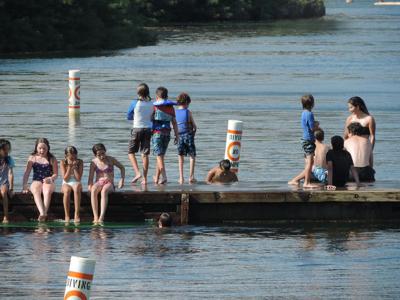
While the dock is public and heavily used by community members during the summer, it is also used as a launch point by one of the port’s tenants, the Columbia Gorge Paddling Center.
“There’s a lot of conflict between them (public and private users) during high-use times,” said Michael McElwee, the port’s executive director, during the Port Commission’s Sept. 10 meeting.
Port staff had several dock reconfigurations, attachment mechanisms and ramp layouts evaluated by a structural engineer, and presented the findings to the commissioners during the Sept. 10 meeting.
The first layout showed the dock maintaining the same “L” configuration, just with a safer ramp and more-secure connections to the seawall; the second showed the two docks lined up parallel to each other, perpendicular to the seawall, also with a safer ramp and more-secure connections to the seawall. Both orientations put the dock further away from the seawall. Regardless of the configuration, the total project cost is estimated at approximately $22,000. The port’s budget allocates $60,000 for the project.
McElwee endorsed the second configuration, calling the “L” shape inefficient because it puts one dock too close to the seawall and creates a swimmer “pinch point.” In theory, the parallel docks perpendicular to the seawall will render more of the dock safe and usable.
The docks currently have signs warning swimmers not to jump off the dock parallel to the seawall. While the sign doesn’t explicitly say so, this warning is due to underwater hazards near the seawall.
While the commissioners agreed that they supported the parallel orientation because it directs swimmers further out into the basin and away from the seawall, Commissioner Hoby Streich expressed concerns about the exposed cables and pipes that would secure the dock to the seawall in both designs.
“I think we’re creating the potential for liability,” Streich said, adding that he is worried kids will try to play on any exposed wires and pipes. “That, to me, is an accident waiting to happen.”
As a potential solution, McElwee proposed using softer material on the pipes and cables to minimize falling hazards, but added, “there is a remarkable number of ways that people have utilized this area in an unsafe way.”
Regardless of the chosen design for reconfiguring the docks, Commissioner Ben Sheppard said that the dock is a community space commonly used by children, “and anything we do needs to keep that in mind as far as safety is concerned.”
McElwee said that he will bring back a specific proposal for the commission to consider and approve at a later meeting. If the commission does support proceeding with the project, McElwee said that construction and installation could be completed before the start of the 2020 summer season.



Commented
Sorry, there are no recent results for popular commented articles.