
By Dan Spatz
For Columbia Gorge News
HOOD RIVER — A longstanding presence in the Hood River Marina ends early next year when a Port of Hood River contractor will remove seven privately-owned boathouses.
Port commissioners approved the contract on Nov. 17, along with a settlement agreement for boathouse owners. It’s a case study in evolving public interests, as the port weighs decades-old access by privately-owned boathouses against demand for public boat slips, diversifying water sports, potential impact of bridge replacement and other issues. Last Tuesday’s decision caps a policy change that preceded any of the current commissioners and senior staff.
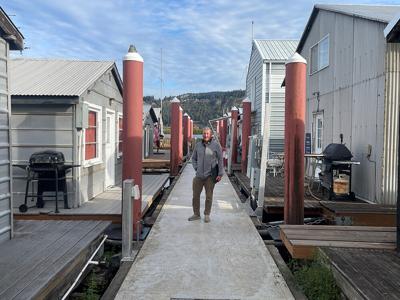
Unlike self-contained houseboats, boathouses are essentially floating garages with limited amenities. At the Hood River Marina, they’re served by a floating concrete dock, which the port installed in 2014 to replace an earlier, failing structure. Also that year, the port replaced previous, one-year boathouse leases with five-year leases designed to encourage better maintenance.
But those new leases also included a non-renewal provision, subject to future port discretion. Owners would be responsible for boathouse removal at their own cost.
Boathouses have been in the marina for decades. “We bring our grandkids here, read a book, relax, bring friends. We’ve had tons of fundraisers for Rotary, United Way, and other groups,” said Hood River resident Steve Tessmer, a boathouse owner and long-time member of the port’s marina advisory committee.
Dock replacement occurred in conjunction with direct port investments in the marina electrical system, float repair, dock restoration and other improvements authorized in May 2013, ultimately totaling $825,500, according to port records. Marina tenants paid for the work through two multi-year assessments. Boathouse owners paid the dock assessment, which ended in 2024. Tessmer said the new dock cost about $250,000.
“We were willing to pay this to get some security” through longer leases, Tessmer said. “We’ve been good, loyal tenants.”
The Hood River Sheriff’s Office has a boathouse moored at the dock; boathouse owners paid that share of the assessment, too.
The port’s rationale
Why remove the boathouses now? Kevin Greenwood, the port’s executive director, cites language in the port’s 2022 non-renewal letter to boathouse owners from then-interim executive director Genevieve Scholl. This cited previous public comments, port policy and marina management practices, as well as “the future needs of all Hood River Marina and waterfront patrons, guests and user groups, and the anticipated impact of the port’s prioritized bridge replacement efforts,” the letter stated.
The letter echoes port commission meeting minutes from 2015-2016, as commissioners at the time debated the highest and best uses of a public marina. Issues included:
Bridge replacement. The boathouses are moored near areas destined for temporary material “staging” during bridge construction. These will be restored after the bridge is completed. If federal funding arrives sometime this winter, initial construction could affect the marina as early as December 2027. Previous port commissioners cited the boathouse dock as a possible impediment, and this still might be a concern. Mike Shannon, the bridge authority’s project manager, suggests it’s too soon to tell. A temporary trestle is planned to avoid marina boat launch interference.
Evolving public use. Recent decades have seen an explosion in diverse marina uses, from paddleboats to kayaks and outrigger canoes, along with traditional watercraft. While boathouses occupy a small footprint, Greenwood notes they constitute a restricted, private use of a public marina. Boathouse removal leaves more room for other, entirely public uses.
In 2018, port commissioners reviewed potential long-term marina uses, especially boat slip expansion. According to a 2022 staff recap, “It was determined that more revenue could be generated by an open water design, but it would require substantial investment to purchase and install more dock. Current trends are still consistent with the 2018 evaluation showing that the small, trailerable boat category has the highest growth rate across the country. The moorage industry is not increasing boathouse inventory, and most marinas are phasing them out.”
Industry data aren’t conclusive, although one recent study, “State of the Waterfront Industry 2026: Trends, Data & Insights” found increasing use of trailerable boats stored at home or stacked, with boat clubs, rentals, charters and shared-use models superseding boat ownership.
Economics. Marina operations lose money, part of a much larger challenge the port faces as bridge tolls are restricted to bridge-related expenses and ultimate replacement. This year’s budget projected a $208,304 marina net deficit on $409,500 revenues (representing about 1% of overall port revenue). Boat slips account for about $329,000 of those revenues; boathouse leases generate about $40,000 annually.
Elsewhere in the Pacific Northwest, several marinas are dropping boathouse moorages, even larger ones such as Tacoma, where 120 long-term tenants got vacated in September. Tacoma marina managers cited public demand for transient, non-covered watercraft outweighing permanent moorages.
Tessmer isn’t convinced.
“This could be the most profitable dock for the port in the whole marina if they just left it alone and operated in good faith, as the previous port commission had done,” he said. While boathouse demolition eventually will open room for more boat slips, Tessmer argues the port could gain even more by extending existing boat docks.
The port could, in fact, increase boathouse lease rates. But Greenwood says it’s not just about the money. “I don’t believe the commission is only looking at the financial side of this. They’re looking at what’s the best way to manage the public’s marina,” he said. “Finances are just a small part of it.
“The port also established a capital replacement reserve fund earlier this year, with the intent of directing ongoing marina assessments toward future capital replacements and improvements,” Greenwood added. “This is part of a broader effort to plan for the long-term maintenance and replacement of marina infrastructure rather than relying solely on borrowing when major improvements become necessary.”
Notices of non-renewal
In 2022, the port informed boathouse owners it would not renew leases once their terms ended this year on Dec. 31.
It was particularly bad timing for one boathouse owner. Jenny Kreft spent almost $40,000 in 2019 and 2020 to demolish an old, dilapidated boathouse she had recently purchased and design its replacement. In a 2025 letter to the port, she said port staff at the time encouraged that work to proceed, only to learn of the lease non-renewal in August 2022.
“When I was later informed that I would not be allowed to rebuild, the financial and personal impact was devastating,” she wrote.
Her moorage stands empty now, and there’s no wait list for boathouses.
In contrast, more than 100 names are on the current wait list for transient slips. The marina has 151 slips accommodating everything from sailboats to kayaks, mostly for annual lease. In the windy Columbia Gorge, sailboats occupy many of those.
So what about that “new” boathouse dock?
It’s only 12 years old, and its designer, Flowing Solutions, says it still has 30-50 years of life ahead of it. A British Columbia firm, International Marine Flotation Systems (IMFS), installed the dock and told the port last November that it isn’t designed for transient slips. Since conversion would require new pilings and other work, IMFS recommended a new dock entirely, creating up to 18 new boat slips.
But the port hasn’t decided the dock’s fate yet.
“I think we’re going to take a look at it once the boathouses are removed,” Greenwood said. “I can’t say at this time what the condition is going to be. It’s going to be quite an effort to detach the boathouses.”
The not-to-exceed $393,921 demolition contract with HME Construction, Inc., approved Tuesday speaks only to boathouse removal, not the dock itself. Commissioners also approved a negotiated settlement providing a 50/50 cost split and boat slip wait list priority for boathouse owners.
“I have spoken to almost every boathouse owner, or at least tried to engage with them,” said Commissioner Kathryn Thomas. “I believe the port has gone above and beyond what could actually have occurred, and that we are attempting to make everyone feel that they can walk away whole in this situation. So I do appreciate the pain, and I also understand that it’s hopefully for the greater good and we will all win in the end, as opposed to just the port winning.”
Demolition begins in January. Of nine current boathouses, seven will likely be transported by barge to Vancouver for disposal. One will relocate, leaving only the sheriff’s unit.
“I grew up in Minnesota, the land of a thousand lakes,” Tessmer recalled earlier this fall. He also testified at Tuesday’s meeting, calling demolition premature. “I love being on the water. There’s no place I’d rather be. We’re very privileged and very blessed to have this opportunity.”
He added: “We understand there’s not a lot of sympathy for us.”
“The decision about the disposition of the boathouses was made by the commission before my time,” said port commissioner Tor Bieker at Tuesday’s meeting. “But that said, I’ve tried to make a careful assessment as a commissioner, and have not been compelled to change course, because I see what the vision for the marina is, and I think the direction we’re proceeding is the best way to serve our constituents as a whole.”
•••
Our journalism needs your support. Subscribe and read more at columbiagorgenews.com.


Commented
Sorry, there are no recent results for popular commented articles.