
Anne Gehrig
OSU Hood River County Extension
Central Gorge Master Gardener Volunteer
The holiday season is upon us. As the daylight wanes, we make our spirits bright with poinsettias, boughs of holly, and sprigs of mistletoe. For centuries before Christmas was designated an official holiday, these “traditional” plants were revered by other cultures and often associated with magical or sinister forces.
Consider the poinsettia: Its original name was Cuetlaxochitl, and the Aztecs used it for making dyes and curing fevers. According to a later Mexican legend, a poor peasant girl picked a humble bouquet of this Central American native to bring to the baby Jesus. When she laid it at the feet of the nativity scene, the green weeds burst into color, giving it the moniker “Flor de Nochebuena” or Christmas Eve Flower. Cuetlaxochitl isn’t truly a flower: its bracts (modified leaves) resemble a flower that turns red as autumn nights grow shorter and cooler.
In the late 19th Century, Cuetlaxochitl was “discovered” by Joel Roberts Poinsett, an avid amateur botanist and U.S. ambassador to Mexico. Captivated by its beauty, he took it from its native home and shipped cuttings back to his greenhouse in South Carolina where he studied it, cultivated it, and shared it with family and friends. Eventually the plant was re-christened “poinsettia” in his honor.
In 1919, a 2-year-old was found dead after allegedly consuming a poinsettia leaf. Extensive scientific studies in the 1970s failed to prove any charge of lethality, and although the charge was eventually dropped, the myth still persists. It was guilt by association: poinsettias belong to the euphorbia family whose tree contains several toxic members. The milky sap of the poinsettia can cause mild dermatitis, but scientists have found no evidence that consumption of poinsettia leaves leads to death. Despite its history as an immigrant living under an assumed name and accused of a serious crime, Cuetlaxochitl remains an endearing holiday symbol.
Mistletoe is another plant cloaked in myth. In the Middle Ages, it was considered an aphrodisiac, a fertility-enhancer, and was thought to protect against poison and the entry of witches into a house. In the 1900s, European mistletoe arrived on this continent, bringing with it the custom of kissing beneath it. Tradition dictates that a berry be plucked with each kiss; no more berries, no more kisses. American mistletoe (Phoradendron), a California native, is the preferred species for holiday celebrations — perhaps because it has more abundant berries? Mistletoe is dioecious: it takes both male and female plants for reproduction. It is also hemiparasitic. It contains chlorophyll and can photosynthesize, but it depends on host plants for water and inorganic nutrients. Heavy infestations can significantly weaken the host and eventually lead to its death, giving new meaning to the phrase “till death do us part.”
Holly’s claim to fame lies in its vibrant coloring: Celts and Druids believed it had properties of eternal life and fertility because it remained green even during the darkest days of winter. Ancient Romans used it to protect their homes from witches and lightning strikes. Early Christians tweaked the symbolism to reflect their beliefs: the leaves became Christ’s crown of thorns, and the berries represented drops of blood.
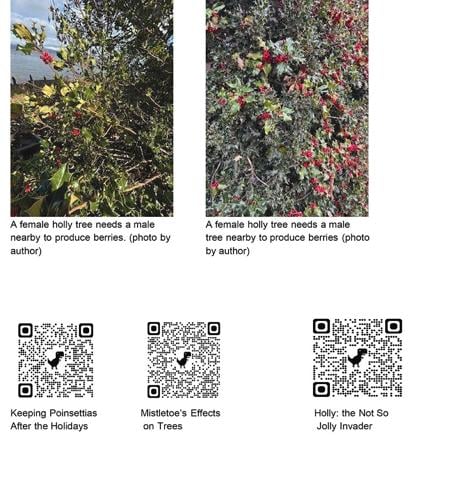
Non-native English holly (Ilex aquafolium) is the kind most typically found in the Pacific Northwest. It provides shelter for small mammals, food for birds, and pollen for bees. Like mistletoe, it’s dioecious: a female plant needs a male plant in order to produce its signature red berries. One male plant can pollinate multiple female plants. It is easy to grow — too easy, perhaps, as it can quickly become invasive. It is tolerant of shade, drought, and poor soils. Washington State recently designated it as a Class C Noxious weed. Holly is mildly toxic: its sap can cause dermatitis, and its berries, if consumed, can result in nausea, vomiting, and gastrointestinal distress.
Holiday plants may not protect you from evil spirits or enhance your fertility, but they can certainly brighten your spirits during dark winter days. So go ahead and have a holly jolly Christmas: put out the poinsettias, hang the mistletoe, and deck your halls with boughs of holly. Just don’t eat the berries.
Central Gorge Master Gardener volunteers provide free beginning gardening classes and continuing education to home gardeners. For research based information about specific gardening or pest questions, submit your concern online at extension.oregonstate.edu/mg/hoodriver or by phone at 541-386-3343. Home gardeners can also drop off plant or pest samples Monday through Thursday between 9 a.m. and 4 p.m. at the OSU Hood River County Extension Service, 2990 Experiment Station Drive, Hood River. The Central Gorge Master Gardener program is a division of the OSU Hood River County Extension Service. OSU Extension Service prohibits discrimination in all its programs, services, activities, and materials.


Commented
Sorry, there are no recent results for popular commented articles.