
Warm Springs, environmental groups give the Hood River a new channel, improving fish habitat and floodplain resilience
By Nathan Wilson
Columbia Gorge News
HOOD RIVER — Though the Powerdale Dam was decommissioned in 2010, its impact on the Hood River has continued. The dilapidated powerhouse still stands, and a berm that used to ferry water between both structures via a massive penstock constricted the river, at least until this summer.
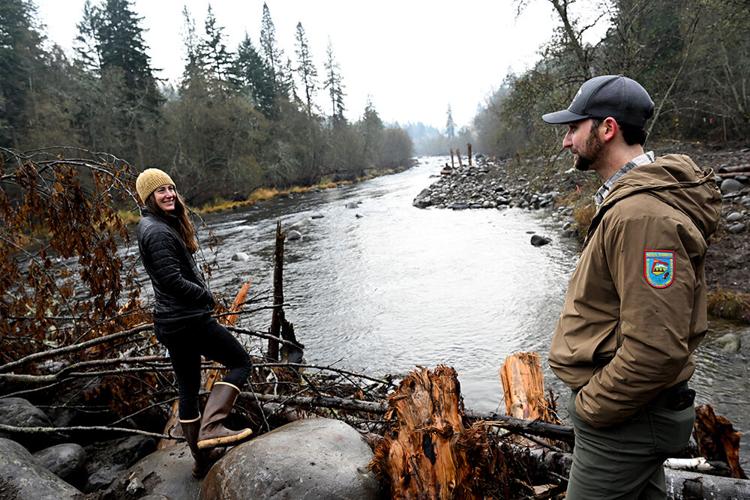
Led by the Confederated Tribes of the Warm Springs and the Hood River Watershed Group, a new year-round side channel is now flowing, and another that activates during high-water events will eventually. Spanning roughly 0.3 miles in total, they provide additional habitat for aquatic animals and slow the river so that juvenile salmonids don’t get washed downstream.
“Having a site like this where we can come in and help reestablish that connectivity is rare and critically important from an ecological perspective,” said Matt Steinwurtzel, fisheries habitat biologist for Warm Springs and co-manager of the project.
As he explained with the watershed group’s Javan Bailey, a restoration manager who also oversaw the effort, limited floodplain exists beside the Hood River because of development and its steep gradient. Upriver from where it meets the Columbia — a 3.5-mile stretch known as the Powerdale Corridor — is one of few opportunities for spreading and braiding, but the berm effectively acted as a “spigot,” funneling water down a narrower path.
“Just taking the dam out wasn’t enough,” Bailey said. “There’s additional work to be done.”
Back in July and August, contractors breached the berm and built two mainstem jams, lattice-structured mounds of logs, vertical piles and boulders capable of withstanding a 100-year flood, to feed the perennial channel. The entrance to the high-flow channel sits a few feet above current river levels and leads into the perennial channel. About 11,500 cubic yards of sediment was removed from both over eight weeks.
That’s enough to fill more than 800 standard dump trucks, and it wasn’t just sediment: excavators removed several concrete footings that held up the penstock as well.
The project took place on property owned by Columbia Land Trust, which received part of the 400-acre corridor in a 2013 settlement agreement with former dam operator PacifiCorp, and enhanced prior work completed by Warm Springs in 2015.
On Nov. 12, volunteers planted well over a thousand stakes of native trees, including cottonwood, willow and dogwood, to encourage riparian growth in the area. And while the seasonal channel was intentionally left bare this summer — “to let the river have its way,” as Bailey said — a number of logs and root wads were installed in the perennial channel to create diverse hydrology.
“Fish really like cover. They feel protected and it gives them a variety of velocities to be in,” Bailey said. “When the river hits these root wads that aren’t moving, a lot of times it goes under and creates scour, which creates pool habitat.”
The natural pools, along with manually dug ones, also provide lower temperatures because of their depth. Situated within a population transition zone, the Hood River serves as a vital cold-water refuge off the warmer Columbia for several fish species, supporting spring and fall Chinook salmon, summer and winter steelhead, Coho salmon, Pacific lamprey, bull trout, sea-run and resident cutthroat trout, rainbow trout and more.
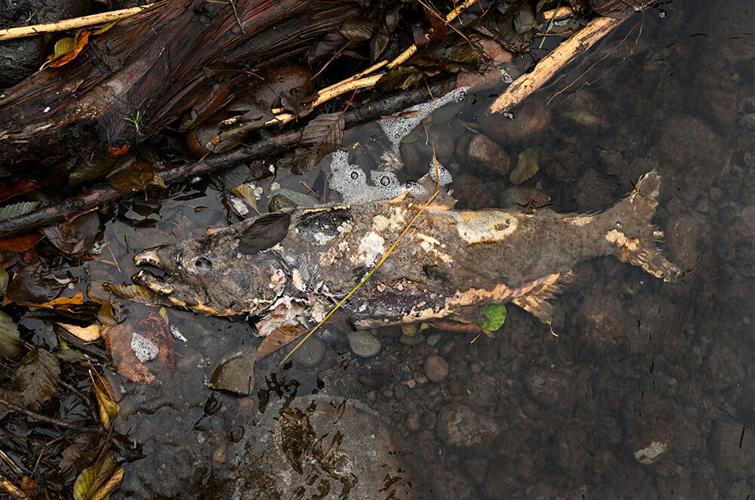
Already, Bailey and Steinwurtzel have spotted several salmonid spawning beds, called redds, in the perennial channel. It’s a particularly heartening result for Steinwurtzel, since the Warm Springs hatchery program in Parkdale has been working to re-establish spring Chinook runs in the basin after they previously went extinct in the 1970s.
“It’s important that tribal members do have harvest opportunities for those first foods within their ceded lands,” he said. “Having fish come back and utilize a project so soon after completion, it tells you that you’re doing something right.”
Over the next five years, Warm Springs and the watershed group will be removing invasive weeds, tracking vegetation growth and monitoring whether fish are using the new habitat as expected. Then, Columbia Land Trust will step back into the primary role, as it already does across the whole corridor.
“We’ll continue to work with our partners to make sure that the habitat is still functioning, that it’s not being impacted, and if there are things that we can do to keep it or nudge it in the right direction, we’ll do that,” said Ian Sinks, Columbia Land Trust’s stewardship director.
A combination of funding provided by Oregon’s Watershed Enhancement Board, the Bonneville Power Administration and grants obtained by the Hood River Watershed Group helped realize the $680,000 project.
Next up on the Powerdale Corridor’s restoration list? Removing the powerhouse and regrading nearby floodplain to further improve connectivity, tentatively scheduled for 2028.


Commented
Sorry, there are no recent results for popular commented articles.