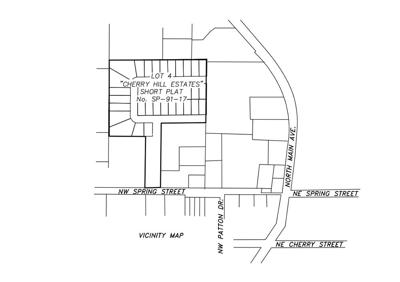
A map of the proposed Cherry Hill Estates subdivision, which would bring 35 new single-family homes to NW Spring Street. White Salmon’s Planning Commission did not approve the project at its Dec. 11 meeting, but city council could still move it forward.Photo courtesty of the City of White Salmon
A map of the proposed Cherry Hill Estates subdivision, which would bring 35 new single-family homes to NW Spring Street. White Salmon’s Planning Commission did not approve the project at its Dec. 11 meeting, but city council could still move it forward.Photo courtesty of the City of White Salmon
WHITE SALMON — White Salmon’s Planning Commission held a staggering five public hearings during its Dec. 11 meeting where they discussed the Cherry Hill Estates subdivision, permits for small schools and daycares, the Heritage Tree Protection Ordinance, White Salmon’s fee structure, and floodplain map updates.
Commissioners spent the most time deliberating Cherry Hill, a pending effort to build 35 single-family homes on 7.93 acres of vacant land on Spring Street, just east of Main Avenue. With two public hearings already in the books, whether Spring Street could physically handle construction traffic and ensuring kids could safely commute to school through that traffic were core concerns.
“Pavement condition itself is sufficient, however, the roadway width running from the subject site to Main [Avenue] is substandard,” said Alex Capron, senior planner for consulting company Facet. Prior to breaking ground, Capron also announced the developer would be required to build a four-foot-wide path on the north side of Spring Street to accommodate pedestrians.
“We got the safe roads to school, which is great,” said Commissioner Carl Trabant, “but I didn’t see a response to the main reason I believe that the commission demanded this back.” Trabant hoped to receive specific data on the frequency, duration and expected size of construction vehicles.
From his observations, Public Works Director Andrew Dirks noted he didn’t see risk of “catastrophic failure” on Spring Street and that the city unsuccessfully pursued funding to repave the road earlier this year. Upcoming water and gas line replacements, though, would improve portions of the road.
But that wasn’t satisfactory for Trabant, or Commissioner Michael Morneault. Alternatively, Trabant suggested routing construction traffic through Four Oaks, another residential subdivision just north of Cherry Hill, avoiding Spring Street entirely. According to Legal Counsel Kelly Hickok, White Salmon couldn’t lawfully demand that condition.
“Anything outside of this new development is really incumbent on the city to manage and fix, including Spring Street,” said Chair Greg Hohensee. “I think that we’re visiting the sins of the city upon this developer.”
With Hohensee and Commissioner Erika Price in favor, approval of the project failed in a 3-2 vote, but city council will make the final verdict.
Next, commissioners amended the commercial zoning code to make schools and daycares with less than 40 total students a permitted use instead of a conditional use, eliminating additional review requirements. While slightly worried about traffic and parking impacts, commissioners saw the need to accommodate more childcare services, so they endorsed the change in a 5-0 vote.
Afterward, commissioners heard a final update on the Heritage Tree Protection Ordinance, which they started refining in April, along with White Salmon’s Tree Board. Broadly speaking, the ordinance seeks to slow the loss of tree canopy over time, protecting benefits to environmental and human health, while not unreasonably impeding growth and development.
Key changes include more specification on arborist reports and when they’re required for tree removals, clarification on how to calculate trunk diameter and tree protection zones used during construction, eliminating parking as an incentive for tree retention and increasing the trunk diameter of protected trees to align with wildfire mitigation efforts. Having held four public hearings on the topic, commissioners had little additional discussion.
“I hope the city is agile enough to amend this code further to make it so that it meets the needs of the community because I do still have concerns about its complexity,” said Hohensee. Commissioners approved the ordinance and passed it onto city council in a 4-0, with Hohensee abstaining.
Hilary Hahn, environmental planner and ecologist for Facet, then presented an analysis of White Salmon’s land use fees, like short-term rental permits, lot line adjustments and more, which haven’t been overhauled since 2007. Compared to nearby cities like Hood River and Stevenson, on average, White Salmon’s fees were 42% lower.
Commissioners had a lengthy debate about the methodology of Facet’s study, but ultimately agreed to move forward since the city’s fees are so outdated. In a 5-0 vote, they decided to implement a technology fee to capture investments in the city’s permitting software, structure fees based on the departments involved, rework how the city contracts planning consultants and reduce fees for multifamily housing projects.
“While we may want to see some more detailed changes,” said Hohensee, “maybe now is not the time to hammer them out. Let’s just throw this at the wall and let the city start collecting some slightly more appropriate fees.”
Lastly, commissioners moved to update floodplain maps required by the United States Federal Emergency Management Agency to reflect new data. Since Washington’s Department of Ecology already signed off on the changes and, out of all property within city limits, only a four-mile stretch of Jewett Creek will be impacted, commissioners sent it to city council unanimously.
The next planning commission meeting will take place on Jan. 8 at 5:30 p.m. in the White Salmon Fire Hall.



Commented