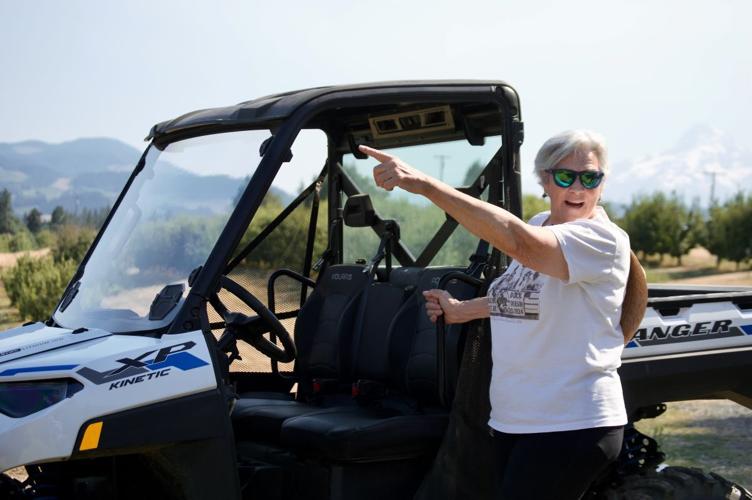
Karen Lewotsky, rural partnerships and water policy director for the Oregon Environmental Council, walks through what the Polaris Ranger XP Kinetic can do on July 23, 2024. The electric vehicle has 110 horsepower, an estimated 45-mile range, 1,250 pounds of bed capacity and ferried interested growers around OSU’s Mid-Columbia Agricultural Research Extension Center.
The field day at OSU’s Mid-Columbia Agricultural Research Extension Center features the Polaris Ranger XP Kinetic, an electric vehicle that costs $29,999 and can squeeze between tight orchard rows.
Karen Lewotsky, rural partnerships and water policy director for the Oregon Environmental Council, walks through what the Polaris Ranger XP Kinetic can do on July 23, 2024. The electric vehicle has 110 horsepower, an estimated 45-mile range, 1,250 pounds of bed capacity and ferried interested growers around OSU’s Mid-Columbia Agricultural Research Extension Center.
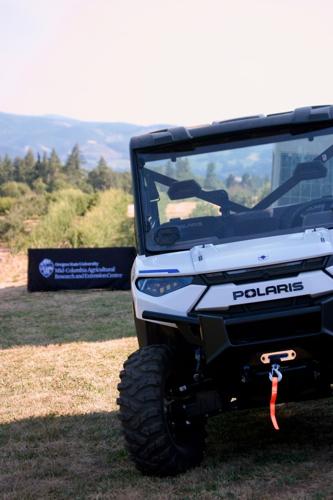
HOOD RIVER — Growers in Hood River Valley gathered at Oregon State University’s Mid-Columbia Agricultural Research Extension Center (MCAREC) on July 23 to learn about emerging pear and cherry production research, but also to check out a new electric vehicle — the Polaris Ranger XP Kinetic.
Oregon’s Clean Fuels Program, which was established in 2016, created an incentive and funding system designed to reduce transportation emissions, the state’s largest source of greenhouse gases. Utilities receive credits for buying, producing or encouraging the use of cleaner fuel, anything from electricity to hydrogen and biofuels. With these credits, Pacific Power bought four electric utility terrain vehicles (E-UTVs) actively used by OSU research centers statewide.
“We were trying to determine if these vehicles can work in an agricultural setting, in an environment where they’re exposed to dirt, snow and the rigors of farming,” said Brian Pearson, the director of MCAREC. “In terms of what my expectations were and how they were proven otherwise, I’m impressed — quite impressed.”
Pearson described how MCAREC uses the E-UTV to plow snow every day during the winter, functioning at temperatures where diesel-powered tractors at other extension centers couldn’t. The E-UTV can also fit between rows of fruit trees, charge with a standard electrical outlet and has 2,500 pounds of towing capacity, the same as the newest comparable model.
Karen Lewotsky is the rural partnerships and water policy director for the Oregon Environmental Council (OEC), a nonprofit organization that helped put the Clean Fuels Program in place. Lewotsky understands that farmers are “show me people” and that the idea of electrifying agriculture comes with apprehension from a rugged, heritage-based industry.
The field day at OSU’s Mid-Columbia Agricultural Research Extension Center features the Polaris Ranger XP Kinetic, an electric vehicle that costs $29,999 and can squeeze between tight orchard rows.
Nathan Wilson photo
“Agriculture, for good reason, is a culture that has a lot of respect for tradition and the way things have been done,” said Lewotsky. “Sometimes that makes the uptake of something new a little difficult.”
Lewotsky doesn’t know any local growers who have purchased an E-UTV, but with more visibility, she’s confident some will. Apart producing less pollution, she said E-UTVs cost 70% less to maintain since electric engines are far simpler, and have fewer things that can go wrong than gas engines. For the price of $29,999, however, the 2024 E-UTV model costs $9,000 more than a 2025 Polaris Ranger with similar specifications.
Regardless, Pearson emphasized the importance of sharing opportunities with people that otherwise might not have access to them, and Lewotsky firmly supported the community-centered work that OSU does through its extension centers.
“When we’re dealing with non-urban agricultural operations, sometimes there can be a disconnect between technologies that are more prevalent in urban areas,” Pearson said. “We are purposely out in the backyard of our growers to be that conduit to them and ensure they have equal access to information, knowledge, extension and teaching resources.
“The work that these individual stations do, scattered around the state focused on regional and local issues, is really important to the agricultural economy,” Lewotsky said. “[OEC] really believes strongly in supporting OSU’s budget in the legislature so that this work can get done.”
In total, Pacific Power provided $201,000 to bring four E-UTVs to OSU extension centers and, through its Electric Mobility Grants program, the utility has allocated more than $6.5 million to Oregon communities since 2020.




Commented