Fall officially began earlier this week, and not long after, the first official precipitation of the season followed.
On Wednesday, according to a U.S. Department of the Interior weather station located at the OSU Extension Center on Experiment Station Drive, the southern side of Hood River received rain, albeit a meager accumulation of less than two-tenths of an inch. Rain also fell in downtown Hood River Tuesday afternoon, but apparently not enough fell at Experiment Station Drive to register on the weather station’s rain gauge.
The arrival of fall with cooler temperatures and more precipitation caused the Mt. Hood National Forest to lift all campfire restrictions on Wednesday. The order rescinded a previous order that restricted campfires in areas east of Highway 35 to designated campgrounds within fire rings and prohibited off highway vehicle use (OHV) on forest trails. With the lifting of these restrictions, campfires are now allowed for dispersed camping, and OHV use is also allowed under normal regulations forest-wide.
“It may appear as a strange time to be lowering fire restriction standards given the current fire that is burning in the Clackamas River Ranger District,” said Kameron Sam, Barlow District Ranger, referring to the 36 Pit fire near Estacada. “But this is the time of year when moisture becomes more consistent and prevalent, temperatures start to drop, especially in the evenings, and overall fire behavior becomes less severe and less likely. We’ve monitored weather models and after a great deal of deliberation, we have determined that the conditions are right to drop these fire restrictions.”
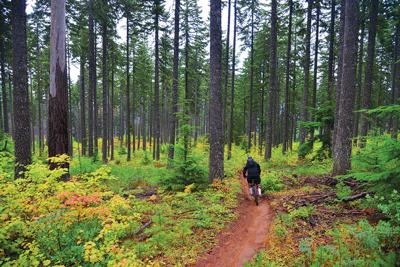
Wednesday’s rain brought prime dirt conditions for mountain bikers and triggered an “EMERGENCY announcement of the Oregon Brown Alert system,” according to the Hood River Area Trail Stewards’ Facebook page — no doubt an official mountain bike dirt condition notification system. The dirt was reportedly excellent in the Post Canyon network of trails and was expected to be similar up off FS Road 44 and at Syncline.
Despite the precipitation, it wasn’t enough for the Hood River County Forestry Department to open trails for OHV use, according to Henry Buckalew, trails program coordinator and forest technician with county forestry.
“We did not get as much rain as we would have liked and the fuels are still too dry,” he explained. “We will reassess it again Monday morning and could possibly open it then or soon thereafter.”
The precipitation also wasn’t enough to produce a “season-ending event” for this year’s fire season and a full countywide burn ban still remains in effect.
“Really, all this has done is settle the dust on the surface,” noted Tiffany Peterson, lieutenant at Wy’East Fire District.
“It makes it feel like fall,” she said of the rain, “but that’s about it.”
Devon Wells, chief of Hood River Fire and EMS, agreed, and said that though the rain was enough to saturate grasses and other thin fuels, thicker fuels were still dry.
“We haven’t lifted any burn bans yet, but if the weather continues like this, it will be a season-ending event,” Wells said.
Typically, local fire agencies wait for word from the Oregon Department of Forestry and then confer before making a decision on the burn ban, according to Wells.
As of Thursday, the western portion of the Columbia River Gorge is one of the few areas of the state that isn’t currently classified as abnormally dry or under drought conditions, according to the federal government’s drought monitoring website. With the exception of portions of Hood River, Multnomah, Tillamook, Clatsop, and Washington counties, the whole of Oregon is either listed as abnormally dry or in some level of drought.
Stan Hinatsu, recreation coordinator for the Columbia River Gorge National Scenic Area division of the U.S. Forest Service, reported the area’s burn bans are also still in effect, pending more rain.
“The general guideline is for the east end of the Gorge, we need over a quarter inch of rain over a three-day period — west, over a half inch of rain over a three-day period,” he explained. “What I understand from our fire folks is the duration is more important than the amount.”
Hinatsu added that “we’re close on those values for the west and east sides,” but precipitation needed to occur for longer durations before this year’s fire season is considered over in the Gorge.



Commented
Sorry, there are no recent results for popular commented articles.