
The Dalles — The Dalles Police Chief Patrick Ashmore has compassion for the homeless, and puts his money where his mouth is: He’s done all-night shifts as a volunteer at the winter warming shelter.
But he also believes neighbors of the St. Vincent de Paul office in downtown The Dalles need empathy. St. Vincent’s normally (in pre-pandemic times) houses the warming shelter, and is continuing as a year-round meal site for people who are homeless. In part 1 of this 2-part series, St. Vincent’s residential neighbors described a daylight break-in, littering, feces, scary behavior and harassment from the homeless people who come to St. Vincent’s for meals and other services.
Ashmore said of the neighbors, “It feels like their quality of life and safety are not considered at times.” He has long said that having services for the homeless so close to a neighborhood and businesses “is not a good mix.”
As much as there is a need for services, he said, there is an equal need to locate those services away from neighborhoods and businesses that are negatively affected.
“It’s unreasonable to expect citizens to put up with the bad behavior that is occurring in their neighborhood,” he said.
He added, “Some seem to think that to be a good neighbor you need to understand the homeless plight and you need to talk to them to be understanding of the whole situation.
“I personally have no problem talking to persons receiving services, some homeless, some not. I have gotten to know several who are very good people. But not all citizens are comfortable talking to persons receiving services who are not just homeless, but mentally ill, addicted to alcohol or controlled substances that alter normal behavior, and are sometimes scary.
“Citizens should not be made to feel guilty for not wanting to approach those who scare them,” Ashmore said. “What I have learned from most of these neighbors I’ve talked to is they are all compassionate people who care very much. In fact, they are hesitant to call law enforcement. They don’t want to see anybody get in trouble, but they have seen an uptick in bad behavior in their neighborhoods, and I can verify there is an uptick in bad behavior in this particular neighborhood.”
He said the behavior he’s seeing is becoming more outlandish and unacceptable.
“Everybody pays taxes and deserves to be in a safe environment and safe neighborhood, where they don’t have to worry that somebody’s going to be in their house when they come home,” Ashmore said.
He described some neighbors of St. Vincent’s who came home last month to find an intruder in their home. Since that break-in, they are “probably on high alert every time they go home now,” Ashmore said. “How sad is that? It makes me really angry.”
The relative handful of the homeless who have frequent police contact “just laugh at us, they could care less,” Ashmore said. “They say, ‘You could come back and write 10 tickets.’
“Jail is not the solution for most of our homeless,” he said, “but as is the case with anyone who breaks the law, if there is no accountability, some just keep reoffending and the neighbors in this particular neighborhood are paying the price.”
Sharron Allen, the neighbor who came home to find a strange man in her house, holding a can of sardines and a yogurt and clearly mentally imbalanced or on drugs, knows that being critical of the homeless can be seen as being unsympathetic or unenlightened.
“We donate all kinds of stuff to the homeless,” she said. “We do give, we do provide. We do accept that there is an issue that needs to be addressed.
“Our complaint is it’s not addressed by society as a whole.” There’s little funding or policy in place to address it, she said.
Allen wants to see the city establish a place where people can park their motorhomes or vehicles and live in them. The city “needs a destination where it’s OK, so they can hang out there rather than in front of people’s homes.”
It is essentially the same ideal scenario that Dave Lutgens, executive director of St. Vincent’s, imagines.
Grant awarded
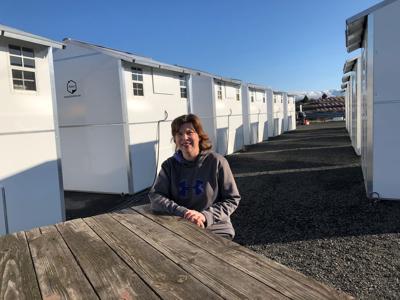
One recent development that will bring some relief to the neighborhood was the awarding last week of a $3.1 million grant to the Mid-Columbia Community Action Council. Part of the funding will keep open until June 2022 a pallet-home winter warming shelter on city-owned property in the port industrial area. (See related story on page 9.)
Services needed
Allen said the penalties proposed by the criminal justice system for the man who broke into her house were “financial or ridiculous,” such as “taking a class on why breaking into someone’s house is bad. He ate some sardines and drank a beer, is he going to give me $5? He needs drug rehab and mental health assistance, which our society is not set up to provide at this time.”
She feels ordinances are not in place to protect the general public, but rather to protect the homeless.
She feels like the city has a "too bad; deal with it" approach to their situation. “If you lived on this street with these circumstances, how would you feel about it?”
Allen calls police on the cars that stay for days in front of her house. It feels like being stalked, she said. It can take a number of calls about the same vehicle before something will be done.
Ashmore said it is not permissible to spend the night in a vehicle on city streets. But people do it all the time and the city generally doesn’t get complaints. If they do get a complaint, but the person isn’t “disturbing anybody and they’re not breaking any laws, the guys have too much to do” to bother people sleeping in their cars, he said.
“They’re parking there because it’s close to the services St. Vincent’s provides,” Ashmore said. “That’s the attraction. That’s the downfall of being in that neighborhood.”
Committee considers issue
The Dalles Mayor Rich Mays is acutely aware of the city’s homeless situation, and has convened a committee to look at it. He said what’s happening in the neighborhood by St. Vincent’s is “super unfortunate. If I lived in that neighborhood I’d be concerned as well.”
He said no city in Oregon or the Pacific Northwest has been “able to solve the problem, quote, unquote.”
Mays feels the state “ought to provide funding and facilities. I don’t feel we’re getting any help from the state at all. They closed mental health facilities years ago and nothing’s happened in the meantime to mitigate that.”
Asked if this issue fell within city purview, Mays said, “That’s the question of the century and I guess it depends on the community.” He feels efforts to address it are fragmented. He hopes the group he’s convened can bring some cohesion to it.
He’s included St. Vincent’s, the faith community, law enforcement, St. Vincent’s neighbors, housing officials, mental health experts, and Mid-Columbia Community Action Council, which has overseen the pallet homes since February.
Worsening situation
Robert Wells-Clark lives a little farther away from St. Vincent’s, but still faces the same problems as other neighbors. He’s called police countless times — he feels he knows all the dispatchers — but also often doesn’t bother.
Last summer, Wells-Clark was driving by St. Vincent’s and a man who was clearly mentally ill or on drugs lobbed what turned out to be a plastic hand grenade through his open car window. Wells-Clark didn’t bother calling police. He was just impressed the guy made the shot.
“I didn’t call that in, I was just done with it.”
In the eight years he’s lived in The Dalles, on a large lot with creek frontage and a little orchard, Wells-Clark has seen the homeless problem get increasingly worse, especially in the last two to three years.
In an interview last fall, before the pallet home project was established, Wells-Clark said, “It’s just progressively gotten worse as enforcement has gotten less. I feel it’s sort of pointless anymore. There’s almost always someone coming on our property on the creek. I would love to be able to go down there and have my daughter go down to the creek.”
He said when the pallet homes went in, it improved the situation “immensely.”
Once, a friend and her 4-year-old came to visit. They went to the creek and the boy found a pile of needles. “He’s like, ‘What are these?’ And I’m like, ‘Oh my God, don’t touch those! We’re leaving.’ And he was really upset we were leaving.”
He’s also seen the homeless light fires in summer by the creek at least four to five times. He’s called police, and one night watched from his window as an officer drove up and sat for five minutes in his patrol car, then left. He called dispatch back, who told him the officer didn’t see any fire. “Of course he didn’t see the fire if you don’t look at all.”
All of Wells-Clark’s efforts have come to naught. His trail cam got stolen. The garbage can he put out got flattened, its contents strewn. His No Trespassing sign was defaced with the words ‘F--- You.’
He and a neighbor take turns picking up trash by the creek. He gets four large bags of garbage and five to six syringes a week. “If those are the ones I’m finding, I’m really worried about someone going down there and getting stuck with a dirty needle. This is totally unacceptable to me. I really want the homeless people to have support and have services they need.”
But St. Vincent’s “doesn’t even provide a bathroom” after hours. He’s had to clean feces from his property multiple times.
He’s largely given up on calling things in, but did make an exception the time a man ran out and pounded on the hood of their car as they drove by.
Hands are tied
The Dalles City Councilor Darcy Long-Curtiss is an energetic advocate for the homeless. She worked to get them into motel rooms last year during the early months of the COVID-19 pandemic, and more recently helped the city to acquire the pallet homes with funding made available to address homeless issues during the pandemic.
The city made zoning exceptions and declared an emergency in order to put the pallet homes on city land by the public works department.
Long-Curtiss is a financial adviser by trade who has found herself in a new role: She lives on-site at the pallet shelter to oversee things.
She noted her comments represented her own opinion and she was not speaking as a city councilor or on behalf of Mid-Columbia Community Action Council, which now manages the pallet homes.
She said she has empathy both for the homeless and for the nearby homeowners of St. Vincent de Paul.
She said with a meal site like St. Vincent’s, it could be expected to have some people hanging out “who maybe haven’t had a shower for awhile. But the crime, the harassment, the breaking into the house, that’s not part of it.”
She feels the neighbors have gone “above and beyond, and when I hear them talk at those meetings, describe all the horrible things they’re putting up with, they are very compassionate and they want to help people. I agree what is happening to them is not OK.”
She said, “The police’s hands are tied. Even for the city, we don’t really talk about it, we just say, we don’t know what to do. But maybe we’ve got to talk about something longer to come up with a solution. You’ve got to put an emphasis on it, and it just hasn’t happened.”
She knows no one agency can address the situation, and that they’ll all have to work together.
Long-Curtiss sees no quick fixes. A lot of the people she works with are dealing with mental illness. She thinks the law needs to change. Years ago, more rights were given to those who have mental illness, because there were abuses in institutions, she said.
But now it’s hard to get anyone committed or put into a treatment facility. “They have lots of rights, which is great, except when they really aren’t capable of making good decisions. And the police don’t have a choice. Nobody is taking the responsibility for the people’s behavior and what’s the consequence? There’s almost no consequence.”
They can’t be forced into treatment. It can be offered — that’s if there’s even an available bed in a treatment facility, which is rare — but with a lot of mental illness, paranoia is a symptom, and they don’t trust what their therapist is recommending, Long-Curtiss said.
Long-Curtiss heard that when the pallet homes went in, the problems around St. Vincent’s got markedly better.
She said St. Vincent’s has a “wonderful program for caring for people in the community but the sheer amount of mental illness and even drug abuse is so dramatic all over, not just The Dalles.”
Lutgens said, “It appears that more folks are coming to realize that the problem is bigger than us feeding the homeless. If we want to avoid turning into Portland, we need a year-round place for folks with pallet homes, as well as an area for campers in tents, and recreational vehicles.
“It should have supervision, porta potties, and trash pickup and hold people accountable for their actions. Darcy has proven it will work this winter,” he said of Long-Curtiss. “Now let’s do it year-round,” he said, shortly before the announcement of the $3.1 million grant that would make that a reality.
Now that the pallet home project is indeed going to be year-round, Long-Curtiss believes it will continue to benefit the neighborhood around St. Vincent’s, but that it won’t solve all problems.
She said, “People who have food and a place to live don’t need to steal to take care of those basic human needs. Having fewer people hanging around St. Vincent de Paul will also have an immediate visual impact. This still leaves the segment of the population who need more intensive services because they are criminals or having mental health and/or drug abuse problems. However, case managers and police will be able to put more attention toward those people if they don’t have to spend time trespassing people for sleeping or parking in places they aren’t supposed to.”
Long-Curtiss said, “We will still need to actively address the problems the SVDP neighbors are having.
“I personally feel we need to be very proactive about this. Enough is enough, and it has been for quite awhile. Addiction and the need to fund it is one of the major reasons people break into people’s houses and steal stuff.
“When the can returns are closed and the source of money to buy drugs and alcohol is cut off, crime goes up. Hopefully the mayor and his new taskforce will be able to implement some of the existing ideas and come up with new ones regarding how to reduce loitering and criminal behavior. Change will only take place if someone steps up like I did and provides strong leadership.”


Commented