

(BINGHAMTON, NY) I’ve taught “The Odyssey” to college students for over a decade, including in a course on witches in Western culture. I suspect my students would immediately notice that the Circe in Christopher Nolan’s adaptation of “The Odyssey” is a departure from the one who appears in Homer’s ancient poem.
Homer’s Circe is an immortal goddess, desirable and beguiling. In classics scholar Emily Wilson’s 2017 translation of “The Odyssey,” she is described as “the lovely Circe with her braided hair.” She lives in a “beautiful tall house of polished stone” and “shining doors,” along with dozens of nymphs, fellow goddesses who serve her and her guests. When Odysseus arrives in Book 10, Circe and her household treat him with the highest standard of hospitality, giving him a bath, fresh clothes, and wine to drink from golden cups.
Then there’s Nolan’s Circe, played by Samantha Morton: She is less ancient goddess than fairy-tale witch, with a dirt-smudged face and an unkempt ponytail. Her hut is dark and dilapidated. She is alone. Inside, where a cauldron bubbles and a caged raven croaks, she offers Odysseus and his men a goopy stew, which they greedily devour. Then something strange happens. They begin to gag. Circe puts her hands to their faces, working their flesh like clay. Noses lengthen into snouts. Bellies swell and tails sprout. The men become pigs.
Some critics found the film’s Circe reductive for being portrayed as “a simple witch,” while others found her “almost poetic” for being “earthily human.” Morton, in an interview with The Times of London, spoke about Circe as “a survivor,” evoking women who speak out against abuse.
So, which is it? How faithful is the film’s Circe to the original poem? And what inspired Nolan – and Morton – to portray her this way?
Circe in Homer’s epic
In Homer’s poem, Circe plays a major role.
After taking Odysseus to her “dazzling bed,” she becomes Odysseus’ lover, hosting him and his men for an entire year. When Odysseus decides it is time to move on, she helps him prepare. She gives the crew instructions to reach the Underworld in Book 11 and to conjure the seer Tiresias, who prophesies how Odysseus will return home.
After this feat, Odysseus and his men return to Circe’s island in Book 12. It is Circe who reveals the famous choices Odysseus must make on the remainder of his journey: whether or not to hear the Sirens’ song, and whether to sail nearer to the whirlpool Charybdis or the six-headed monster Scylla. Circe reiterates Tiresias’ warning to avoid the sun god’s sacred cattle – to “remember home” so that Odysseus can “at last arrive in Ithaca.”

In the film, Circe appears only briefly. She doesn’t play hostess for a day, let alone a year. And though she tells Odysseus how to reach the Underworld, it is Tiresias – played by an unrecognizable Anthony Hopkins – who foretells Odysseus’ coming challenges, and Odysseus embarks without returning to Circe’s island.
In Nolan’s adaptation, Circe is simply another obstacle for Odysseus to overcome on his journey. She is more villain than lover, healer or seer. So it’s understandable that some viewers might come away from the film seeing her as “just a witch.”
Circe the feminist
But this version of Circe – angry, vindictive and, yes, witchy – didn’t appear out of thin air.
The film’s Circe defends her actions, telling Odysseus: “I didn’t turn your men into anything – this is who they are! They have raped and pillaged across the world, you think that’s against their nature?”
It’s a fair point. Odysseus’ men have set fire to Troy, blinded the Cyclops and raided the island of the Laestrygonians, repeatedly choosing their own interests over the virtue of xenia, or hospitality, that the film stresses is central to Greek culture.
In her condemnation of Odysseus’ men, I see the tradition of feminist retellings of “The Odyssey,” where Circe serves as a symbol of resistance to the patriarchal values represented – even if ambivalently – in Homer’s poem.
Scottish poet Carol Ann Duffy’s 1999 collection “The World’s Wife” contains her poem “Circe.” Much like Margaret Atwood’s 2005 novel “The Penelopiad,” which reimagines “The Odyssey” from Penelope’s perspective, “Circe” views the events of Book 10 from Circe’s point of view.
Circe, the poem’s speaker, instructs the nymphs in a recipe for cooking pork. Her references to ingredients – parts of the butchered pig – assume double meanings as readers recall that these pigs were once men:
  Lay two pig's cheeks, with the tongue,
  in a dish, and strew it well over with salt
  and cloves. Remember the skills of the tongue –
  to lick, to lap, to loosen, lubricate, to lie
  in the soft pouch of the face ...
In the comic, familiar vein of this poem, this Circe is jaded. She has loved and lost. She has encountered betrayal and, she suggests, abuse. Addressing a feminine audience that presumably shares her experience, she remembers a time when she was “younger” and “hoping for men.” Now, she turns the traditionally feminine work of cooking into a refuge – and a weapon. Circe shows her nymphs precisely what men are good for.
“Season with mace,” she says, referring at once to a spice and to a self-defense weapon. The poem is funny, but it also makes the reader think differently about the witch.
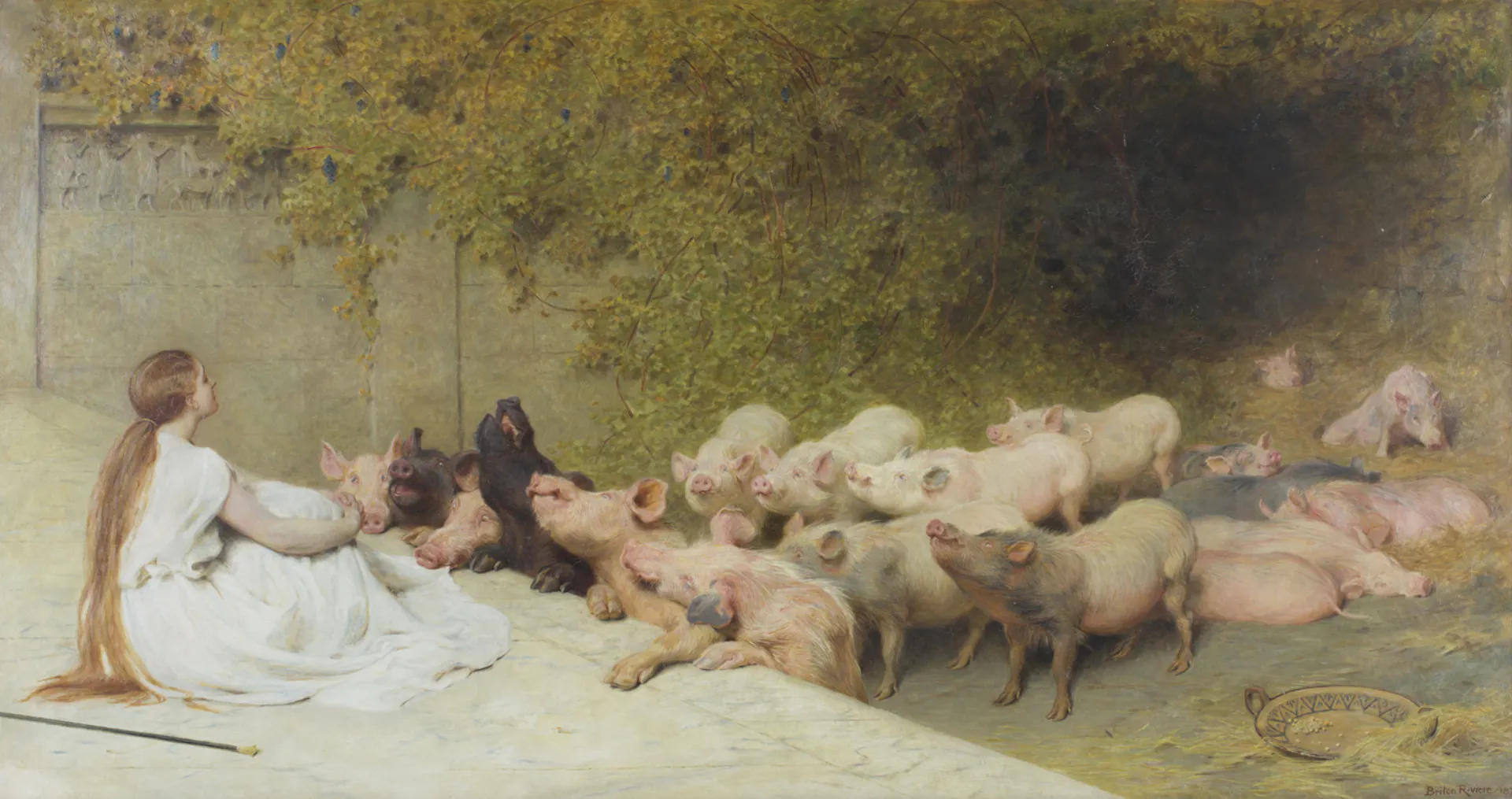
In Nolan’s “Odyssey,” when Circe returns Odysseus’ men to their human form, she whispers, “Back into your disguises.” The line could be dismissed as the babbling of a crazy old crone. But viewed alongside Duffy’s poem, it could also be taken seriously as a moral judgment: these men are guided by their grossest, most insatiable appetites. This Circe is unhinged because of what she knows. She is a witch, yes. But she also speaks the truth.
Madeline Miller, in her bestselling 2018 novel “Circe,” also reclaims the witch as a figure of empowerment. Her Circe initially welcomes ships to her island. In a chilling scene, a sailor asks, “Mistress? When will your husband be home? We would toast such fine hospitality.” When Circe replies, “If you would thank your host, thank me. This house is mine alone,” the men assault her.
Claiming her treasures for themselves, they fall asleep drunk on her wine. Circe regains consciousness, turns the men into pigs, and resolves to do the same with future visitors. When Miller’s Circe tells Odysseus, “You must understand that your men would have robbed me blind,” readers, like the hero, recognize her magic as her means to assert ownership of her body, to manifest her will in a hostile world.
A witch for a reason
The Circe of Nolan’s “Odyssey” indicts Odysseus and his men: their version of masculinity, their violence and their entitlement. Odysseus arrives at the same conclusion – that he, too, is a pig, and not a man; that he has stolen too much from others’ tables, violated the sanctity of their homes and desecrated their gods.
This depiction of Circe is integral to Nolan’s apocalyptic narrative.
As many, including Emily Wilson, have pointed out, Nolan goes to great lengths to portray the Trojan War as a moral failure of the Greeks. Characters in the film hint at the looming collapse of Bronze Age Greek civilization, the scattering of its people and the disappearance of writing, linking the Greeks’ campaign of conquest and plunder to the eventual destruction of the world they inhabit. What comes next ultimately vindicates Circe’s condemnation of the sailors.
This Circe may not look much like the lovely goddess of the poem, and her role may be limited to the metamorphosis of men into pigs. But she makes a point that resonates with past feminist appropriations of this compelling character in a visceral way that moviegoers won’t forget.
This article is republished from The Conversation, a nonprofit, independent news organization bringing you facts and trustworthy analysis to help you make sense of our complex world. It was written by: Bailey Sincox, Binghamton University, State University of New York
Read more:
Bailey Sincox does not work for, consult, own shares in or receive funding from any company or organization that would benefit from this article, and has disclosed no relevant affiliations beyond their academic appointment.




Commented