

Over several decades, I have sold hundreds upon hundreds of items, from a Plymouth Fury III station wagon to a red plastic beer cup I listed on eBay as the Holy Grail.
Had I been just an average hoarder, my possessions should have been reduced by now to a loincloth, a pair of sandals and a toothbrush. Instead, I offset my exiting items with yet more things dragged home from swap meets (often six a weekend), yard sales, estate sales, pawn shops, classified ads and online marketplaces.
I’ve slowed tremendously on collecting in recent decades. Marriage can provide quite the incentive to clear a pathway through your home, but I still own such a whopping accretion of things that the garage could only be safely traversed by a mountain goat. It’s a hopeless logjam of possessions, several of which have been featured in museums, while others should be in a landfill.
I’ve recently realized it isn’t merely stuff: It is a physical manifestation of my overstuffed brain, wherein resides a heap of unfinished projects, deadlines, failures, forgotten dreams, fuzzy memories and short-lived triumphs.
Lacking the trepanning tool needed to empty my mind, I’ve upped the efforts to purge the possessions, and started keeping track of the advantages and means of ridding yourself of clutter.
6 reasons to sell stuff
- It’s nice to be able to see your floor once in a while.
- It’s a good exercise for your mind and spirit to weigh what really matters to you, possession-wise, and to determine what you might feel freer without.
- You get money! Sell enough stuff and when flying cars finally come on the market, you’ll be ready to buy.
- Clearing out the dross can give you space to organize the things you keep so they enrich rather than frustrate your life.
- If you change residences, the people who help you move won’t hate you as much.
- Shedding possessions can also be a kindness to the loved ones who survive you. If you’ve waded through the estates of relatives and friends, you know what a sad and trying experience it can be. And you don’t want to exit this world leaving your progeny to wonder, “Why did granddad leave us these bags of old underpants? Did he think the elastic would grow back?”
What to know about stuff
To determine how, or if, you’ll sell an item, you’ll want some idea of its worth. Even if you once knew the value of your possessions, things change. That ’60 Beatles 78 RPM 10” record from India you bought for $30 in 1975 can sell for $1,500 now, while compact discs you paid $17 for in 1988 might sell for 50 cents now.
Some things can surprise you. My wife and I inherited a 4.5-inch metal bust of early 20th-century socialist Eugene Debs. We assumed it wasn’t anything special, since the same relative had also left us his VHS adult-film collection and 18 pounds of lead fishing weights. A few minutes of poking around the Internet, however, revealed that an identical bust of Mr. Debs’ head recently sold for $603 on eBay.
That statuette had Debs’ and the sculptor’s name engraved on it, so tracking its value down wasn’t hard. But what if you’re scrapping an early 1950s’ turntable for parts and its potentially valuable tonearm has no identifying marks?
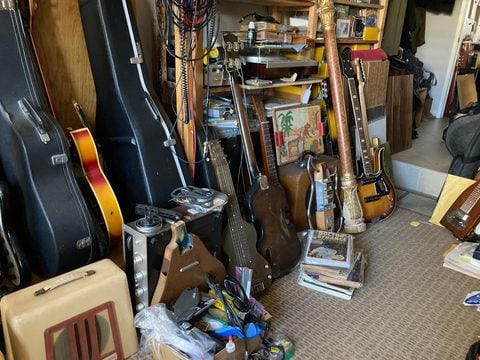
A cross-section of the author's hoard.
A decade ago, the internet made it possible to wear your eyes to a bleary nub by searching online through hundreds of turntable photos from the 1950s before finding its match. Today you only need to drag a photo of your object onto a free image recognition service such as Google Lens. It will likely find matches for your mystery item in seconds.
Once you have a good idea of what you’re selling, determining its value helps you decide how you’ll sell it.
My preferred go-to indicator of what things are worth is eBay, and it costs nothing to find out. I don’t recommend relying on the sellers’ asking prices; they mostly reflect the human capacity for optimism. Instead, refine your search by scrolling the “Sold Items” option listed on the left column of the eBay screen. Voila! You’ll see what people have actually paid for the thing.
Actually selling stuff
I have sold a nutty range of objects over the years, including wooden shoes, a used condom vending (with graffiti) and a medical school’s human skeleton in a wooden crate, to which I couldn’t resist affixing a Dymo label reading “The Complete Elvis Presley.”
Music has been the center of my life since I started buying records when I was 8. Thousands of records and hundreds of guitars and music books later, I still own some 130 times my weight in stuff (not counting furniture, car and appliances) That’s an awful lot of ME to be dragging around, and it gets my wife wondering if this house wouldn’t be better minus 131 times that weight.
Human-to-human transactions
Yard sales can be great, one reason being you don’t have to schlep your mounds of stuff past your driveway.
A modicum of prep is needed, though. Research and price the items you’re putting out. Have lots of change on hand. Avail yourself of the free advertising on Craigslist, NextDoor, Facebook Marketplace and such, along with putting a lot of signs up in your neighborhood, with helpful arrows and your address writ legible and large. Colorful posterboard can be had cheap at dollar stores. It’s also a good idea to have a sign at the front of your property. Otherwise, passersby might assume the junk strewn on the lawn is just your lifestyle.
Saturdays are best for holding a sale. Carrying over to Sunday is rarely worth the bother. Ending on a Saturday afternoon, you can haul unsold items to a thrift store. Or you could abandon your obsolete TV or dog-chewed couch at the curb with a “Free” sign on it. Cynical Jim has found this to be true: If no one’s carted off your stuff after a night or two, replace the “Free” sign with one reading “$20.” Someone will be only too glad to steal it.
The other place for parting with things face-to-face and under the sky is the swap meet. (“Flea market” is the more common term on the East Coast.)
Southern California used to abound in swap meets, in part because there were so many drive-in theaters to host them. They’re more common now in community college parking lots, but not so common that there are a lot of spaces for occasional sellers like us.
Once upon a time, it was possible to find a grime-covered Gibson Firebird guitar for $8, or a live goat for $20. It’s mostly the same vendors every week now, hawking new sunglasses, t-shirts or the old TV set you abandoned on your curb. There are still a few fun swap meets — two in Southern California are the weekly Goldenwest College swap and the monthly Long Beach Antique Market held at Veteran’s Stadium. If you can reserve a spot at either of those, you might do well.
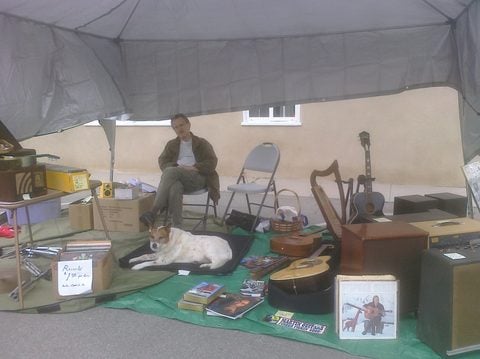
The author (and Nikita) hawking wares at a swap meet.
With today’s wavering economy, inflation, wars, disasters and such, it’s hard to predict whether anything will sell. I recently held a yard sale with a lot of musical instruments, both affordable ones and rarities. If I’d been buying rather than selling, I’d have cleared the place out. As it was, I sold just one rare item, a 1940s’ Fender triple-neck console steel guitar. I’d priced it at the low end of the fair market price, but a 19-year-old kid wanted it so much that when his dad offered me $200 below my asking price, I accepted it. Then the dad pulled up his $400,000 Lamborghini to haul it away. Isn’t commerce fun?
Depending on what you have for sale, you might look into buying a booth at specialized sales events that travel from city to city, such as gem shows, guitar shows and gun shows.
It’s hard to predict their success, and some guitar shows have worn out their welcome: A seller can pay $500 for a small booth, only to find buyers aren’t coming through the door because it’s not fun to spend $40 ($25 admission, $15 parking) for the privilege of looking at rare guitars only Joe Bonamassa can afford. Smaller, more localized shows — such as ones for rare records, old hi-fi gear or vintage clothing — can be more fun and worthwhile.
The world of e-commerce
I signed onto eBay 27 years ago. I have since bought a glut of stuff, of course, but also sold hundreds and hundreds of things, from a record album worth $40 that went for 25 cents, to a 1948 D’Angelico archtop guitar that sold for $8,000 (I sold it for a friend, sadly).
In those bygone days, eBay’s listing fees were tiered to the amount of the opening bid you set. I started my auctions at 25 cents, counting on the free market to raise the bids to their proper place. Several rare items, like the $40 album, selling for candy bar prices disabused me of that notion. Since then, I set my initial bid price at the lowest amount I’d be willing to settle for without throwing up.
EBay gives you the option to set an invisible reserve price on your auction, which means you can start at a low bid to snare bidders, who then can’t win unless they jack their bid above the hidden reserve.
That seems sneaky to me, so I never used it. Which brings me to the most important thing to know while you’re selling your stuff: Do unto others as you would have them do unto you. I try to abide by that, because I think more people than not agree that kindness rocks. So you describe the item as accurately as you can, price it at an amount that would have appealed to you in your rabid collector days, and don’t try to hard-sell your potential customers.
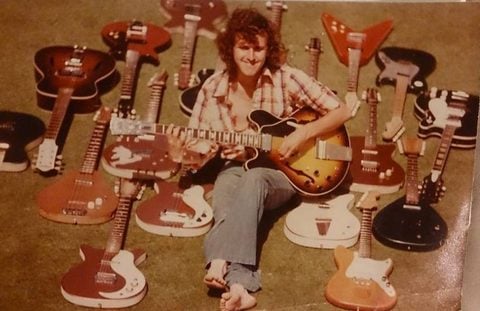
The author in the 1970s, with a lawnful of guitars.
When I sell on eBay these days, it’s often items rare and obscure enough that eBay’s global presence might result in two aspiring oligarchs driving the price through the roof. EBay likes getting some of that money. The percentage they take can vary depending on what’s being sold. For example, when the musical instrument-based Reverb site came along, eBay dropped the percentage it takes on musical instrument sales to stay competitive.
For selling instruments and records at fixed prices, Reverb and Discogs, respectively, can do well for you. Poke around online enough and you’ll likely find similar sites devoted to bubble gum cards, Edsels, Victorian corsets and everything else under the sun.
My favorite selling place in recent years is Facebook Marketplace. It costs nothing to list or sell items there. You can post as much info and images as needed, and you can sell your items either locally or internationally, though you’ll need to figure out packing and shipping for the latter.
Selling locally, you can meet the buyer at anyplace from your home to a McDonald’s parking lot with security cameras. And because your potential buyers are Facebook members, you can check out their profiles to decide how safe you'll feel when you meet them. I’ve wound up becoming friends with some of my buyers.
Shipping stuff carries its own concerns. I don’t even want to think about tariffs and the other record-keeping bother that accompanies selling internationally these days. You will also find yourself using more packing tape than you have in a lifetime of holiday seasons. And boxes? See below.
Think outside the box about boxes
Has your life partner invited an unfettered flow of Amazon packages into your house? Encourage this, because you’ll want to reuse those boxes if you’re selling and shipping much online. It’s a costly bummer to have to buy boxes, so I’ve found myself obsessing over my cache of free boxes nearly as much as I do the things I’m shipping in them.
Do boxes matter? I once bought a fragile archtop guitar from a guy in Russia. It arrived six weeks later, in impossibly good condition considering it had travelled around the world in a burlap potato sack.
Such miracles do happen. More often than not the USPS and major shipping companies do a competent job. But pack the boxes yourself as securely as possible, and consider buying insurance, because the more you ship the more inevitable it becomes that a package will arrive looking like it had been delivered by catapult.
You can’t count on the Amazon Fairy to bring every box you’re going to need. You can buy a limited range of box sizes at Home Depot for reasonable prices, and less reasonable prices at Staples. If you’re desperate, you can find just about any size box in the massive Uline catalog (https://www.uline.com/), but the cost isn’t fun. Uline’s least expensive LP record mailer, for example, is $1.37, with a minimum order of 100, plus shipping — and plus tax if you don’t have a resale license. Uline guitar boxes are $11.67 each, with a minimum order of five. You can buy 250 or more for $10.20 apiece, if you don’t mind the neighbors wondering why you bought enough boxes to build a corrugated cardboard duplex.
There are ways to get free boxes, if you don’t mind dumpster diving. To ship guitars or things of similar size, try checking out a Guitar Center dumpster bay to figure out what days and approximate times they discard their instrument boxes. (Or ask an employee, but they’re usually bored enough to mislead you just for laughs.) You can often haul away five or more boxes, usually with the packing material in them. For larger boxes, ask at appliance stores.
Lacking megastores, local mom-and-pop shops can be helpful, either giving you their discards or charging some nominal amount that helps them stay in business. For packing materials, I find the $1 pool noodles at dollar stores can protect items well and are far less infuriating to use than foam peanuts.
I hate to end this on a sad note, but there’s a price to be paid for hoarding esoteric things. One of the hoards I’m selling is hundreds of 16-inch, 16-RPM records, once used by radio networks and Armed Forces Radio to broadcast operas, dramas, country jamborees and other lengthy programs. No one makes shipping boxes for 16” records, but I’ve found 18” pizza boxes do the job.
That’s a lot of pizza, and guess who can’t digest wheat or cheese?
(Photos courtesy of the author.)
The article Tips on Selling Stuff from a Guy Who's Sold a Lot of Stuff originally appeared on NerdWallet.


Commented
Sorry, there are no recent results for popular commented articles.