Isodapedon Varzealis. A Òparrot-beakedÓ reptile that lived alongside dinosaurs in Brazil 230 million years ago may have had relatives in Scotland, say scientists. The fossilised skull of the newly discovered species with a Òparrot-like beakÓ was unearthed by palaeontologists in southern Brazil in 2020. But it may be related to an ancient reptile previously found in Scotland, according to a study published in the journal Royal Society Open Science. Based on the size of the skull, scientists say the individual is estimated to have measured between 1.2 and 1.5 metres (3.9ft to 4.9ft) in length. Scientists say the remains were found within the Quarta ColÂnia UNESCO Global Geopark which has already yielded some of the oldest dinosaurs in the world.
Isodapedon Varzealis. A Òparrot-beakedÓ reptile that lived alongside dinosaurs in Brazil 230 million years ago may have had relatives in Scotland, say scientists. The fossilised skull of the newly discovered species with a Òparrot-like beakÓ was unearthed by palaeontologists in southern Brazil in 2020. But it may be related to an ancient reptile previously found in Scotland, according to a study published in the journal Royal Society Open Science. Based on the size of the skull, scientists say the individual is estimated to have measured between 1.2 and 1.5 metres (3.9ft to 4.9ft) in length. Scientists say the remains were found within the Quarta ColÂnia UNESCO Global Geopark which has already yielded some of the oldest dinosaurs in the world.
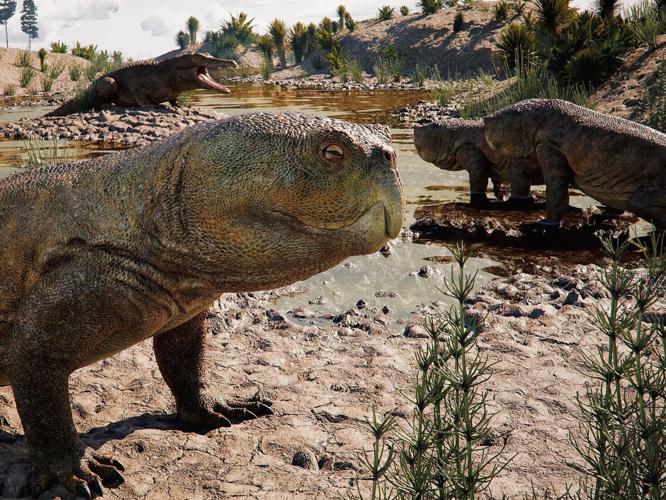
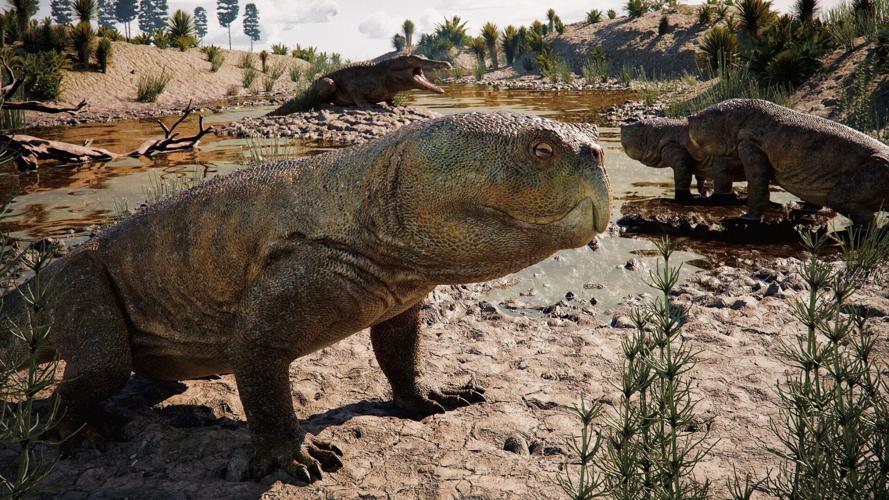
Isodapedon Varzealis in a landscape 230 million years ago. (Caio Fantini via SWNS)
By Talker
By Stephen Beech
A "parrot-beaked" reptile that lived alongside dinosaurs in Brazil 230 million years ago may have had relatives in Scotland, say scientists.
The fossilized skull of the newly discovered species with a "parrot-like beak" was unearthed by paleontologists in southern Brazil in 2020.
But it may be related to an ancient reptile previously found in Scotland, according to a study published in the journal Royal Society Open Science.
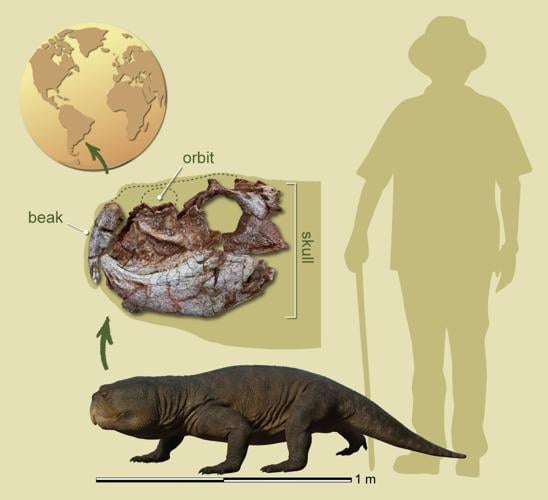
Based on the size of the skull, scientists say the individual is estimated to have measured between 1.2 and 1.5 meters (3.9ft to 4.9ft) in length.
Scientists say the remains were found within the Quarta Colônia UNESCO Global Geopark which has already yielded some of the oldest dinosaurs in the world.
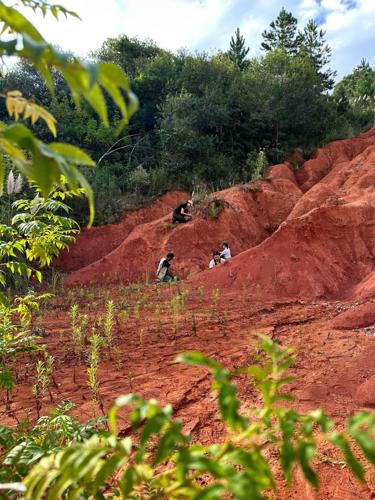
Prospecting at the fossil site. (Rodrigo Temp Müller via SWNS)
By Talker
Among the most abundant fossils in that region are rhynchosaurs.
They are four-legged herbivorous reptiles characterized by the presence of a pointed beak and a unique chewing apparatus, composed of multiple rows of small teeth used to crush and process plant material.
Researchers from the Federal University of Santa Maria (UFSM) say the new rhynchosaur, named Isodapedon varzealis, shares characteristics with a species previously discovered in Scotland.
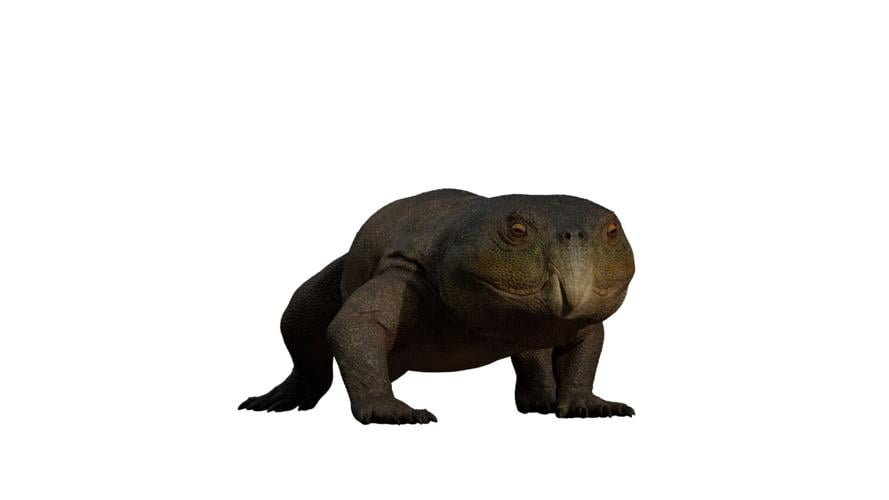
Study supervisor Rodrigo Temp Müller, of UFSM, said: "Its skull, broad and triangular in shape, had a pointed beak resembling that of parrots.
"This beak may have aided both in cutting vegetation and in digging into the soil in search of roots and tubers.
"The fossil skull of Isodapedon varzealis was excavated at a site located in the municipality of Agudo in 2020.
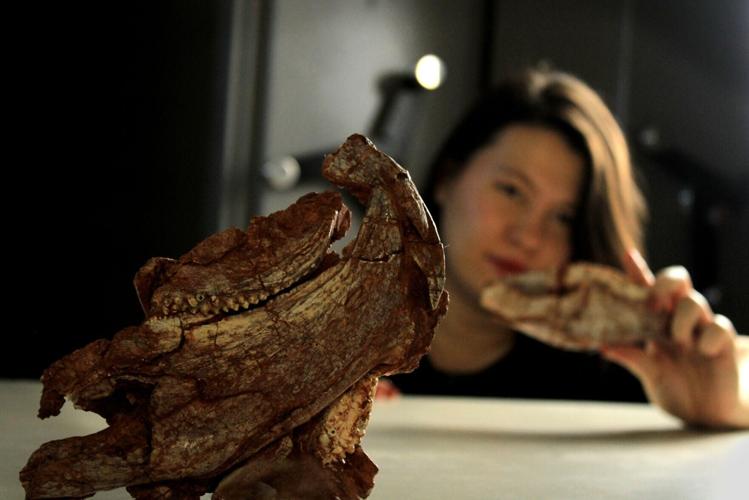
"The material was subsequently carefully prepared in the laboratory of the Palaeontological Research Centre of UFSM through a process aimed at removing the rock surrounding the fossil.
"Because the specimen is fragile, delicate tools such as scalpels and needles were used.
"After the sediment was removed, the anatomical features could be analysed in detail.
He says the research team identified "unusual" features compared to rhynchosaurs known from those rock layers, indicating that it represents a previously unknown species.
They are four-legged herbivorous reptiles characterized by the presence of a pointed beak and a unique chewing apparatus. (Mauricio Garcia via SWNS)
By Talker
Müller said: "The fossil material assigned to this species includes a partial skull, in which the maxillae and mandibles stand out due to their uncommon morphology.
"In rhynchosaurs, the maxillary teeth are arranged in two or more 'tooth plates' separated by a groove, typically forming strongly asymmetrical portions.
"In the new species, however, the two plates display more symmetrical proportions."
He explained that the new species was named Isodapedon varzealis as "Isodapedon" means "equal tooth plates," in reference to the observed symmetry, while "varzealis" alludes to the locality where the fossil was found, in Agudo, in the region known as Várzea do Agudo.
Müller said: "At the time when Isodapedon varzealis lived, around 230 million years ago, the species acted as a primary consumer within its ecosystem.
"It was likely preyed upon by larger reptiles, including forms related to the ancestors of crocodiles, as well as early dinosaurs.
"Since only a single skull of the species has been recorded so far, its maximum size remains uncertain.
"However, comparisons with other rhynchosaurs suggest that it could have reached up to about three metres in length, making it a considerably more challenging prey for most carnivores inhabiting the site where the new species was found."
He says an analysis of the evolutionary relationships of the new species indicated that it has "strong affinities" with Hyperodapedon gordoni, from Scotland.
Müller said: This relationship, which may at first seem unusual, is not so unlikely.
Isodapedon Varzealis fossil. (Rodrigo Temp Müller via SWNS)
By Talker
"In fact, another species from the same fossil site as Isodapedon varzealis, the precursor of crocodiles Dynamosuchus collisensis, also has a close relative recorded in rocks from Scotland.
"This distribution can be explained by the fact that, around 230 million years ago, during the Triassic Period, the continents were joined together, forming Pangaea.
"This configuration allowed faunas from different regions of the planet to disperse across vast areas of the supercontinent.
"In this way, the new species reinforces the idea that Triassic faunas of South America shared similar components with those of Europe at the same time."
Isodapedon varzealis brings the total number of known rhynchosaur species from the Brazilian Triassic to six.
But Müller explained that the six species didn't all coexist, as some lived at different times, separated by millions of years.
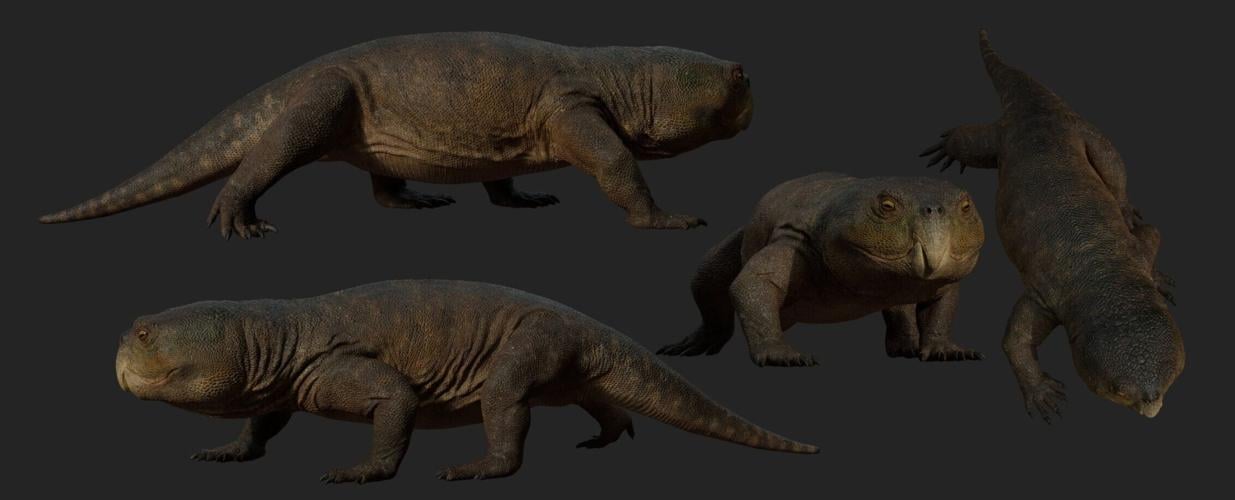
Digital illustration of a Isodapedon Varzealis. (Caio Fantini via SWNS)
By Talker
He said: "Even so, the new species comes from layers in which three others have already been recorded, indicating that the group reached a peak of diversity during a period marked by the emergence and diversification of other groups, such as dinosaurs.
"This coexistence of multiple rhynchosaur species may be explained by the adoption of different feeding strategies.
"It is possible that each species specialized in consuming distinct types of vegetation, which could help explain the variations in their chewing."
Müller added: "This scenario reinforces the importance of rhynchosaurs as primary consumers in ecosystems that witnessed the origin and early diversification of dinosaurs."
The fossilized skull is now housed in UFSM's scientific collection.



Commented
Sorry, there are no recent results for popular commented articles.