The Iran War has caused prices at the pump to surge across the country. Relief may be far off.
OREGON — Gas prices across the country have soared since the United States and Israel attacked Iran on Feb. 28, with Oregon’s statewide cost per gallon shooting to an average of $5.00 a gallon on April 7, up from $3.92. The national average was $4.14.
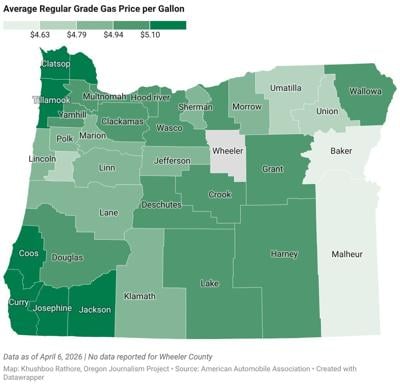
Oregon’s highest prices are found in Curry County, according to AAA, with an average price of $5.27 per gallon on April 6. The lowest are in Malheur County, at $4.50 per gallon.
Even if the Iran War ends tomorrow, prices won’t quickly drop to prewar levels, says AAA Oregon/Idaho spokeswoman Marie Dodds.
Oil prices depend on a complex global infrastructure, transporting crude oil and refined products, such as gasoline, through the Strait of Hormuz, now under the control of Iran’s attack drones and network of sea mines. Scores of refineries across Iran and neighboring countries have been bombed and damaged in the past five weeks.
“Rebuilding that, as we all know, can take a lot of time,” Dodds says.
Historically, gas prices have soared during geopolitical conflicts, including the Russian attacks on Ukraine in 2022, the Arab Spring in 2012, and the 1979 Iran hostage crisis.
Gas stations set their prices independently, but rely on factors such as wholesale costs, local competition, customer income levels, and profit margins, Dodds says.
Some retailers in Oregon are small, family-owned franchises. They have to take the price assigned to them and may add a small margin, says Oregon Fuels Association lobbyist Mike Freese.
“Sometimes they aren’t able to price it where they make much with any margin, and then other times they’re trying to catch up without hurting themselves too much,” Freese says.
Oregon has the fifth-highest gas prices in the country. That’s due to several factors: It’s the only West Coast state without an oil refinery; cargos that unload at the state’s main terminals in Portland must bear the expense of traveling up the Columbia River, and Oregon has mirrored California’s clean-air policies. Freese says the impact of the state’s Clean Fuels Program, for instance, adds about 26 cents to the price of a gallon of gas.
Oregon’s highest gas prices can be found in its northwestern and southwestern counties on the borders of Washington and California, where gas prices outstrip Oregon’s.
In Curry County, customers often buy just a few gallons then head elsewhere for cheaper gas. “So we just keep losing business,” says one employee at a Curry County Chevron. “They bitch about the prices.”
•••
This story was produced by the Oregon Journalism Project (oregonjournalismproject.org), a nonprofit investigative newsroom for the state of Oregon.



Commented