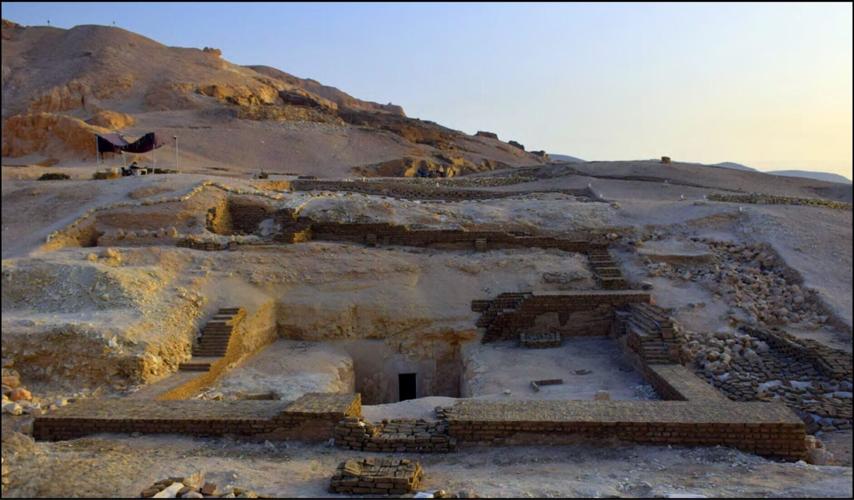
Exterior view of the superstructure of TT 209. The protective covering and visual homogenization of its walls were completed at the end of the 2026 season. (José Miguel Barrios Mufrege via SWNS)
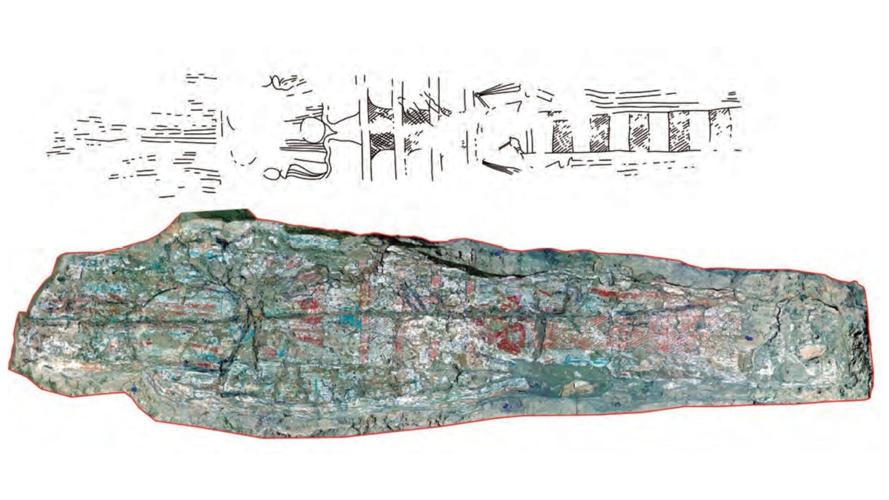
Preserved painted decoration showing an Osirian djed pillar on the outer side of the floorboard of the outer box of Coffin 3. (Jared Carballo-Pérez via SWNS)
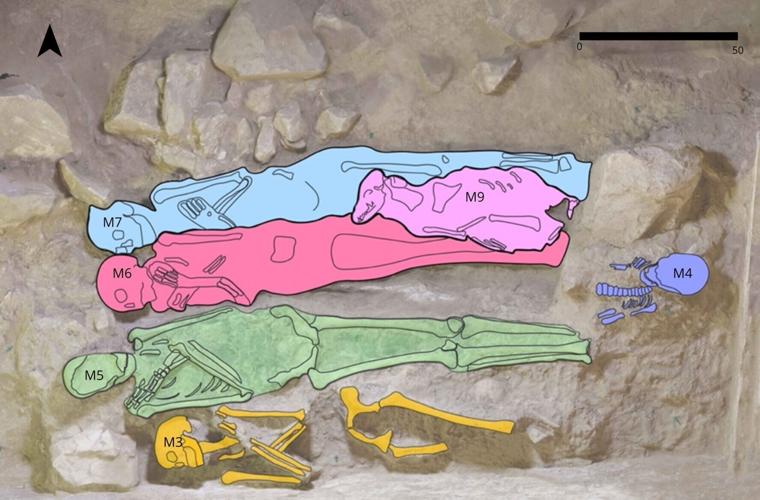
Detail of superposition and spatial relationships between individuals in SC3 (TT 209). The figure shows the relative position of several individuals, highlighting direct vertical contacts and partial overlaps between bodies. M6 and M7 are closely superimposed, with the canid (M9) placed over their lower limbs. (Jared Carballo-Pérez via SWNS)
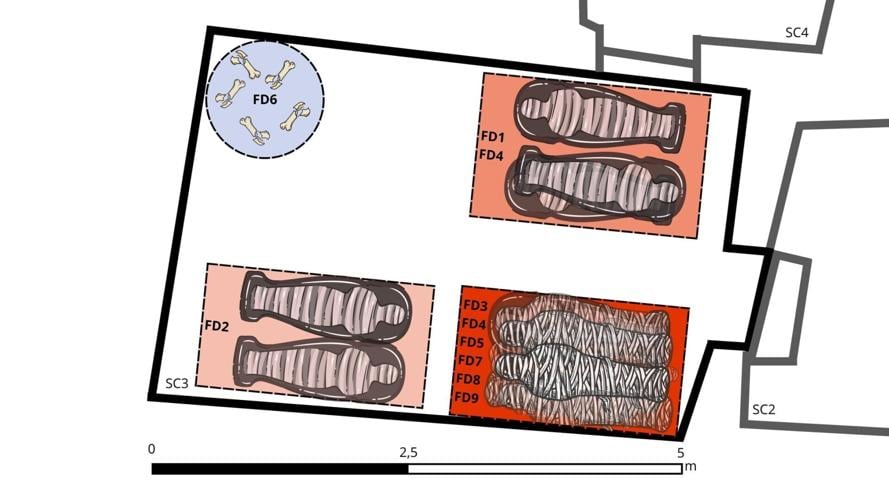
Schematic plan of SC3 in TT 209 showing the approximate spatial distribution of funerary deposits (FD). Early deposits (FD1ÂFD2) are located in the eastern/northeastern and southwestern sectors and display relatively discrete spatial organization. Subsequent and later deposits (FD3ÂFD9) are mainly concentrated in the southeastern sector. The dashed outlines indicate approximate depositional areas, while the schematic representations of mummified bodies reflect their general orientation and spatial relationships rather than exact anatomical positions. The circular area (FD6) corresponds to a secondary assemblage of disarticulated, thermally altered remains. (Jared Carballo-Pérez via SWNS)
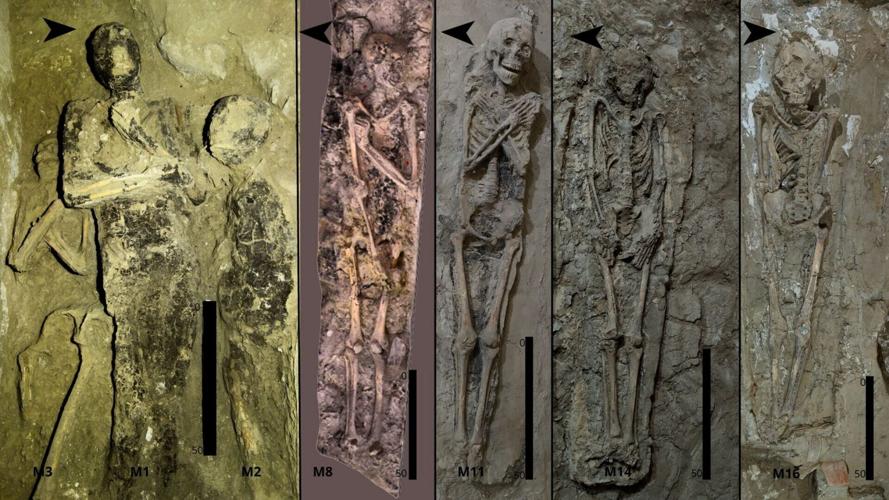
Mummified individuals from Side Chamber 3 of Theban Tomb 209, showing variation in body orientation and arm position. (Jared Carballo-Pérez via SWNS)
By Talker
By Stephen Beech
Mummies were buried on top of one another when space started to run out in ancient Egyptian tombs, reveals new research.
People of high social standing were also buried with their pets, suggests the study.
The in-depth analysis of part of the Theban Necropolis, comprising more than 400 tombs, shows how burial trends changed over hundreds of years.
Researchers in Spain examined a part of one of the tombs, opposite Luxor, more closely to reconstruct how the burial space was used and reused between its construction during the 25th Dynasty (754-656 B.C.) and the Ptolemaic period (305-30 B.C.), when it was abandoned.
Exterior view of the superstructure of TT 209. The protective covering and visual homogenization of its walls were completed at the end of the 2026 season. (José Miguel Barrios Mufrege via SWNS)
By Talker
Study first author Jared Carballo-Pérez, from the University of La Laguna in the Canary Islands, said: "We found a total of 16 mummified human individuals, a mummified dog, and a disturbed deposit containing the remains of at least four individuals.
"The detailed study of the bodies indicates neither chaotic accumulation nor a loss of the original ritual over time.
"Rather, there was a spatial logic in which each new deposition was adapted to the presence of previous bodies — a kind of funerary memory in the processes of reuse."
Senior author Miguel Ángel Molinero Polo, also from the University of La Laguna, said: "We have few details regarding how the people who entered tombs behaved, what their motivations were in each historical period, and how they conceptually reconfigured the pre-existing space."
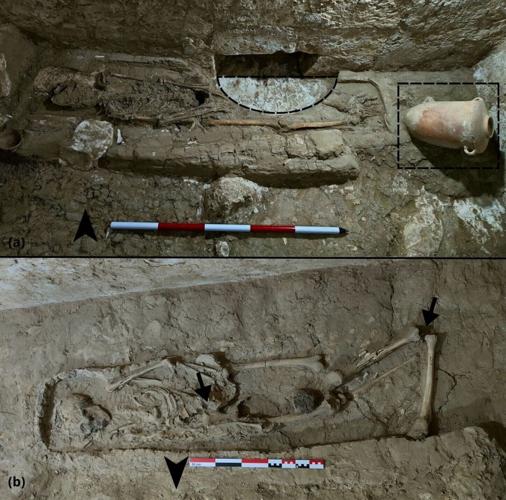
Evidence of disturbance and displacement affecting two mummified individuals in side Chamber 3. (Jared Carballo-Pérez via SWNS)
By Talker
To deepen understanding of the deposition of bodies and the transformation of funerary space, the team excavated the chamber, photographed the mummies, and produced sketches and descriptions of their position, orientation and relationship with the tomb's structures.
The chamber contains nine funerary deposits, comprising individual and multiple burials, as well as associated funerary objects.
For the earliest deposits, the team observed relatively separated burials where bodies were placed in coffins.
Molinero Polo said: "The earliest individuals buried here appear to have been of high social standing, as they were interred in coffins, with funerary nets and amulets, and with an assemblage containing costly items, such as the contents held in Phoenician amphorae, a large number of which were found alongside them."
Later, toward the end of the 25th dynasty and the Persian period (about 680-404 B.C.), bodies started being inserted into any space still available.
Preserved painted decoration showing an Osirian djed pillar on the outer side of the floorboard of the outer box of Coffin 3. (Jared Carballo-Pérez via SWNS)
By Talker
In some cases, a change could be seen in the positioning of limbs, for example a folded-in arm whereas in earlier burials arms were typically stretched out.
Also in the Persian period, the team observed a shift from individual deposits to a vertical way of arranging bodies.
Superposition of bodies was found in two-thirds of the burials in the chamber, according to the findings published in the journal Frontiers in Environmental Archaeology.
In the southeastern section of the chamber, Molinero Polo says four mummies and one mummified dog were buried on top of one another in the Ptolemaic Period.
Detail of superposition and spatial relationships between individuals in SC3 (TT 209). The figure shows the relative position of several individuals, highlighting direct vertical contacts and partial overlaps between bodies. M6 and M7 are closely superimposed, with the canid (M9) placed over their lower limbs. (Jared Carballo-Pérez via SWNS)
Molinero Polo said: "The bodies buried in vertical superposition did not have coffins but were carefully mummified.
"They also can be associated with upright jars that point to a specific ritual not found in the earlier phases of the tomb's use."
Carballo-Pérez said: "One detail I find quite beautiful is the presence of a mummified dog placed directly on top of the mummies of a man and a woman.
"This could indicate a close relationship between these human individuals and the animal, an idea that I think is quite easy to empathize with."
Molinero Polo said: "It could also reflect a further change in ritual practice, with an animal taking on the role of a psychopomp, a symbolic helper in the journey to the afterlife."
Schematic plan of SC3 in TT 209 showing the approximate spatial distribution of funerary deposits (FD). Early deposits (FD1ÂFD2) are located in the eastern/northeastern and southwestern sectors and display relatively discrete spatial organization. Subsequent and later deposits (FD3ÂFD9) are mainly concentrated in the southeastern sector. The dashed outlines indicate approximate depositional areas, while the schematic representations of mummified bodies reflect their general orientation and spatial relationships rather than exact anatomical positions. The circular area (FD6) corresponds to a secondary assemblage of disarticulated, thermally altered remains. (Jared Carballo-Pérez via SWNS)
By Talker
He said that, alongside certain changes in the arrangement of bodies — for example, in later deposits individuals were buried with both arms folded over their chests in what Egyptologists call the "Osirian position" — suggests that the tomb did not become disordered or without structure, or that cultural rites were lost.
Instead, he says the chamber should be considered a repeatedly reactivated space, reconfigured by new burials that transformed the organization and meaning of space itself without erasing the past.
In some funerary deposits, Carballo-Pérez said it is difficult to identify the exact sequence of depositions and reconstruct the precise intentionality behind them.
He says that is due to century-long use during which the chamber flooded multiple times as well as fires and human re-entry that transported debris within the tomb.
Carballo-Pérez added: "Nevertheless, what we present means that deposits that were previously considered 'disordered' can be reinterpreted.
"This helps us develop a better understanding of the social behaviors behind funerary practices."



Commented