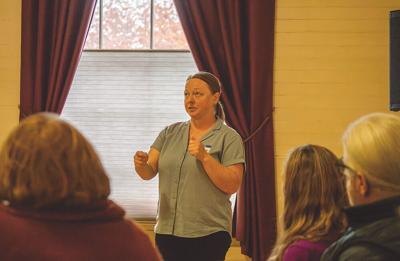
Jennifer Pauletto, the executive director of Washington Gorge Action Programs, tells a story about domestic violence and houselessness on Nov. 13, the first day of Mid-Columbia Houseless Collaborative’s third annual Housing Stabilization Summit. The collaborative includes more than 40 local governments, organizations and community members.
Jennifer Pauletto, the executive director of Washington Gorge Action Programs, tells a story about domestic violence and houselessness on Nov. 13, the first day of Mid-Columbia Houseless Collaborative’s third annual Housing Stabilization Summit. The collaborative includes more than 40 local governments, organizations and community members.
THE DALLES — The Mid-Columbia Houseless Collaborative hosted its third annual Housing Stabilization Summit Nov. 13. The first of two days focused on empathizing with houseless folks and how member organizations, like the Mid-Columbia Community Action Council (MCCAC), Washington Gorge Action Programs (WAGAP) and others, can more effectively meet their needs.
To begin, six panelists shared how they’ve been impacted by houselessness. Marie Parker, housing stabilization specialist and community health worker for MCCAC, opened up about her drug addiction from age 16 to 48. During that time, Parker and her young daughter had to live in their car for six months, taking showers at a truck stop. Their situation got more complicated in the following years.
“Eventually, my daughter started using too and her house got raided. She went to jail, my grandson went into foster care and I ended up back in my car. I really, really wanted to do something different — I really wanted to go see my grandson,” said Parker. “I didn’t know who to reach out to.” With her cousin’s help and after multiple relapses, Parker got clean and started working at The Annex, MCCAC’s long-term, transitional shelter in The Dalles. Based on their life stories and those of their clients, the panelists then read five fictional stories about houselessness that captured a range of experiences: Domestic violence, the difficulties of finding shelter with a pet, volatile landlord-tenant relationships and drug abuse.
In small groups, participants listened and unpacked each story, discussing different barriers and intervention strategies. Rosie Strange, project coordinator of Áqwłtpwisha Chúushna for the Columbia Gorge Health Council, built their story around in-lieu fishing sites, areas where Indigenous peoples can exclusively access the Columbia River and often set up trailers.
The main character in Strange’s story faced many challenges: Living without running water or electricity, finding transportation to and from a remote area, guarding her belongings since stealing is common and human trafficking is a risk. In 2021, Oregon had the 13th highest missing rate of Missing and Murdered Indigenous Persons (MMIP) in the country, according to a report from the U.S. Attorney’s Office District of Oregon. “The federal government has continued to ignore us and not honor treaties that have been established for generations of people,” said Strange. “We’ve been promised housing [on in-lieu sites] since The Dalles Dam was built, and that has never come.”
Once Strange finished, the group brainstormed ways to mitigate these problems. They highlighted the need for more frequent bus routes, advocating against microaggressions and why culturally appropriate outreach workers are vital. After the group heard each story, the houseless collaborative transitioned into its quarterly meeting.
Kenny LaPoint, MCCAC’s executive director, announced the nonprofit is actively working to establish a year-round shelter in Hood River, with very early plans to develop a youth shelter in The Dalles as well. In 2023, LaPoint said that MCCAC served over 3,000 people, helping 149 of those individuals find permanent housing, and offered a few words of encouragement.
“That lived experience makes your clients see you as a real person who understands their real hurt,” he said. “I just want all of you to know that I fully support and see your hearts, and I want you to use them to change this place.”
They also discussed the 2025 Point-in-Time (PIT) count, a federally mandated tally of all houseless individuals that takes place every year in the last ten days of January. Considering weather conditions and the transient nature of houselessness, PIT counts are notoriously difficult, and the numbers are almost always lower than reality.
Across Hood River, Wasco, Sherman, Skamania and Klickitat counties, 345 individuals were houseless in 2024, the highest being in Wasco County. Of those 345 people, 190 were unsheltered and 85 were youth. If you’d like to help the houseless collaborative conduct its next PIT count, sign up for one of MCCAC’s training sessions at www.app.smartsheet.com/b/form/d1f64179ecb54b3db2af2828a9a5b1e5.



Commented