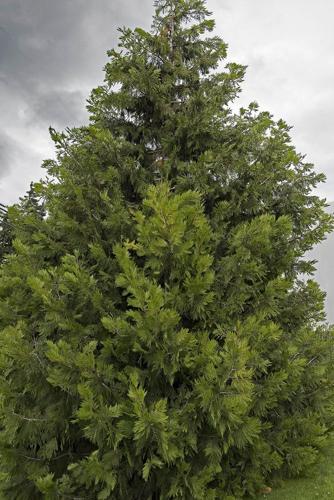
The City of Hood River Tree Committee’s May Tree of the Month is this incense-cedar (Calocedrus decurrens), growing near the Hood River Aquatic Center.
The incense-cedar is actually classified as a false cedar. Oregon has four species of trees often called cedars, but none of them is actually a true cedar. True cedars are native to the Mediterranean and Himalayan regions of the world.
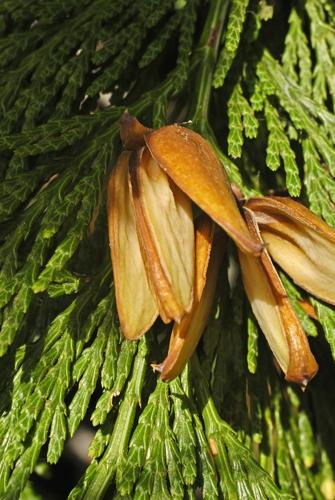
Oregon has four species of false cedars. They all have tiny, scale-like foliage and small cones. The cones are often the best way to tell the false cedars apart. The cones of this incense-cedar, when open, look like a flying goose or like Donald Duck’s bill with his tongue sticking out.
Although incense-cedar grows throughout much of the Oregon Cascade Range, it is increasingly common south of Santiam Pass into California. It is well adapted to drought conditions and extreme temperatures. Another of the false cedars common in Oregon, the western redcedar (Thuja plicata) prefers moist habitats such as found in the damper, coastal fog belt.
Incense-cedar can grow to 110-feet tall and 5-feet in diameter, so it’s not suitable as a street tree or one to plant near over-head power lines, but its drought tolerance makes it well adapted to certain challenging planting sites in the local area.
■
The Tree of the Month is brought to you by the City of Hood River Tree Committee, a citizen advisory committee appointed by the Hood River City Council. The committee works to promote and protect trees throughout the community.
The information for this article was taken from an excerpt of the OSU Department of Forestry Publication EC 1450, entitled, “Trees to Know in Oregon.”



Commented