
Who better than a brewer to understand that cider takes time?
Matt Swihart, well known for his beer around here, stepped into the cider world, formally — his word — this year with his Dry Cider, made using Newtown apples he grows on his Odell area property: Double Mountain farm, which had its name before Swihart opened Double Mountain Brewery and Taproom 10 years ago in Hood River.
“It’s a different animal, because you’re not going through a brewing process. You kind of press and go,” Swihart said of the cider process.
Dry Cider is on tap at the taproom and at outlets around the area, and it will flow at the Hard-Pressed Cider Fest in Odell on Saturday (see sidebar).
“Hood River is the best place to grow fruit — I know I’m biased but this is an amazing valley for growing fruit, and we should be known for it and for great cider and great wine, and cherry beer and all these things,” he said, referring to the kriek (cherry) sour ales that are Double Mountain staples.
Is he up for the new challenge?
‘Hail Yeah’
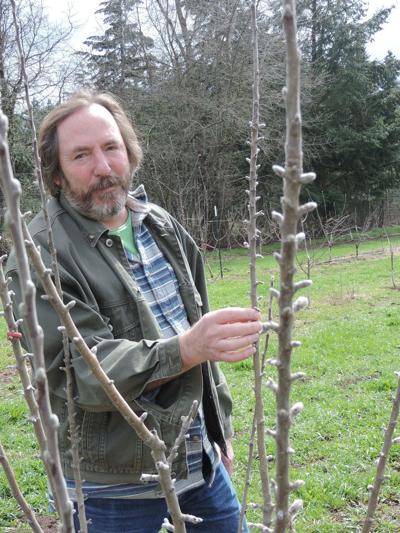
The ciders come mostly from local fruit, with Swihart’s blended in, and pressed and fermented in leased space in the Diamond fruit building at Windmaster Corner. Swihart has a new block of pears just coming into production, and through grafting he is developing the rest of a 10-acre section to trees that will bear high-tannin cider apples with the idea of developing complex ciders.
Swihart, who worked at Full Sail before he and former partner Charlie Devereux (now running Wayfinder Beer in Portland) started Double Mountain in 2007.
The Odell property used to grow peaches, and Swihart for a time saw grapes as a possibility.
“I thought I was going to be a wine guy, but then I took some classes and quickly realized I knew I was not a wine guy. I was a beer guy,” he jokes.
“I said, ‘The orchard needs to be an orchard and I need to stay a brewer.’ Now we’ve diversified to cider, and that’s what we’ve got going on,” he said.
“I like doing things slowly, and I said, ‘Yeah, dry cider, we have some Newtowns,’ and next year, maybe add a perry and have the opportunity to do more estate stuff down the road.” He has in mind using the bees that pollinate his orchards to create an estate mead.
“We have this block of all pears, and we plan to do perry, but we wanted to start with cider, stick with that, and we’ll get into perry this next season, and when this develops I’d like to do an estate cider that would just be the apples from here,” in about five years, Swihart said. “It’s a long-term game but that’s the beauty of it. We can do it at this pace because it’s not what’s paying the bills.”
As a seasoned beer pro but new to cider, “I’m really happy with what’s coming out in the valley, and that was our approach, didn’t want to go to market with something I couldn’t reproduce,” consistently, he said. “It had to get to a certain level where I was comfortable doing it in a larger way. That’s why I’m a little late to the game but that’s okay, because it’s an orchard; you don’t plant an orchard and harvest it right away. It’s a long-term proposition.”
There’s a definite personality to the terroir — the combined soil-topography-moisture-weather equation — on his land. Pointing up the hill, to the northwest, he says, “That block in front is the best in the site for tree fruit because you have the southern exposure,” but he explains that it’s not quite that simple in terms of maximizing the trees for cider fruit. “Up here, as the frost in the valley can be quite a challenge, the beauty of this is great cold drainage, it just spills so well off this parcel. We’re at 1,100 feet, which you would think would be more vulnerable but it’s not, it has the slope, and the cold air spills down into the valley. We don’t use smudge pots, or fans.”
It’s about the ripening time, north to south, he said. “Over the hill, on the north side, ripening comes later, and in terms of picking and spray programs you start on this side and finish on the other, whether you’re pruning or picking or what have you.
“The stuff that hangs on the tree longer has the most flavor. This may seem kind of spiritual or something, but it seems to me that if it’s a little cool, it just seems the longer it’s on the tree, the more flavor development you get, but I think that’s generally true. It’s the beauty of it, and the same way with our cherry beers: If you’re picking stuff for Rosauers you’re grabbing it early and letting it ripen in cold storage, whereas we’re letting stuff hang on the trees as long as possible for better flavor development, and when that happens it makes it more difficult to transport, but for us it’s all going into cider. We don’t need a pretty cherry or apple, we’re just going for the flavor.”
Swihart buys fruit from area orchards and from Rich Hanners, who operates Swihart’s orchard.
“I can direct where the fruit goes,” he said. “Rich doesn’t mind if I buy it myself to make cider or sell it to the packing house.” The 40-year-old orchard is mainly red and green Anjous and Boscs, all tended by Hanners.
The relationship has benefitted both men: last year Hanners had a sizeable portion of his pears damaged by hail, ruining them for the packing market. Swihart bought them and turned them into a pear cider that was available for a time at the pub, with a name riffed from Swihart’s popular stout “Hell Yeah.”
He called it “Hail Yeah.” While the Dry Cider is the pub standard, Hail Yeah is an example of the seasonal or one-off brews that just might crop up at the taproom.
•
His association with the long-time Hood River orchardist starts with a funny small-world story.
“We hadn’t known each other. We met in Hawaii.”
A mutual friend introduced them at a beer festival in the islands, and as they got to talking Swihart said, “I’ve got this orchard.”
“Really? I’m an orchardist,” Hanners told him.
Swihart recalls saying, “I’m trying to develop this orchard, to have these cider varieties no one grows.”
Hanners said, “That’s what I do. Why don’t we do this together?”
Swihart said, “That was the start of that block,” pointing to his young trees.


Commented