
Friday court filing prompts hearing delay
In his 28 years of serving as a deputy sheriff in Klickitat County, Sgt. Erik Anderson said the 1998 fatal stabbings of two men and a pregnant woman in the small community of Klickitat, Wash., was the most serious set of crimes he has been charged with investigating.
Columbia Gorge News spoke with Anderson ahead of a hearing that was set to reconsider the mandatory life sentences of one of two men convicted of the murders of Carlos Mendoza, Dionna Gomez, and Juan Olmos on New Year's Eve, 1998.
At the time of the murders, Anderson was living in Klickitat at the time, only a few blocks away from where they occurred.
“I was 27, and I only had like two or three years on me … I’d never had my own homicide case for a small department that only sees a homicide once every three or four years or so,” he said.
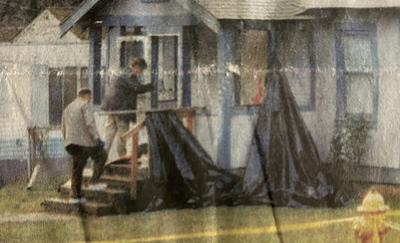
Just before 5 a.m., New Year’s Day in 1999, he got a call from a Klickitat County 911 dispatcher that a local man reported a man injured, later identified as Olmos, laying in a pool of blood on a front porch of a vacant neighboring house. More officers showed up to the scene shortly after and followed the trail left by Olmos to an upper apartment on a side street in Teacher’s Alley to find the bodies of Mendoza and Gomez.
The victims received 143 stab wounds amid the encounter. In the apartment investigators found Gomez’s 18-month-old daughter unharmed, whom news reports at the time state was returned to relatives.
It took investigators about a year and a half to solve the case. Initially Anderson was dealt a tough hand to play. At the time the Klickitat County Sheriff’s Office did not have full-time detectives to handle the case, and there were only two or three deputies on duty at a time. Anderson was made the lead investigator to solve the case, despite having never worked on a homicide, along with another full-time officer. After about a week, his partner was reassigned to patrol duties full-time, and Anderson was left as the sole investigator. He too would have to take on patrol later during the course of the investigation, he recalled.
“We just didn’t have the resources locally,” he said. “Just managing the sheer volume of physical evidence took about a day and a half to get things bagged and tagged. And also, we had dozens of interviews that needed to be done chasing down leads … Now as time went on I got the help. I didn’t do the whole project on my own, I got help, but it was a lot for one lead guy to take on.”
He added that procedure has since changed with the implementation of incident command centers, an innovation that arose out of the Sept. 11 attacks; as well, he said that he learned to delegate responsibilies as a result of working on the case.
At the time the department caught criticism about the lengthy investigation.
"People were bitter that we hadn't solved it, and they thought we weren't taking it seriously ... They didn't know but we continued to work very hard on this, and we did follow every lead we could with the resources we had. That kind of bothered me," he said.
In interviews with witnesses, Anderson had to figure out what was rumor, and what was true. Neighbors had not been able to identify individuals at the scene during the commotion.
One witness positively identified the Neals at a local swimming hole an hour before the murders happened. Further witness statements revealed Neal Jr. had told them information about the crimes that were not previously known to the public, and that while he almost always carried a knife with him, shortly after the homicides he no longer carried that knife, according to court records. They also confirmed that Neal had frequently engaged with Olmos in a drug operation, according to the probable cause affadavit used to justify Neal Jr's arrest.
Through the course of the investigation items that seemed pertinent to the case showed up in spots along Klickitat River, including a bag containing a knife and jacket, and later Anderson discovered a pair of shoes which seemed to contain trace amounts of blood.
The pair of shoes were later sent to the Washington State Patrol Crime Lab, which was unable to confirm the DNA samples, but a later inquiry through the FBI’s Crime Lab, whose equipment was able to detect DNA in smaller samples, found that the DNA found on the outside of the shoe belonged to one of the victims, while blood samples found inside the sole of the shoe matched the younger Neal’s DNA type.
The lab's findings gave investigators the probable cause necessary to arrest Neal, who had by that point moved to California, Anderson said.
“The most crucial piece of evidence was obviously the pair of tennis shoes I found down by the river,” he said. “DNA (sampling) was still sort of in its beginning stages and so there was a lot of demand for cold cases and all these new cases — everybody wanted DNA results. And so the labs were backed up … but the FBI was gracious enough to do the testing for us on this case, and though it took a long time to get those results back, it’s what ultimately locked in Neal Jr.”
Anderson traveled to California to oversee his arrest and confession that night. During the confession Neal Jr. implicated his father in the crimes, who by that time was in jail in San Bernardino, he said. Senior never confessed to the crimes, which Anderson said left a gap in knowledge about the case.
“Motive is still an unknown,” he said. “There were drugs involved all the way around, and so that probably affected judgment and decision-making that probably led to them doing things maybe they wouldn’t normally have done, but there’s really no good reason to go kill these people like they did. That still has never really been made clear.”
Hearing canceled
Neal Jr. has been incarcerated at Walla Walla Penitentiary since pleading guilty in 2001. Neal Sr. died in 2005 while held in detention at Monroe Correctional Complex in Snohomish County.
Last year, Neal Jr., who was 19 at the time of the crimes, appealed his two concurrent mandatory life without parole sentences in conjunction with a 2021 Washington State Supreme Court decision that ruled that protection against mandatory life without parole sentences for juveniles convicted of a crime should be extended to individuals up to the age of 20 at the time of the crime. He was scheduled to appear in Klickitat County Superior Court Nov. 21 to argue for a lighter sentence.
The hearing has since been canceled following a filing by the state that argues the court would exceed its authority by offering to hold a re-sentencing hearing before the legislature could enact a response to the 2021 court decision.


Commented
Sorry, there are no recent results for popular commented articles.