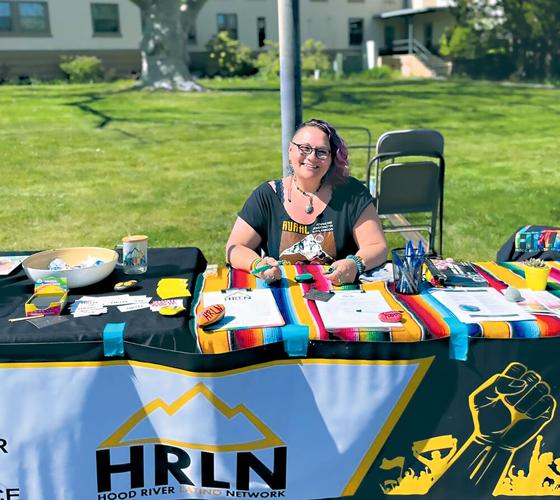
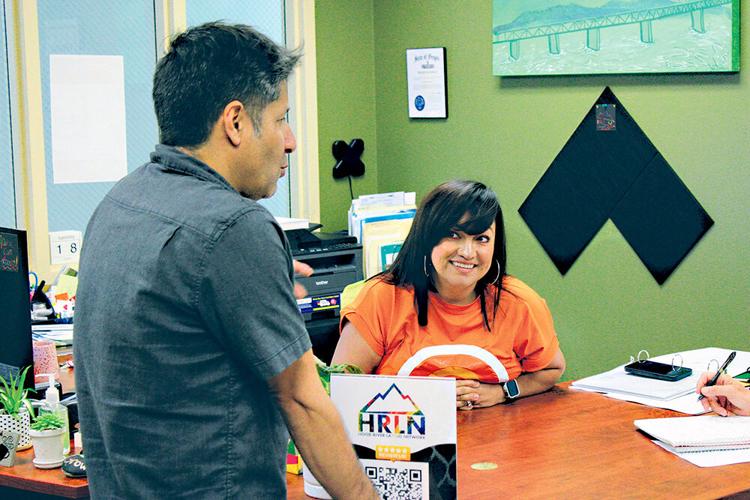
Arturo Leyva and Martha Verduzco-Ortega. The center is located at 1406 12th St., Suite 2 in Hood River. At right, Amber Rose, tabling for HRLN at an event.
Arturo Leyva and Martha Verduzco-Ortega. The center is located at 1406 12th St., Suite 2 in Hood River. At right, Amber Rose, tabling for HRLN at an event.
HOOD RIVER — If you are an immigrant living in Hood River County, the Rural Organizing Project has just given you a gift: A collaboration with community organizer, activist, and all-around girlboss Martha Verduzco-Ortega.
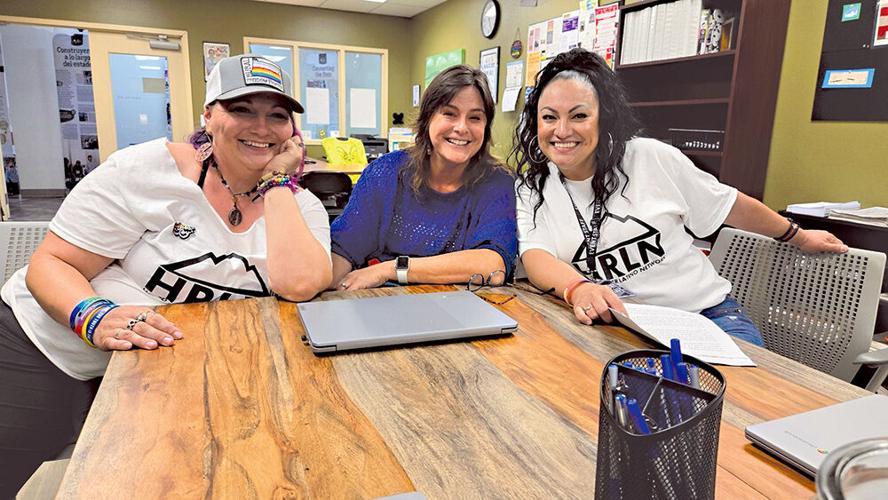
Pictured above, left to right, are Amber Rose, Suzanne Cross and Martha Verduzco-Ortega of Hood River Latino Network’s Immigration Help Center.
Josie Noteboom photo
The Rural Organizing Project is a decades-old statewide organization that supports rural communities, with a focus on grassroots activism and equal access to justice. Originally formed to fight against a 1992 anti-LGBTQ initiative called the “Abnormal Behaviors Initiative,” ROP now fosters strong, interconnected communities, builds rural leadership, and advances democracy for all.
Verduzco, one of the founders of the local Hood River Latino Network, was tapped by ROP to set up a Field Office to assist immigrants in Hood River County. Verduzco comes with a background in criminal justice, community organizing, activism and labor relations. This newly-opened field office, the Immigration Help Center, focuses on social justice for all, but under Verduzco’s guidance, looks to amplify immigrant voices far beyond social justice.
A day at the Field Office is never dull. They open every weekday but are available whenever needed. Verduzco and staff specialize in helping local immigrants to navigate complex systems and connect with local resources. This might mean assisting with green card applications, or the mountains of paperwork required to apply for citizenship. They help with DACA renewals. They offer driver’s license written test practice classes in Spanish, assist with voter registration and education and provide translation services.
Her team also creates videos on a daily basis. One video featured a county health worker demonstrating how naloxone can save a life; another invited the community to the monthly barbecue. They use social media to inform and to build community.
Verduzco sees the Immigrant Help Center as a community hub. “We want to help the local Hispanic population navigate systems, build resiliency, and find their voice,” said Verduzco, affectionately known as Tita.
Josie Noteboom photo
In a recent example, a local packing house worker was having difficulty navigating FRANCES, the state’s new employment platform. Verduzco invited her in, and in a single visit, the client was signed up, online and in control. In fact, labor justice is a major part of the office’s work. The team, particularly Verduzco, is very familiar with OSHA agricultural labor standards, particularly in terms of housing. She has made labor rights a priority for her community. People know Tita, they trust her, and they feel comfortable coming to the new field office because of her.
Verduzco can’t do the work alone. She partners with Arturo Leyva, communications and marketing director, and Amber Orion, community organizer and outreach coordinator. Leyva, Radio Tierra’s production and programming director, hopes to collaborate regularly with the local public Hispanic radio station to promote events, provide information, and increase advocacy. Leyva has also been building bridges to elevate HRLN’s messaging and community outreach. Orion focuses on building relationships with local organizations, assists with community events, such as the Hood River Latino Fest, set for Aug. 18 this year. She accompanies Verduzco to NORCOR to engage with incarcerated youth and helps organize the monthly barbecue, or La Parilla Civica, “a monthly event where we barbecue with our community members and help them to register to vote.”
While ROP is the primary fiscal sponsor for the field office, the Oregon Law Center provides a consulting attorney a few hours each month, and other funding sources, such as the Salvador Fund, Ford Family Foundation and Energy Trust of Oregon. They are in search of additional funding for office infrastructure.
One of the team’s goals is to engage youth. Summer intern and Oregon State University graphic design major Josie Noteboom helps promote events and engage with youth through social media. With Leyva’s guidance, the office purchased all the tech needed to produce a podcast. Leyva hopes the next generation of community activists will use the office: “We want to train youth to be more active in their own community,” Leyva said.
While the collaboration between the Rural Organizing Project and the Hood River Latino Network provides critical infrastructure, it’s Verduzco that brings the people, her people, into the office. Her presence is reassuring, and her professional yet assertive approach is inspiring. She is the Immigrant Help Center’s Jefa.



Commented