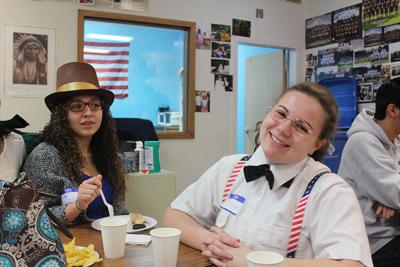
History came alive last Friday in the AP U.S. History class at the Hood River Valley High School. Students participated in a Progressive Era dinner party with interactive roles as historical figures.
The Progressive Era was characterized as a time of social reform and political advancements. It spanned form the 1900s to the 1920s and the changes are still affecting us today. People moved to cities during the Progressive Era and a more urbanized society grew. This caused industrial and urban tensions, along with growing ethnic prejudice against the large immigrant population. These tensions caused a rise of reformers and social activists.
Choosing from a list of influential Progressive Era historical figures, the students at HRVHS were given the chance to become activists from the past. Each student was to research their historical figure and find out what their position would be on certain areas of society, such as, women’s suffrage, child labor laws, and immigration. Then they would be ready to come to class, dressed in appropriate Progressive Era attire, and converse with other leading figures of the time.
Charley Boonstra who represented Alice Hamilton, the first women to ever attend Harvard, said,” This party is a great way to step out of your bubble and look at issues from a different perspective.”
On the day of the party, each student brought food and came prepared to discuss their positions on the issues that characterized the Progressive Era. There were heated debates all over the room, as students got into character and began to feel as if they really were in the Progressive Era.
Emma Goldman, represented by Lauren Robinson, and Mother Jones, represented by Payton Rigert, got into a spirited debate about women’s rights. Emma Goldman was a free thinking “rebel women” who believed in women’s suffrage; whereas, Mother Jones believed that the women’s place was in the household and that men must support them.
Many of the other historical figures that were represented also had different opinions and it was interesting to see the interactions between the students when they talked together. Dave Case the AP U.S. History teacher, said, “I think it was fun because the kids stepped out of their comfort zones. They learned a lot more about history than if I had been lecturing. The dinner was goofy, but memorable.”
Case represented Williams Jennings Bryan, an activist for the Populist Party who eventually combined with the Democratic Party. He wanted “Free Silver“ because it reduced power attributed to money and put more money in the hands of the people.
All of the students were very outspoken and interactive with their parts. A lot of the historical figures were people that you don’t necessarily hear about in you textbook.
Billy Sunday, represented by Arthur Finstad, was from Hood River. Sunday Drive, near Odell, is named after the famous preacher.



Commented