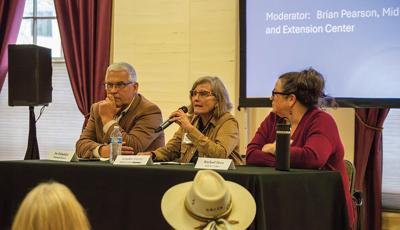
From left to right, Joe Dabulskis, Jennifer Euwer and Rachael Horn discuss the challenges the face as growers in the Columbia Gorge during the last panel at Mid-Columbia Economic Development District’s (MCEDD’s) ninth annual symposium. Among several other programs, MCEDD helps shape the economic vision for five counties in the Gorge.
From left to right, Joe Dabulskis, Jennifer Euwer and Rachael Horn discuss the challenges the face as growers in the Columbia Gorge during the last panel at Mid-Columbia Economic Development District’s (MCEDD’s) ninth annual symposium. Among several other programs, MCEDD helps shape the economic vision for five counties in the Gorge.
Columbia Gorge News incorrectly characterized Commissioner Jennifer Euwer's relationship with Diamond Fruit Growers and the farmworkers she employs. Euwer does not sell produce to Diamond, the co-op packages and markets the produce for her. The wages she pays her farmworkers also did not completely fund the college tuition for those workers' children. We regret the errors.
THE DALLES — The Mid-Columbia Economic Development District (MCEDD) held its ninth annual symposium on Nov. 1 in The Dalles. City councilors, port directors, scientists and other leaders gathered in the Civic Auditorium to learn about funding opportunities for rural areas, regional economic trends and challenges facing small businesses.
But arguably the most potent message was that growers across the Mid-Columbia, including Skamania, Klickitat, Hood River, Wasco and Sherman counties, are in crisis. Due to climate change, monopolization and burdensome — albeit necessary — state labor requirements, those who feed us face an increasingly uncertain future.
“Being a farmer is the biggest and scariest gamble anyone can take. I mean, you’re literally rolling the dice every year,” said Rachael Horn, the founder and head winemaker at AniChe Cellars in Underwood.
While the Tunnel 5 Fire was human-caused, climate change not only produces more wildfires, but more ecologically damaging ones. For Jennifer Euwer, owner of Valley Crest Orchards in Parkdale and chair of Hood River’s Board of Commissioners, the impacts of wildfire look different: she doesn’t worry about the taste of her pears, rather, it’s being unable to harvest because the air is so toxic.
Irrigation is another issue. Euwer is located in the Middle Fork Irrigation District, fed by the Eliot, Langille and Coe glaciers on Mount Hood. With more rain and less snow accumulating, Mount Hood’s major glaciers have lost 60% of their area in the last 120 years, and that has accelerated in recent decades, according to the Oregon Glaciers Institute.
“One year we’ll have one of the worst crops we’ve ever grown,” said Joe Dabulskis, owner of Holzapfel Ranch in Sherman County and chair of MCEDD. “Then followed by some of the best wheat we’ve ever grown.” Rain is scarcer east of the Cascades, and climate change makes precipitation patterns more erratic — more difficult to predict. Dabulskis described how he used to have a creek running though his property, but now, it’s disappeared.
Largely due to drought and heatwaves, climate change is reducing the amount of usable farmland nationwide.According to the United States Department of Agriculture, the country lost 20.1 million acres of farmland between 2017-2022. That’s approximately 7.65 acres per minute.
“We’re talking about storms and such intermittent devastation in growing regions all over our planet,” said Horn. “We can’t plan for heat domes of 118 degrees in June. How do you plan for that?”
“Since we grow commodities that are interchangeable and we’re price-takers, we don’t have any control over how much we get paid for our fruit,” said Euwer. Walmart, Kroger and Albertsons own a third of grocery stores in the United States, the Washington Post found. Locally, Euwer has few options for packing and marketing her fruit, doing so through the Diamond Fruit Growers co-op.
Likewise, Dabulskis explained how his revenue depends on global trends, like the quality of wheat harvests from other major providers such as Argentina and Australia, and policies like crop tariffs. His margins are already tight, and all three growers emphasized that labor requirements are another factor.
Since fruit is delicate and must be picked by hand, migrant farmworkers provide an essential service throughout the Gorge, and farmers supply their housing. However, Oregon’s Occupational Health and Safety Administration (OHSA), as previously reported by Columbia Gorge News, is currently updating its rules. One pending proposal would mandate that rooms where workers cook, live and sleep have at least 100 square feet per person.
“OHSA is caught between people who will never stop saying this needs to be bigger and better, and the farmers who say we literally can’t afford this,” said Euwer. Farmworker housing, along with their wages, represents about half of her total costs, yet Euwer called it a "privilege" to work with them.
In short, the pressures growers must contend with are unpredictable and wide-ranging, but just 2% of America’s population works on farms — responsible for feeding the other 98%.
“Mankind cannot survive without farmers, but we’re kind of at the mercy of everyone else,” said Dabulskis. “We don’t set the price for what we’re selling our crop for, or where it gets sold.”



Commented