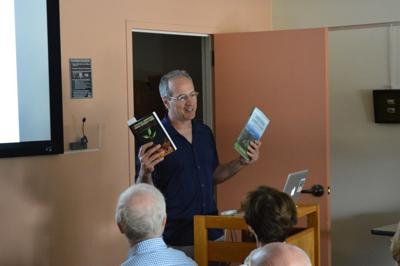
Dominick DellaSala, an Ashland scientist, gave a talk about forest fire ecology at the Hood River County Library Wednesday night. His argument: fire is “nature’s phoenix,” a beneficial process that restores plant and animal biodiversity.
Dominick DellaSala, an Ashland scientist, gave a talk about forest fire ecology at the Hood River County Library Wednesday night. His argument: fire is “nature’s phoenix,” a beneficial process that restores plant and animal biodiversity.
In the case of forest fires, redemption lies in ruin.
Such is the argument of Dominick DellaSala, Chief Scientist for the GEOS Institute of Ashland, who gave a free talk at the Hood River County Library on Wednesday. The event, organized by Portland environmental group Bark, brought in about 30 people.
The night’s topic was wildfires and the ecological benefits that come in their aftermath. The presentation was based on DellaSala’s book, which had just hit Amazon’s digital shelves the night before: The Ecological Importance of Mixed-Severity Fires — Nature’s Phoenix.
“Fire is to a dry forest what rain is to a rainforest,” said DellaSala. “And that’s a hard one for a lot of people to understand, because you visualize this verdant, green rain forest on one hand and this blackened, charred forest on the other hand — and you have (to use) a different part of your brain.”
The primal fear of forest fires, DellaSala argued, can cut down to the primal “reptilian” part of the human brain instead of the more logical “neocortex.”
DellaSala extolled the ecological benefits of wildfires in forests, which allows for new species of animals and plants to flourish. He argued that heavy fire suppression, often conducted during emergencies, is damaging to the wildlife, as well as unnecessary in remote areas.
He said black back woodpeckers and spotted owls are “resilient” in fires, especially if there are patches of green trees at hand to sustain true biodiversity. “The green trees are the bedroom. The burned trees are the kitchen … they get prey in the brush,” said DellaSala.
DellaSala argued that certain forest thinning operations can be beneficial, but most are harmful. He said homeowners can make a bigger impact by clearing brush and trees in 200-foot perimeter around their homes, as opposed to remote wooded areas.
He also indicated that tin roofing, as opposed to older wood constructions, is imperative in building a “firewise” home.
DellaSala is the founder and Chief Scientist of the GEOS Institute in Ashland, an environmental conservation group. He is a political advocate, who has spoken at congressional hearings in defense of the Endangered Species Act, roadless area conservation, national monument designations, forest protections and climate change.
A copy of Nature’s Phoenix is available at the Hood River County Library, and is also available at Amazon.com.



Commented