
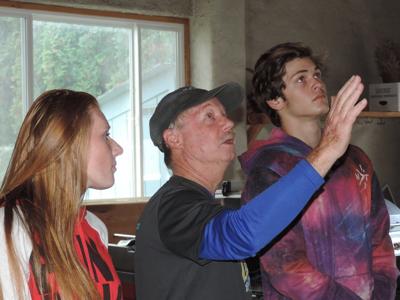
“The hope of this space is to create a maker space for all students in the district.” — Pete Lawson, coordinator, Community Works Program
The most unlikely location is producing a most practical education environment.
Known informally as “The Fire House” for its repurposed location on the Heights, the Community Works Program is a program of the Hood River County School District.
While designed for high school students, Fire House’s role will expand, according to Coordinator Pete Lawson.
He is working with middle school and elementary teachers to involve students, making it a new and developing lane to learning for students with varying educational needs as well as interests.
“My hope is we can use this space as much as we can for all students,” Lawson said.
At the Fire House, students are learning skills ranging from building fences to making jewelry from minerals, pressing and shaping skateboards, handling construction and landscaping tools, building garden beds, and planting and nurturing produce in those beds.
“We’re in year three; it really took almost a whole year to work out agreements with the city, fire department and school district; last two years hitting the space in terms of renovating it really hard,” said Lawson, who cited community partnerships as vital in developing The Fire House.
The workshop and maker space was carved out of a neglected former fire department substation located on Wilson Street a block off 12th; the city public works cistern is co-located within the fenced yard.
“When we took over, the building had not been used much for 17 years and was in a lot of disrepair,” he said. “We had no functioning bathroom or water, and all the work here including plumbing has had students involved,” he said.
Inside is a flexible work space and office/meeting room and toilet. Inside and in the yard, the students learn landscaping and construction skills. Lapidary and skateboard-making equipment inside are another important arm of the program.
“All the work we’ve done here is with students,” Lawson said, with the volunteer guidance of plumbers and electricians from the community.
He explained that he approached then-fire chief Devon Wells, who approved of the new use of the facility. The department had less need for the Wilson Street property after construction of the new Ty Taylor Fire Station.
Current Chief Leonard Damian called it “a win-win for the schools and the city.”
The city provides utilities and charges no rent. Public Works Director Mark Lago said the city is glad to provide an asset that meets student needs.
While much of the work has been done by students, Lawson noted that “we couldn’t have students in here until we had a ramp, and the city has three guys out here the next day. We didn’t have water, and they were here the next day. The city also waived inspection fees.
“Our community sees the value in this and in having students have these experiences so when they are in the work force, they’re better prepared,” Lawson said.
The program is funded through the district general fund as well as Measure 98-funded High School Success Fund, which provides support for schools that are expanding programs to meet career and technical education as well as drop-out reduction.
Fire House definitely meets both needs, according to Neely Kirwan, District Curriculum director.
“Beyond the career education, it (Fire House) just opens students’ horizons to what is really possible,” Kirwan said.
“We are really excited about the future of this program and what it adds to existing opportunities for students, such as the agriculture and media programs,” she added.
Lawson said community members are coming in more and more, volunteering and teaching expertise, but the focus is really on soft skills. These include work place cooperation and the ability to self-assess and self-direct.
“It’s about how to work, and to be in a work place and succeed with others,” Lawson said. “We wanted both.”
Lawson, an educator who grew up in a family that built houses, taught for 15 years, then lived in Costa Rica for a time “to recharge the batteries,” and came to work for the district as a special education teacher. “I added a Career Technical Education endorsement which allowed us to take this program and open it up to a larger group of students,” he said.
“Originally, it was just for students with developmental disabilities, and a range of abilities, now open to students who had struggled with managing behavior or with higher level of repetition or who could benefit from exposure to more hands-on educational programs.
“The hope of this space is to create a maker space for all students in the district,” Lawson said. He will seek to establish it “as a space we can offer it up to teachers throughout the district.”
In the past two weeks, grade schoolers and middle schoolers have spent an hour or so learning about lapidary and skateboard skills from some of the 15-20 high school students who attended classes at Community Works.
“We are still serving some with developmental disabilities and now we are mixing in any student who might benefit from an exposure to construction or trades to students who might be at risk of dropping out,” Lawson said.
Community Works students include those from the Options Academy alternative school as well as mainstream pupils augmenting their schedules. One student, senior Courtney Rigel, has been attending Community Works for much of the past three years, and combines her studies there with classroom time at HRVHS and online. (See Kaleidoscope for more from Rigel and others.)
Fire House is there for students who are getting ready to transition to post-high school, sophomores experiencing academic failure, and at least one student with developmental disability.
“A strength-based approach in an off-campus setting can really help with student behavior,” Lawson said. “A lot of them struggle with larger classrooms and the larger campus setting.”
By strength-based, Lawson means the attempt to expose students to a variety of tools and work experiences.
“The student who maybe struggles with reading or math and experiences a lot of failure in a traditional academic setting comes here and finds out they are skilled at running a table saw or rock equipment,” Lawson said.
“What I see it is helps the students to reframe her lens of educational learning, to a more positive experience, so school is, ‘Look at what I made’ instead of ‘Man, I got another F on that test I tried three times to do well on.’”
Put another way, it is finding a strength and pursuing it.
“Sometimes it is something in the student already. More and more, I hear students here at Fire House say, ‘You’re trying to help us with things that might help us in the job, but I just want to get to work.’ That’s one of the best things a teacher can hear.”
The one restriction with expanding the program is the size of the space, and safety considerations.
“Part of it is that this been an active construction site; more bodies doesn’t mean more work gets done, it becomes one of those things where it’s not super unsafe but it can be students start stepping over each other.”
But Lawson and his adult volunteers are working on ways to accommodate more small groups at different stations, with the hope of teaching 20-25 students at a time.
Currently the two daily high school sessions are comprised of 15 students each.
“We start with stretching, and then talk about a theme related to work, and split up into lapidary, construction and landscaping.” Students are largely self-directed, after thorough training on tools and machinery and safety practices and equipment.
“Over and over I hear builders say, ‘You can’t learn by watching someone do these activities and run those tools, the real way you learn is having your hand on that drill,” he said.
Contractors and specialists, including Land Electric, have spent time teaching students about installing electrical boxes and running wire. Students also helped install the much-needed heater last month.
“We get students involved as much as they can,” Lawson said. “With electrical, we want to make sure its safe and to code, but a lot of electricians wouldn’t be so inclined. It takes time. So we really appreciate it.”
A key volunteer with the program is contractor Jack Miller, who has helped since year one.
It started on a neighborhood walk, where Lawson and the students saw Miller building a house and stopped to ask questions. Miller gave them a tour, then agreed to let students help him build the house, and that evolved to Miller spending four hours, twice a week, at The Fire House.
“They helped him build his house, and they have benefited from being off campus. Also, this is real work,” Lawson said. “They can see the value, ‘I’m part of this.’ I have seen students in last couple of years feeling invested and feeling connected to this.
“Jack said ‘Okay,’ when I asked him and that’s big because a lot of people would say, ‘That’s a liability’ or ‘It will slow down the project,’ but he’s invested in our community, and wants to see the future of our community get these skills.
Other community partners include Tum-A-Lum Lumber Dirt Hugger and Morgan Paint, who have provided materials at cost.
Other examples include Tru Gorge, located a block away, donating a forklift, to help Lawson and Miller install the heater.
“It was such a value for students to see something like this get put together, and to build confidence in their own skills and say ‘it’s not a big mystery,’” Lawson said.


Commented