
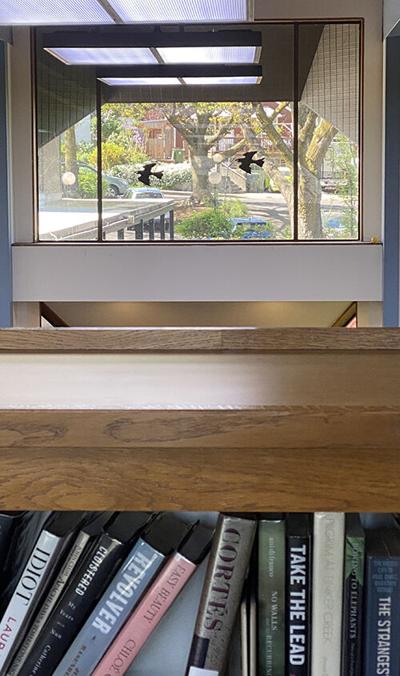

THE GORGE — On March 31, Oregon State Librarian Wendy Cornelisen got an unexpected email from the federal agency that provides grants and assistance to libraries nationwide: Less than an hour earlier, its staff had been told they were on administrative leave. That their service was over, along with a quarter of her library’s funding.
President Donald Trump had signed an executive order on March 14 to dismantle seven agencies “to the full extent of the law,” including the Institute of Museum and Library Services (IMLS).
That’s because he “determined it was unnecessary,” the president said, according to the Associated Press.
The loss “will cause significant financial harm to the State of Oregon,” Cornelisen wrote in court testimony.
“Students of all ages will have many, many fewer books and articles for academic study,” said Jeff Wavrunek, director of The Dalles Public Library.
“The impact of funding cuts would be significant for rural communities like Hood River County that rely heavily on resource sharing and statewide support systems,” said Hood River Library Director Rachael Fox.
Created by a Republican-led congress in 1996 to restructure similar previous agencies, IMLS funds access to technology, services, and grants at official state libraries nationwide.
As Fox noted, most affected will be rural or marginalized communities with few resources of their own: the Washington Talking Book and Braille Library for those with disabilities, hospital and prison libraries, and services in small country towns with little local money to spend on library databases, either for research or fun.
IMLS soaks up just 0.003% of the annual federal budget — “change in the couch of congress,” Cornelisen said, less than $300 million a year. And that money was appropriated by Congress in 2004.
“It has been an incredibly long-standing support for libraries at the federal level that has allowed libraries across the country, especially in rural areas, to continue to exist, to continue to grow,” Cornelisen added.
In turn, those state libraries provide economies of scale, paying for discounted access to technology databases and online services for all local libraries in their states and for K-12 students. Without IMLS, local libraries would need $70-$100,000 a year to provide this.
With their federal funding, state libraries also issue grants for projects — like Hood River’s new bookmobile.
A group of 20 states, including Oregon and Washington, have sued the federal government in an attempt to halt the dismantling of IMLS.
Local effects
Interlibrary loans in Hood River and Wasco counties are funded by the Sage Library Consortium courier system, and would be half-defunded, limiting patrons to their local shelves instead of 77 libraries-worth of material across 15 Oregon counties.
No longer could students, researchers and others rely on placing a hold and getting a book from another Sage library delivered to their county.
This will impact rural communities in particular.
“These are libraries that have very small budgets. They don’t have a lot of funding to purchase items for their collection,” said Fox. Instead, they rely on interlibrary loans and IMLS.
It’s a big system: Last year, about 91,582 items moved between Sage libraries at a cost of around $120,000, said Fox — whose library patrons participated to the tune of about 12,000 holds fulfilled. “By having this, we’re able to share those resources,” Fox said. “We don’t have to buy every single item.”
“Our library does not have the shelf space nor the funds to purchase and stock all the books our patrons want from the ‘Word Wagon’ or the shelves in our county’s libraries,” concurred Wavrunek. “Students, homeschoolers, families, and fixed-income seniors will have access to substantially fewer library materials.”
Wavrunek added, “The situation is still fluid as no sustainable solution has been determined yet.”
The Sage program is now reliant on emergency fundraising and needs about $80,000 just to get through the next fiscal year if IMLS is defunct.
Other items at risk include grants for new bookmobiles, makerspaces like The Dalles’, digital skills training, digitization of old newspapers like the Hood River Glacier — and two-thirds of the state support and development services staff who manage those programs.
Popular programs like Oregon’s Battle of the Books, online ebook lending system Library2Go, and services for students are funded by IMLS.
“Without that funding, special projects might not be able to happen in the future,” Fox said.
Some free training opportunities for staff, volunteers, and board members will go.
All IMLS funding in Washington was cut off as of April 1. Libraries don’t know if they’ll be reimbursed — for instance, Seattle Public Library doesn’t know if they’ll receive reimbursement for $90,000 of previously approved work.
Compared to Oregon, the White Salmon Valley Library is more fortunate: 96% of its district’s funding comes from taxpayer dollars within the Fort Vancouver Regional Libraries area, a junior taxing district.
That includes interlibrary loan services, said Communications and Marketing Director Julian Mendez. But if other libraries in Washington lose funding for their data exchange systems, White Salmon would forfeit access to their materials.
Also, libraries provide free internet to all their patrons, a large expense. Fort Vancouver Regional Libraries pays a federally-subsidized internet rate 80% lower than is standard. For now, this discount remains in place — but if it goes away that would be a big impact, said Executive Director Jennifer Giltrop.
As in Oregon, federal funding for workforce development, research and reference databases for patrons, local history resources, digital newspapers, and other statewide services through the Washington State Library is likely to be stripped without IMLS.
Under an official ILMS award notification dated April 18, 2024, the State Library of Oregon is scheduled to receive more than $975,000 by Sept. 30. More than $450,000 would have gone to local libraries; more than $250,000 was for staff salaries.
The state library is still seeking ongoing reimbursements for expenses, but since that March 31 email, ILMS headquarters has stayed dead silent.
“It’s really just an unfortunate time for not having maybe all the specifics,” Giltrop said. “Libraries continue to be a place for everyone that provide equal access, and it’s where we all have the ability to exercise our First Amendment rights to read and think, and engage in democracy.”


Commented