
When school went online due to COVID, a lot of classes had to adjust. For some, the transition was simple: Written work turned to online work, an in-person classroom became a Google classroom, face-to-face teaching became Zoom teaching. But there were some classes that weren’t as clear cut.
For example, how do you teach band class online?
This was the question that Ryan Murtfeldt, music teacher at Henkle Middle School, found himself facing in the spring of 2020 and throughout the 2020-2021 school year.
Murtfeldt took a student-first approach. Instead of trying to figure out how to force the traditional band model to work in an online format, he tried to focus on what would engage students.
“I asked myself, ‘What’s the number one thing that makes band fun? Why do the kids want to be in band?’” Murtfeldt said. “And it’s that social aspect of creating something together that I think is kind of at the core of what makes band fun and appealing and engaging for kids. So I started to ask myself, ‘How do I replicate that?’”
There wasn’t a clear cut answer out of the gate. He started out making teaching videos of himself at home with his dog, doing his best to relate to the kids while teaching them.
“I just tried to be like, ‘Hey, kids, I’m in lockdown too, this is crazy, but grab your instrument, we’re still going to play!’” he said. “Just having a lot of energy and flowing with it, and hoping that the kids would flow with it, too.”
The results were mixed, he said. Some kids just didn’t do well in a Zoom format and kind of faded out. Even so, there were a core group of kids who were engaged and still excited to be participating in band class, even in a pandemic.
They had Zoom lessons, but because of lag and natural delays, there was no way to cohesively play as a band on Zoom without it getting messy and confusing. There was no direct way around this that he could find, Murtfeldt said, all streaming and video-chatting services have some sort of delay. So he tried to find the next best thing.
“I found some different apps,” Murtfeldt said. “There’s one called SmartMusic where the kids can play a recording of the song at home and play along with it. It gives them the sheet music and it gives them this band that they play with. Then it gives them real time feedback on how they did with notes and with rhythms.”
He said he would use SmartMusic to introduce a piece of music to students initially so they could get the hang of it. However, he still wanted to have Zoom rehearsals where they could all interact and see each other, but he hadn’t quite figured out how.
Funnily enough, however, his inspiration came in the form of a birthday party.
“I was at a (virtual) birthday party once and somebody had a great idea,” he said. “They said, ‘Just have one person sing, see if there’s a volunteer who would sing. And then everybody else goes on mute, and they sing along but everybody just hears that one person who’s not on mute.’”
That gave Murtfeldt a great idea. He realized he could use that same technique for his classes.
“I took that idea from the birthday party and we ran with that in band,” he said. “So I would play and they would all be on mute, playing along. So they could see me and we could see each other but they could only hear me and hear themselves.”
They would also do it where Murtfeldt would ask who wanted a solo and one of the students would be the one unmuted while everyone else played along.
Murtfeldt said he also found that playing as a group was a lot more manageable in smaller groups, so he would put them into breakout rooms for their instruments.
“So I’d put the flutes together in a breakout room, and I’d put the trombones together in a breakout room, and then they would play together or take turns kind of leading,” he said. “And I would pop into all the different breakout rooms and help the kids.”
However, Murtfeldt said the key to teaching band online was having multiple strategies and not relying on only one method.
“So (using breakout rooms) was a strategy. The SmartMusic app was a strategy. And then I also decided that we were going to create digital composition,” he said. “I found a program called BandLab, which is free and it’s web-based. So you could use it on any device, it’s basically a digital recording studio.”
They didn’t just use BandLab for their instruments, Murtfeldt said. It was more than that. It also had copyright free sounds with hundreds of different rock guitar riffs and drum beats, as well as sound effects like ocean waves.
“Kids could go in there and basically paste together a collage of sounds,” he said. “And they created these compositions, and it was really fun. It was also really eye-opening because kids who struggle to learn how to play the trumpet, for example, thrived in this music composition scenario. So I was able to see sides of their musicality, sides of their musicianship or skillfulness that I wouldn’t have seen in band. Like, ‘Whoa, this kid is really musical. They have these great ideas for how to start a song and how to develop it and how to create an ending that I never would have seen just in band.’”
Murtfeldt said he’s carried that over to his classes even now that things are back in person. The students still get to use BandLab sometimes, and he thinks it’s been really beneficial.
However, there was still the question of how to do their concert. Obviously, it wasn’t safe to do it in person, but just having one person play on Zoom wouldn’t work either. However, as luck would have it, there was a dad in the community who happened to be a filmmaker. The band boosters, a group of parents who fundraise for the band, raised the money to get the filmmaker, Michael Peterson, on board.
“Each kid took their phone and recorded themselves playing their instrument at home and then they sent those individual videos to me,” Murtfeldt said. “And then they also recorded themselves on a separate track playing the music. So, (Peterson) edited the music separately from the video, and then put those all together and edited all that together into a concert.”
After the first concert, Murtfeldt figured out the editing piece, having seen what Peterson did, and was able to put together a few more throughout the year.
“It was its own totally different way of creating a concert, and then sharing that with the community,” he said. “But for the kids that engaged with it, it was great. It was really cool and fun. And I think the parents and the community got to see ‘Oh, band is possible online.’”
Now that they’re back in person, however, things don’t just go back to normal for band like they might for other classes. Because many band instruments are wind instruments, there’s an increased threat of spreading illnesses like COVID-19 through aerosols, the little particles of saliva that come out when we talk.
With wind instruments, an increased amount of aerosols come out of the end of the instrument, as well as by the mouth where the performer is blowing into the instrument. Because of this, it’s not just safe to all be in a room playing. Most classes can just mask up, but you can’t do that while playing an instrument.
At least, that’s what you’d think.
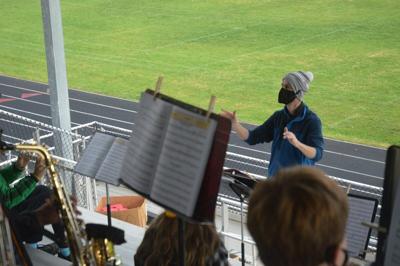
But in actuality, the students have access to specialized “band masks,” that the school was able to provide using some of the federal grants received due to COVID. The band masks have flaps that allow students to put their instrument inside their mask partially to play, but still keep the aerosols closed in. Even flute players, who play to the side, have masks with a side flap. Additionally, the students have covers for the ends of their instruments to keep aerosols in, almost like masks just for their instruments.
They also social distance while playing, Murtfeldt said. Band practices are conducted in the grandstands outside by the football field, and students space themselves six feet apart.
Though it sounds complicated, Murtfeldt said that he and the students have been glad to adjust if it means continuing band safely. In many ways, he even welcomes the challenge.
“It’s just been complicated, like complicated problem solving,” he said. “But I love being creative. That’s why I’m a music teacher. And I love helping kids to be creative. So it’s just like, ‘Alright, this is a reality right now. How do we have fun and learn regardless?’”
The bands will be having their first in-person concert since coming back, Murtfeldt. For some of the students, this will be their first ever in-person concert, and he’s really glad they can have the experience despite the pandemic.
“I’m so proud of them and so, so excited,” he said.
The concert will take place on Saturday, Dec. 11, at 11 a.m. in the grandstands.


Commented
Sorry, there are no recent results for popular commented articles.