
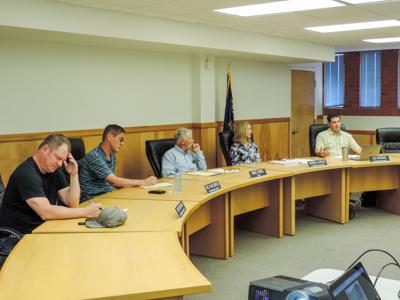
Since both of Hood River County’s revenue measures failed on the May 21 Special District Elections ballot, the Board of Commissioners must decide whether to make severe cuts now — including permanently closing departments — or hold out in hopes that the voters will pass the levy if it’s reworked for the May 2020 ballot.
The current draft of the county’s 2019-20 budget reflects the latter, utilizing one-time income they scraped from a variety of sources to backfill $400,000. “Part of it was unexpected, part of it was from other areas,” said County Chair Mike Oates, including the county’s contingency fund, a small capital reserve and money from the Mid-Columbia Council of Governments (MCCOG), which closed last year.
“We can push the decisions off another year … but I don’t think it changes the landscape. I think it makes it more difficult, I think it creates more difficulties internally for preparing for downsizing,” said Commissioner Karen Joplin, adding that she does not think this draft of the budget reflects the county’s goal of sustainability, defined in a previous discussion as “creating a system that provided a service that was not adequate in the best way, but at least adequate in a way that could be delivered the year after and the year after.”
The county’s message to the public during the campaign for the two revenue measures was that the county needed to find an additional source of revenue, or it would have to make severe cuts, but there was some confusion about the time-line of those cuts, and how the revenue measures themselves would impact them.
“Without cutting, we’re putting everybody who worked on this campaign in the position of walking out into public and being called liars,” said Commissioner Rich McBride.
Liz Whitmore, campaign manager for the Safe & Healthy HRC campaign in support of the two revenue measures, was invited to present her comments on the campaign, election and the county’s next steps.
“Our understanding was if these didn’t pass, there would be serious consequences,” said Whitmore.
“We were all very shocked to learn that the county decided to tap into one-time funding to not make cuts. I don’t understand the logic in that,” she said, adding that, should the county decide to continue with its current draft budget and not make severe cuts, she would not be involved in the county’s effort to try and pass the levy again.
“You need to do the hard work now. Our messaging to the community was that the commission needs to be sustainable,” she said, adding that she’s not advocating for “spiteful cuts to make a statement, but the sustainable budget that you talked about.”
Several years ago, the commission set up a plan to limit withdraws from the county’s Reserve Fund to a maximum of $750,000 until 2020 to give the county time to come up with a solution to the budget deficit. The commissioners clarified that the county’s message was that they would have to make severe cuts if an additional funding source wasn’t found by the end of that time-frame, not that they would make cuts if these two particular revenue measures didn’t pass.
“Why we started down that path in the first place was to preserve those services that we have now,” said Commissioner Les Perkins on the commission’s decision to draw from reserves. “What we have left to cut … are things we can’t just bring back. So yes, cutting those and making people understand the reality of the situation we’re in would make (the levy) likely to pass, but at the same time that would be putting the county in a situation where we can’t easily bring back those services — and a lot of those services disproportionately impact lower-income folks.”
In order to avoid those substantial cuts, the county needs to fill the “hole”— which includes the total county deficit ($1,149,622) and a $500,000 investment in capital — for a total of $1,649,622, based on the most-recent draft of the county’s 2019/20 budget.
When added to additional funding requests from each department, that number jumps to $4,711,954 — the amount the county would need to “properly fund current services for the next five years.”
The minimum levy rate to fill the hole and add essential capital investment, such as vehicle repair, is 69 cents; 48 cents without capital investment.
“We can try and continue to scrape from here … we can continue to do that and we might be okay,” Joplin said, referencing specific community response she received during the campaign that the county “will find the money somewhere, they always have, they won’t really do that (substantially cut services),’ I think in a genuine response, I will do my best to find the money somewhere and that is what we did,” she added. “We tried our best to find the money somewhere and not go through the pain of cutting and disabling departments where they won’t recover and won’t be able to perform their service.”
Sheriff Matt English advocated for an incremental approach — slowly downsizing so that his office and adjust to the changing service level, and so he can adequately place those who end up losing their jobs, rather than facing sudden cuts when the money runs out.
“I’m not advocating for cutting anybody, but I’d rather ensure the viability and success of my people … it’s my people that I’m worried about — they’re in limbo all the time,” he said. “I just see cuts coming and I worry.”
Even without major cuts, the commissioners said, constituents will notice a change in service going forward as departments start dropping unsustainable practices, such as excessive overtime or sending deputies out alone.
Whether or not the commission decides to retry the levy or not, County Administrator Jeff Hecksel said that the county needs to stop “burning cash” if it is going to achieve sustainability. “The most important thing is to quit burning cash because when you get to the end of it, it is the ugliest place you are ever going to be,” he said. “A government is expected to deal with anomalies and emergencies and if you keep burning cash, you have nothing to deal with a problem or emergency. You don’t want to be there; you don’t ever want to be there. It’s a terrible place to be.”


Commented
Sorry, there are no recent results for popular commented articles.