
By Aileen Hymas
For Columbia Gorge News
WASCO CO.—Flood-prone counties across Oregon have reached a deadline this month to choose how they will implement new floodplain building codes. These rules were designed — and mandated — by the Federal Emergency Management Agency (FEMA) to protect endangered salmon, steelhead and killer whale species.
While the changes are speeding through Oregon’s typically-lengthy land use procedures, they’ve been in process nearly fifteen years since courts found FEMA liable in 2009 for not protecting Oregon fish habitats in the National Floodplain Insurance Program.
The Wasco County Board of County Commissioners held a public meeting Dec. 9 and finalized the adoption of a model floodplain ordinance, which will go into effect July 31, 2025.
While Planning Director Daniel Dougherty said his department is still digging into the granular specifics of the requirements, FEMA’s literature says the new rules are designed to allow the salmon and steelhead to continue their runs in the special floodplain hazard zone, focusing on a no-net-loss standard for floodplain function.
In July, FEMA sent a letter requiring the county to implement new flood hazard management requirements in adherence to the Endangered Species Act (ESA) or face losing access to the National Floodplain Insurance Program (NFIP). Currently, 37 parcels in Wasco County are enrolled in the NFIP.
While the planning department says these changes have the potential to dramatically impact future building in these zones, Dougherty told Columbia Gorge News in an email that, over the past five years, the planning department has only processed two flood zone land use applications.
“I want to stress the importance that this could very well limit or eliminate new developments on any of these properties, especially for those properties that are undeveloped and completely within the floodplain,” Dougherty said during a county board meeting Aug. 18.
Mary Stites is a staff attorney with the Northwest Environmental Defence Center, one of the plaintiffs in the original lawsuit against FEMA. She said these changes won’t just protect fish, but people living in the floodplain too.
“Flooding events are happening right now, and the more we build in these flood-prone areas, the worse the impacts are. Why not engage in a regulatory system that protects people and communities?” Stites said.
The adopted ordinance is one of three options FEMA has offered to Oregon counties implementing the new standards:
1. A model ordinance drafted by the agency to provide clear and objective standards to the building code, or
2. A permit-by-permit habitat assessment and mitigation plan,
3. No future development in the floodplain.
The City of The Dalles also opted to adopt the model ordinance.
Changes precipitated by endangered fish lawsuit
The decade-and-a-half process of updating the NFIP to comply with the ESA started when the Portland Audubon Society, National Wildlife Federation, Northwest Environmental Defense Center and the Association of Northwest Steelheaders sued FEMA in 2009.
The lawsuit found FEMA in violation of Section 7 of the ESA by failing to consult with the National Marine Fisheries Service (NMFS) on impacts of the NFIP to 16 salmon and steelhead species listed as threatened and/or endangered.
Following this settlement, NMFS issued a document in 2016 known as the “BiOp”, or the Oregon NFIP Biological Opinion, which identified practices currently permitted in flood hazard zones which negatively impact fish on the endangered list, as well as orca whales that subsist on these species.
Stites explained that the BiOp highlighted major problems with the current development practices happening in Oregon floodplains.
“What’s unique about this opinion is it’s what we call a Jeopardy opinion, and those are very, very rare. It basically means the National Flood Insurance Program is causing such a level of harm to these endangered species that it jeopardizes their continued existence,” said Stites.
Since these findings, FEMA has issued a 2021 draft to incorporate the ESA into the NPIF, and a 2023 notice of intent to put out a final Environmental Impact Statement after counties have completed "pre-implementation compliance measures,” of which Wasco County received notice on July 15 of this year.
“It’s not to say that a new apartment building in Hood River will directly kill an orca,” Stites said, “but continued development that doesn’t consider these criteria harms salmon and reduces the orcas’ food base.”
She continued, “The call of this BiOp is not to stop development. It’s to make sure it occurs in a sensible way, and the costs of impacts to floodplains are borne by the developers, not the taxpayers.”
Implementation delays, then whiplash
While developing the BiOp took five years of research, public hearings and community input to prepare the building code changes, the Oregon congress still had not implemented the first set of interim measures in 2018, three years later.
In Sept. 2023, the Audubon Society, now known as Bird Alliance of Oregon, sued FEMA again over delays, resulting in an injunction that required counties to adopt these changes by the end of this year.
FEMA required Wasco County to select one of the three measures before Dec. 1 and begin reporting floodplain development to the agency by Jan. 31, 2025, a timeline which Dougherty said is impossible for the county to meet while following state land-use laws.
“FEMA does not comprehend that when a local jurisdiction in Oregon seeks to administer and enforce new land use regulations under state law, the jurisdiction has to follow very stringent procedural due process requirements, which include public and impacted owner notification, public input, public hearings and opportunities for comment and appeal,” he said.
Aligning with these concerns, Governor Tina Kotek and the state legislature have pushed back against FEMA’s timeline.
On Aug. 22, Oregon’s legislature sent a letter to FEMA asking for additional time, and on Sept. 26, Kotek sent a letter requesting that FEMA pause the pre-implementation compliance measures completely and join with state agencies in addressing habitat and endangered species’ needs.
“I respectfully ask that FEMA engage more fully in deliberative dialogue with my agencies in order to craft the best solutions possible for public safety and species protection,” Kotek said in the letter.
Columbia Gorge News reached out to Kotek’s office about a response from FEMA. At the time of printing this article, Kotek’s office has not responded.
Stites agrees that FEMA didn’t give counties much of a runway to implement these measures, but that’s because the federal agency failed to meet previous deadlines.
“FEMA is on the hot seat,” she said. “They have to be responsive to complying with federal law, and they are years and years and years behind. That’s impacting development, but this is not something that people were unaware of, because the call of the BiOp has been around since 2016 — for nine years.”
What are these new requirements?
The NMFS’s BiOp centers around the concept of “no net loss” of floodplain function, meaning the areas within FEMA’s designated special flood hazard zone (SFHZ) should not lose or reduce the natural quality of any net open space, water-permeable surface, riparian buffer zone or trees thicker than 6 inches in diameter breast height.
The following list is a simplified explanation:
1. Floodplain storage: Any developments in the SFHZ should not restrict the fish’s access, and any new buildings put in should have another building the same size taken down. The same applies to impervious surfaces, like roads, which water cannot penetrate.
2. Water quality: Developments in the SFHZ which can’t hit the no-net-loss target of impervious surfaces must collect the stormwater and treat it, or send it straight to the ocean. The requirements also call for additional native plants and designated open space added to the Riparian Buffer Zone between the buildings and the high water line.
3. Vegetation: There must be no net loss to trees larger than 6 inches in diameter breast height. Any removal of trees within the SFHZ must result in another native-species tree planted elsewhere in the same area.
During the Aug. 18 meeting, Dougherty recommended the commissioners adopt the model ordinance over a parcel-by-parcel permitting option because the ordinance would provide a more impartial approach.
“We want to move as close as we can to clear and objective standards, specifically for residential developments,” Dougherty said.
The board did not consider a building moratorium.
How does this impact housing?
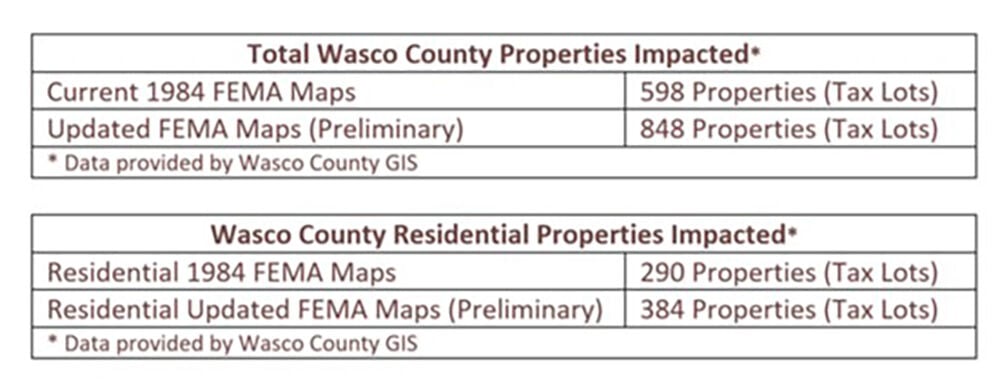
Wasco County has been updating the current 1984 flood maps, which add 250 new tax lots to the flood zone. 94 of those newly-added properties are residential.
According to Dougherty, the new ordinance will apply to 15.7% of vacant, residentially-zoned properties within the county flood maps.
Columbia Gorge News asked Dougherty how many potential builds will be prevented by the new restrictions, to which Dougherty wrote back, “It’s difficult to answer.”
He continued, “FEMA’s requirements do not preclude development, but do provide standards for no-net-loss to floodplain functions, which might increase costs of development or potentially preclude development due to geographic constraints.”
Stites argued making developers pay now to reduce flooding impacts makes more sense than making the federal government pay when floods damage homes.
“We should not be putting new housing — and vulnerable populations — in harm’s way. Poor floodplain management devastates security,” she said.


Commented