
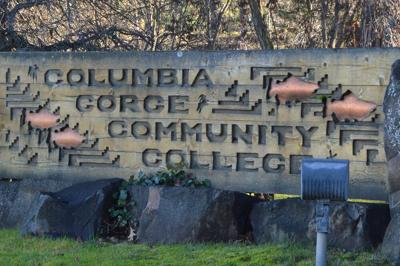
THE GORGE — An increasingly acrimonious meeting on May 1 did not lead to resolution for union and management at Columbia Gorge Community College.
The college has held weekly public bargaining meetings since Jan. 30.
The union had initially asked for a $15,000 increase in faculty wages, a larger cost-of-living adjustment (COLA), and raises for classified staff.
The college had planned $215,000 for wage increases during bargaining, authorized by President Kenneth Lawson.
Union president and chemistry professor Rob Kovacich estimated that $215,000 is 1% of the college’s total budget. “This does not feel adequate to take care of our workers,” said union vice-president and writing professor tina ontiveros on April 17.
Executive Director of Institutional Effectiveness Courtney Saldivar claimed the union’s initial proposal would cost $1 million.
The college’s next budget is still unavailable, but Vice-President Jarett Gilbert said he expects it to look like last year’s.
CGCC’s bargaining team, lead by Gilbert, counter-offered to increase full-time faculty wages by $3,000 across the board. They offered 3% COLAS for all employees, dropping to 2.5% after a year.
The administration also offered $18.50 starting wages to classified staff — a raise from the current starting wage, though more than $6 under the living wage for Wasco County, according to the Massachusetts Institute of Technology (MIT) living wage calculator, used by both bargaining teams.
This would raise CGCC from the very bottom of Oregon’s average pay for faculty to the middle, and near the top for classified staff, Gilbert said.
He noted the college’s priority is competitive wages to “recruit and retain” full-time faculty. The union’s first priority is living wage, ontiveros said.
After fighting to get part-time and full-time faculty on the same pay scale in a previous bargaining period, the union is not willing to split the wage chart.
“Pay period and equity is also important to us ... it’s important to us that we are within 5% of our peer institutions,” Gilbert said. He noted administration didn’t conduct cost-of-living comparisons between CGCC and their four chosen peer institutions before making their offer.
The union explained in a joint response to Columbia Gorge News that while new full-time faculty would start in the middle of the state's average wage scale, experienced full-time and part-time faculty would still "close to the bottom of pay for community colleges across the state of Oregon."
The response continued, "The administration is paying themselves more money than anyone else at the college. The dollar amount of Administration raises has outpaced all other employees'."
"We are committed to improving our salary scale so we can continue to recruit and retain a high-quality and diverse group of faculty and staff,” said CGCC President Dr. Kenneth Lawson in an email to Columbia Gorge News.
The latest finances
The union analyzed cost of living at all Oregon’s community colleges, comparing to CGCC. The closest matches were in Portland.
Starting pay for faculty at those colleges goes ranges from $71,790 to $121,747. CGCC’s range is $47,228 to $83,745.
“This isn’t us saying, ‘We want to be paid what people in Portland are paid.’ This is us saying the union ask was not unreasonable,” ontiveros said. “And this is us saying, ‘Even if we got everything we asked for in our first initial run-through, we are still not keeping up with our peers across the state ... who live in similar cost of housing situations or cost of living situations.”
On May 1, the union counter-offered:
A $12,000 raise for all faculty. They refused to compromise on living wages for classified staff, or on the addition of a 3.5% annual step increase, but compromised for a lower COLA and bi-annual longevity increases.
The union did an information request for the wages of all CGCC’s employees.
According to MIT data last updated in February 2025, the lowest possible living wage for this area is $25.79. That's the amount required for food, housing, transportation, internet, or other basics. Any CGCC worker making less than $53,638 per year is not making living wages, the union claimed.
This includes “many” full-time employees at CGCC, including instructional services administrative assistant, bilingual student support services, equitable funding support navigator, resource navigator and accounts specialist.
Lab work
The union also wants faculty to receive the same pay for lab and lecture hours. At a large university, graduate students would teach labs; here, professors do.
“Today, I did a 3-hour lab, and not once did I sit down,” expert guest Jim Pytel said. Pytel is lecturer in mechanical technology and chair of technology and trades at CGCC, and like all its professors, he gets paid 0.715 or 0.834 of full wages for teaching labs. The average for similar colleges is 0.96, according to union calculations.
Nursing and science faculty face the same task. “Can’t just let students play with chemicals,” ontiveros noted.
Where would the money come from?
“I think if there’s one thing that we’re hearing consistently from workers, it’s that, ‘Should we be recruiting so many people when we can’t afford to pay our current employees a livable wage?’ ... It is a pervasive feeling across the workforce,” ontiveros said in an earlier meeting.
CGCC is currently searching for two new management staff, each of whose wages would be around $100,000 – $125,000.
On May 1, the union put up a chart showing pay raises at CGCC over the last five years.
“What this looks like to me is you’re unwilling to increase the bargaining units’ pay to the same amount that you’ve increased your own pay,” Kovacich said.
Pay raises reached more than $21,000 for the president and vice-presidents, and $34,000 for the human resources director. Faculty and classified staff increased by about $7,860 to $17,700.
“The people who make the most money are getting the largest pay increases. That’s absurd,” said Kovacich.
As human resources director, Saldivar said:
“That is total wages for some of those people. They’re also doing a second job. Did you ask about that? I don’t think you did, so that is totally not a fair representation of complete and total wages. If you want to put down the spreadsheet that I sent you, complete and total wages, gross wages for all people, that would be fair. This is not a fair representation of what was given to you.”
Saldivar also objected that faculty overload was not included, and that management also conduct second jobs such as being “on the on call team,” which Kovacich didn’t ask about.
Faculty overload is basically overtime pay, when a professor must carry out a job that goes beyond their contract.
According to 2024 federal data from the U.S. Department of Education’s National Center for Education Statistics, CGCC has 23 management staff, compared to an average of 16 at several dozen similar colleges across the U.S.
During an increasingly heated conversation, Saldivar added: “We’re overstaffed. We have too many faculty, we have too many management, we have too many. ... so yes, we could probably do better with wages and stuff like that. But it’s going to mean people are gonna lose their jobs.”
The union disagreed. “Admin threatened layoffs to scare us when we know they can adjust budget priorities to save Union jobs,” they noted in an email to union members the following week.
“We consider the college’s offer to be far too low. It doesn’t realize CGCC’s values of equity, belonging, and inclusive prosperity. ... If admin values its workers, please make a budget adjustment to take better care of its workers,” Kovacich said.
“You guys are gonna have to come up with more money someplace else, because that’s not gonna cut it,” he added.
In the meantime, one non-faculty employee testified to the union: “Relocating somewhere more affordable is technically an option, but my aging parents live here and need family nearby to provide support and care. It is demoralizing to feel like am being priced out of my life, despite obtaining higher education and being a conscientious and devoted employee.”
Columbia Gorge News will cover the May 8 bargaining session online and in our next edition.
A previous version of this article incorrectly spelled Jim Pytel's name.


Commented