
The menace needs a new brand.
In a talk on climate change Monday in Hood River, the term “think globally, act locally,” was never uttered, but the spirit of the phrase was evident in the room.
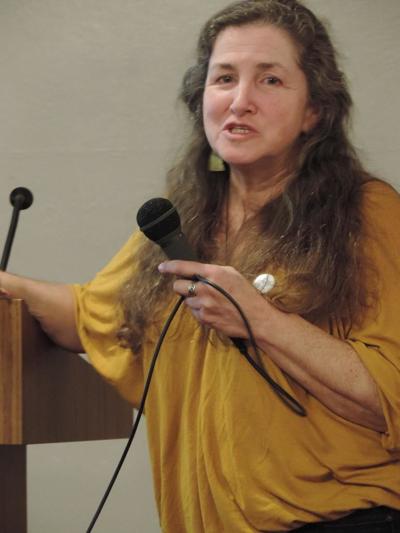
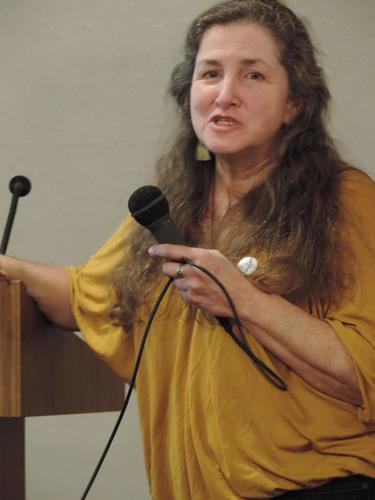
Bernadette Rodgers, a Portland State University professor and board chair of 350PDX, a grassroots movement, called on a new phrase for climate change.
“We shouldn’t call it ‘climate change’ anymore. That’s too gentle a word. What’s more called for are the words climate chaos or disruption,” Rogers said, citing extensive scientific findings showing dangerous curves on the graphs and charts indicating how close the planet is spinning toward environmental disaster.
Her talk was billed as “Addressing the Causes of Climate Disruption,” but Rogers began by saying, “I think you all know what the causes are. We need to be focusing on solutions.”
Rogers drew some nervous chuckles when she said, “I’m not sure anyone thinks of it as a hoax anymore.”
The March 19 talk at Hood River Hotel was attended by about 50 people and was sponsored by Indivisible Columbia Gorge, Columbia Gorge Women’s Action Network, and Columbia Gorge Climate Action Network. Rogers said she is not a climate scientist, but as a trained astronomer she was stationed in the south Andes of Chile for 13 years, and recently settled in Portland and teaches astronomy and climate science at PSU and Portland Community College.
“We have a small window before things get too bad. That’s what motivates me,” Rogers said. She said the Paris Accord of 2016, which the Trump Administration opted out of last year, sets standards that could right the world’s course — but worldwide behavioral changes need to be made.
“The longer we wait, the more drastic are our changes we’ll have to make,” she said.
In June 2016, Rogers was arrested in Vancouver along with 20 other people protesting coal trains traversing the western United States. (The result was several court appearances but “essentially a jay-walking ticket that came to $60,” she said.)
The impact of fossil fuels such as coal contribute to what Rogers called “the direct evidence of the carbon pollution we’re putting into the atmosphere.
“I had taught climate change in the 1990s and hadn’t looked at it as much more than an academic topic,” she said.
But in recent years, her consciousness has raised along with the world’s CO2 levels.
She was inspired by a NASA colleague’s decision to leave the agency because of its practice of sending up an airborne scientific research airliner to take atmospheric readings about 200 days a year. Her colleague felt the carbon emissions were not justified.
“Everyone has a tipping point or a person who spurs them in a direction, and that was the tipping point for me,” Rogers said. “It made a big impression on me,” she said, and when she came to Portland she quickly became involved with the non-profit climate justice movement known as 350PDX.org.
350.org was named after 350 parts per million — the safe concentration of carbon dioxide in the atmosphere — now hovering at around 402 ppm.
The organization has made four what it calls demands: a fast and just transition to 100 percent renewable energy for all; no new fossil fuel projects; “not a penny for dirty energy;” and divestment from companies that engage in harming practices.
“If we know it’s wrong to wreck the world, it should be wrong to profit from it,” Rogers said.
“We’re talking about not just taking money out of corporations but also taking away corporations’ social license, the idea that the things they do are okay.
“If the earth was a basketball, our atmosphere would be about as thick as the thinnest sheet of paper,” she said. It is that gossamer ratio she wants the average person to grasp: that the tipping layer is dangerously thin and fractional changes in the earth’s temperature make a critical difference.
“The biosphere we have is very finely tuned for life as we know it; even a small change can tip the balance,” she said.
Rogers was introduced by Bonnie New of Indivisible. Joining in the conversation were Peter Cornelison, a staffer with Friends of the Columbia Gorge and a member of Hood River City Council, and Buck Parker of Hood River, a lifelong environmental advocate who was instrumental in inviting Rogers to Hood River.
Parker called for confidence in climate change responses moving forward.
“For a modern industrial society, people power over energy issues is surprisingly localized. It is not as federalized to the degree you would think,” said Parker, former president of EarthJustice.
“The abdication of the federal government in this role, which I still hope is temporary, has actually opened up 50 new battlefields, for there really is power to do something at the state and local level, simply from the Public Utility Commissions on down, and it’s kind of one of those things that was overlooked for decades,” Parker said. “In some ways, we’re having more power over these issues than we’re accustomed to having on something that has such a global impact,” said Parker. The Harvard law graduate retired in 2015, having served EarthJustice, the nation’s largest environmental law organization, since 1980, including 11 years as its president.
“The work of CGCAN and 350.org at the local level is really important and in fact that’s the level at which a lot is going to have to be done, even if you have a brake pedal on it,” Parker said.


Commented