
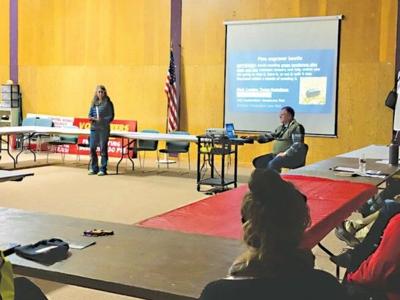
HUSUM — On Feb. 21, Klickitat County Fire District No. 3, hosted a wildfire mitigation community meeting open to all residents throughout the region interested in learning about protecting their homes in a wildland-urban interface.
Klickitat County encompasses a geographic area of 1,904 square miles and a population of around 22,000 people. It includes the towns of White Salmon, Lyle, Bingen and Trout Lake — many of which have houses lined against the borders of the forests or grasslands, if not include parts of the landscape in the parcel itself.
Wesley Long, fire chief at Klickitat County Fire District No. 3, explained that he wants to continue working with the Underwood Conservation District, Department of Natural Resources (DNR), Mt. Adams Recourse Stewards (MARS) and various other partners to create a wildfire resilient Klickitat County.
“We need to work together to reduce fuels and create defensible spaces around homes to reduce the chance of wildfire on our own property as well as our neighbor’s property,” Long said, adding that he hopes this meeting continues a “web-effect” in which neighbors can share with one another valuable resources about wildfire mitigation programs.
Dan Richardson, climate and resilience coordinator from Underwood Conservation District, pointed to the statistic of how the annual total wildfire acres burned has remained the same, but there has been an increase in structures destroyed.
“Wildfire season is longer and more destructive,” Richardson said. “Creating a defensible space around your home is fundamental for wildfire safety — gutter cleanouts, removing ignitable objects on the deck, porch, house in the summer if you’re away or getting evacuated.”
Charlie Landsman, community resilience coordinator wildland fire management division at DNR, emphasized Richardson’s statement.
“When it comes to structural ignition, you’re basically looking at creating a defensible space for wildfire resilience. [This includes] the fuels around that structure — trees, shrubs and other things like that,” Landsman said. “But we’re also looking at the structure itself.”
To combat this, Landsman explained the Wildfire Ready Neighbors Program, which launched a little over a year ago in Klickitat County. At wildfireready.com, individuals can sign up for a free consultation to discuss their property’s resilience to wildfire.
“A wildland fire professional will come out to your property to take a look around and talk to you about your specific situation, structure, management goals, any constraints that you have, whether it’s aesthetics or privacy,” Landsman said. “We can come up with a plan specific to your property and identify all those risk assets and prioritize all those because not all hazardous production actions are equal.”
Another program Landsman emphasized was DNR’s Firewise Micro Grant, which awards up to $4,000 for communities to plan and execute fire mitigation efforts. It can include objectives such as a chipper day, community slash depot, or to rent dumpsters to remove flammable objects around homes.
“It’s really not strictly limited to any one specific type of project,” he said. “It’s to cover that community assessment and action plan and help move you forward in your fire mitigation efforts.”
Landsman encourages individuals wanting to learn more about the grant, as well as other federal grants, to reach out to him at charles.landsman@dnr.wa.gov.
For small forest landowners, DNR Service Forester Sharon Frazey, added that the Forest Landowner Assistance Program was created specifically to promote wildfire resilience and forest health on private land and individual parcels. The program also offers financial and technical assistance for fuels reduction.
“Historically, we’ve had a lot of fire suppression over the past 100 years and so our forests are dense, they have lots of those fuels we’ve been talking about,” Frazey said, adding that fire risk reduction and forest health go hand in hand. It includes slash burning and prescribed fire burns.
More information can be found at dnr.wa.gov/LandownerAssistancePortal.
“We’re hoping that the community will be able to see more [prescribed fires], be more open to it and understand its importance in trying to slow an unmanaged fire down,” Frazey said. “I think that’s the take home message for tonight — tell your neighbors and spread the news.”
Sarah Allaben, Fire Adapted Communities coordinator at MARS, added that a nearly created MARS Prescribed Burn Association can help with this.
“We really want to focus on helping make prescribed fire accessible to any private landowners, because it is such a key part of our landscape and it’s such an effective way to reduce fire risk and create healthier forest,” Allaben said. “We can provide technical assistance and consultation site visits to help you figure out what you need to do to your land before it’s safe to put prescribed fire in it.”
Allaben noted that there’s often a barrier to entry for learning about prescribed fires and hopes this program can fill the gap. More information is available at mtadamsstewards.org or reaching out to info@mtadamsstewards.org.
“We’ve been able to build up the equipment, hand tools, drip torches, engine, toes, and more that folks can share and use, as well as sharing their time,” Allaben said. “We want people to be connecting, learning about this together, and then volunteering on one another’s burns helping share knowledge, equipment and skills.”


Commented