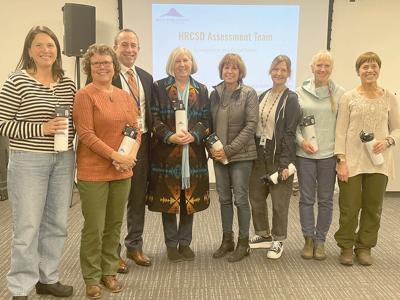
Hood River County School District (HRCSD) recognized its assessment team at the Nov. 13 board meeting. Pictured, left to right, are Caree DeBorde, Staci Winfield, Superintendent Bill Newton, Sally Pritchett, Kristi Ewald, Heidi Burns, Marie Mallon and Kathleen Welland.
Hood River County School District (HRCSD) recognized its assessment team at the Nov. 13 board meeting. Pictured, left to right, are Caree DeBorde, Staci Winfield, Superintendent Bill Newton, Sally Pritchett, Kristi Ewald, Heidi Burns, Marie Mallon and Kathleen Welland.
HOOD RIVER — Hood River County School District board members appointed two new budget committee members at the Nov. 13 meeting.
Five community members applied for the two vacant positions. Selected were Sarah Economou for position 6 and Matthew Althoff for position 7; both are three-year terms ending June 2027.
Budget committee meetings are open to the public, said Director Chrissy Reitz (position 1). “There’s still the opportunity to be very much involved in this process — and it would be a great thing to see more people, just in the community, involved in this part of it,” she said.
The board also unanimously approved a resolution to declare November as Native American Heritage Month and American Indian and Alaska Native Heritage Month at the Nov. 13 meeting.
“This is a dedicated time to honor the traditions, languages, and stories of Native American and Alaska Native communities, ensuring that their rich histories and contributions remain vibrant across generations,” said Superintendent Bill Newton during his report.
The district has trained 42 teachers thus far in a tribal history / shared history curriculum through a partnership with the Columbia Regional Educator Network and the Tribal Nations Educator Collaborative via the Educator Advancement Council, he said.
“We are so lucky to have had the training in our region, as we are the only region in the state so far to have it,” Newton said. “We were able to bring in Native American people from our region to speak directly with our educators and to learn about their personal experiences with our schools. Through this curriculum, educators are helping Native students feel seen and valued, while offering non-Native students the opportunity to learn about the rich, diverse histories of the surrounding Tribal Nations.
“This is vital work for fostering a future in which all students respect the sovereignty and significance of Tribal Nations,” he continued.
In Oregon, all districts are required to implement lesson plans developed by the Oregon Department of Education in collaboration with the Office of Indian Education and the state’s nine federally recognized tribes. These lessons are currently available for students in fourth and fifth, eighth and 10th grades; curriculum for other grade levels will be available in the future.



Commented
Sorry, there are no recent results for popular commented articles.