HOOD RIVER — The Hood River County Board of Commissioners met July 17 to discuss several matters, with Chair Jennifer Euwer joining via Zoom.
A public hearing occurred for an Urbanization Request in Odell by Grant Porter, who requested an exception for urban use of a 17.43-acre parcel. The request passed with unanimous approval, as the parcel has the necessary infrastructure and neighbors are on agreeable terms with Porter.
Commissioner updates
Leti Moretti’s report from District 1 mentioned the merging of One Community Health with Northshore Medical starting in January 2024, which she said will make it easier for people in the Gorge seeking medical attention including mental and behavioral help. She also said that Stu Watson, vice-chair of the Mid-Columbia Housing Authority, agreed to serve until a replacement for his position can be found.
Arthur Babitz of District 2 said Oregon has given $20 million in state funds towards the new bridge project, but additional contributions aren’t expected until the next funding cycle. Cascade Locks, Babitz said, did not receive any funding from the state for their bridge project.
County priorities
July’s meeting also saw a presentation from the planning department to review the county’s current project lists, priorities and timelines. Eric Walker, director of Hood River County Community Development, said there is an extensive list of projects on the County Strategic Plan, and, without a full-time county planner, the department is spread thin.
“Both Parkdale and Odell [unincorporated community plans] are likely to consume a lot of time,” Walker said.
They chose 17 projects, though the development “wish list” is much longer, and projects all vary in levels of progress and completion. Commissioners confirmed development in Parkdale and Odell are top priorities in the county, which has been informing the planning list thus far.
Other projects that are state or federal requirements take up priority space on the list too, such as the FEMA Floodmap update, so dates and goals of development must be carefully set. However, the FEMA update was delayed until spring of 2024, which opens some capacity for Parkdale development that will ramp up soon. Other Odell projects are currently in the public evaluation and community outreach phases.
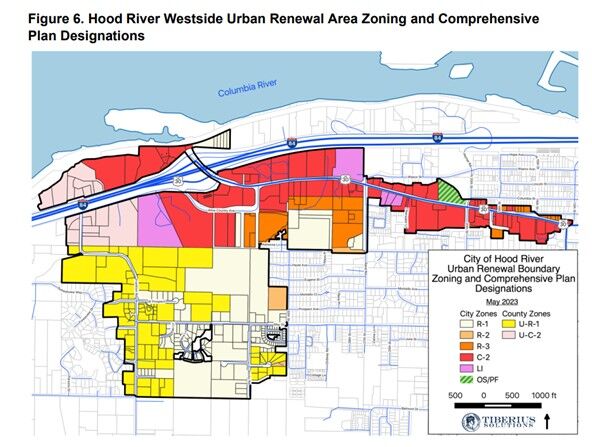
Hood River Westside Urban Renewal area zoning and comprehensive plan designations.
Contributed graphic
Urban renewal
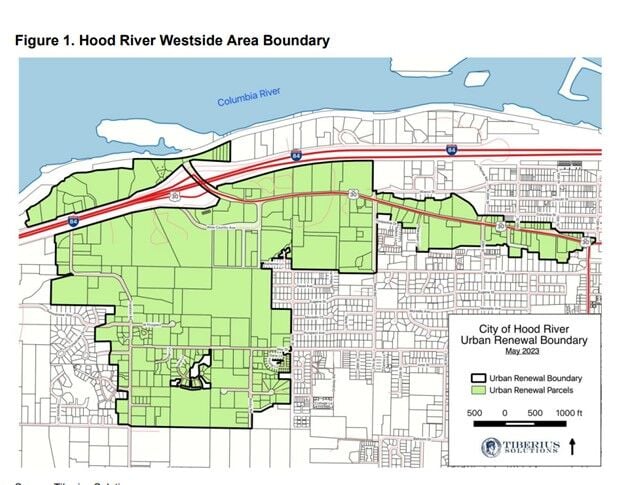
Westside Urban Renewal was discussed by the City of Hood River, who presented alongside their consultant Elaine Howard. She said it is a funding tool, not a planning tool, so actual urban renewal projects are not solidified yet. The project is a proposed district of 406.1 acres, leaving roughly 140 free acres for other possible urban zoning.
Since May, the city has been holding virtual community open houses, sending letters and surveys, and offering notice to taxing districts, all about the urban renewal. Materials have been available in English and Spanish throughout the community outreach process. They listed three main areas of focus: Transportation and roads, housing and affordable housing, and parks and trails. Several county projects align with these urban development focus points, but each also relies largely on land acquisition. Once the funding plan for the urban renewal is set and approved, many projects will require additional funding and work, especially to establish better infrastructure.
Climate Trust
Members of the Forest Department and Climate Trust spoke again to the board about the County Forest Carbon Project, a carbon credit sale opportunity that is projected to gain the county a revenue of roughly $23 million over the first seven to 10 years. There are no out-of-pocket costs for the county, as it will all be taken out of the total revenue by The Climate Trust.
The Climate Trust is an Oregon-based non-profit that has worked in carbon for 20 years; they will handle all parts of the carbon sales, from measuring and modeling to documents, registering credits, marketing and selling, and monitor the land and project for 40 years. Hood River County has committed certain space to this project, but otherwise only guarantees commitment to maintaining or improving the conditions of the forestland dedicated to carbon credits. They also plan to use the revenue from this project to acquire more county forestland.
Julius Passay with The Climate Trust and Doug Thiesies of the Hood River Forest Department explained that this kind of project takes up to 15 months to get up and running. Passay also explained that the carbon credits in the plan are buffered to guard against land loss from potential fires, disease, or other mishap. If the county wanted to add more acres, the plan is set up to allow that without a new proposal, but harvesting cycles are still on a three-year plan for sustainable growth and reliable flow. The plan update ended with a summary of the next steps, which include the title and encumbrance report, a public hearing, and full agreement from the commissioners. They mentioned planning a special work session to thoroughly review the plan prior to a voting session.



Commented