
All Hood River County voters should have received their ballots by now, and have two weeks to turn them in.
The deadline is 8 p.m. on May 15 to submit ballots in the wide-ranging Primary Election. Postmarks do not count.
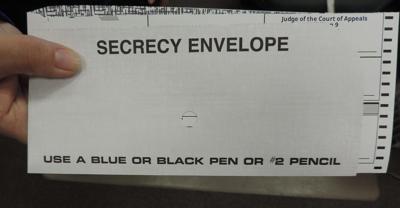
Kim Kean of County Elections noted that there is a change in the means of turning in ballots: Hood River, along with other counties, has changed from using a secrecy envelope to what is termed a “secrecy sleeve.” (See photo.)
The sleeve looks like a defective envelope and some of the language implies it should be an envelope, Kean noted. Ballots go inside the sleeve just as they did the envelope.
Voting is essentially a four-step process:
Fill out your ballot, following directions provided.
Place the ballot inside the sleeve, which does not seal.
Place the sleeve and ballot inside the outer envelope with the signature line, and sign it.
Mail the ballot or deliver it to either of two drop-off locations — Cascade Locks City Hall or the County Building, Sixth and State streets.
Sign only the ballot envelope containing your ballot; signing for someone else can result in nullification of the ballot.
Kean said counties are switching to the secrecy sleeve for two purposes — it is easier for people on the election board to process the envelopes and it discourages people from just turning in their ballot without the signature envelope.
Voters are urged to drop off ballots any time after May 8 to ensure it does not arrive too late to count, due to postal delay. One first-class stamp is sufficient postage.
DIST. 52 CHANGE
The ballots will contain the name of Aurora del Val under State House Dist. 52, but del Val withdrew from the race early last month, leaving two contestants: Rep. Jeff Helfrich, the Republican appointed to the post in November, and Democrat Anna Williams. Both are Hood River residents.
Candidates for the State House Dist. 52 and State Sen. 26 positions seek nomination for the November General Election and two candidates vie for the chairmanship of the Hood River County Board of Commissioners: Commissioner Rich McBride of Hood River and former School Board member Mike Oates of Odell.
Also on the ballot is a request by Hood River County School District to continue the existing Local Option Levy.
The Local Option Levy is a local property assessment approved by the voters of Hood River County to provide additional funds to the School District.
Local Option Levies are limited to five years. HRCSD’s Levy will expire on June 30, 2018. Here is a summary of what will be on the May 15 ballot:
Governor — Democrats
Candace Neville
Ed Jones
Kate Brown (incumbent)
Governor — Republicans
David Stauffer
Jonathan Edwards
Sam Carpenter
Knute Buehler
Greg Wooldridge
Jack Tacy
Keenan Bohach
Jeff Smith
Bruce Cuff
U.S. House District 2 — Democrats
Raz Mason
Jennifer Neahring
Eric Burnette
Jamie McLeod-Skinner
Timothy White
Michael Byrne
Jim Crary
U.S. House District 2 — Republicans
Paul Romero
Randy Pollock
Greg Walden (incumbent)
County Board Chair
Mike Oates
Rich McBride
Oregon State Senate District 26
Chrissy Reitz (D)
Rep. Chuck Thomsen (R — incumbent)
Oregon House of Representatives District 52
Anna Williams (D)
Jeff Helfrich (R — incumbent)
Oregon Commissioner of Labor and Industries (non-partisan)
Jack Howard
Lou Ogden
Val Hoyle (incumbent)
Local Option details
The Hood River County School District’s five-year request is for renewal of the existing Local Option Levy.
It has been approved by the voters of Hood River County since 2004.
The continued rate of $1.25 per $1,000 assessed value is estimated to raise $2,500,000 per year. The owner of a property valued at $300,000 would pay $375 per year.
The Local Option Levy results in “matching” revenue from the State equal to approximately 23 percent of local option revenue collected, or approximately $560,000 per year.
This measure would continue providing funds to help HRCSD preserve the equivalent of approximately 15 teaching and 30 support staff positions, protect core academic programs, electives, and class sizes at every school, and maintain a full school year for all children.
It would also preserve advanced placement, career-technical and dual credit courses, sustain extracurricular athletics and intramural programs, electives and co-curricular activities including P.E., music, fine arts, engineering, and computer science and provide Community Education programs and community access.


Commented